JANUARY - DECEMBER 2016
[on CRISPR/Cas9-based 'gene drives']
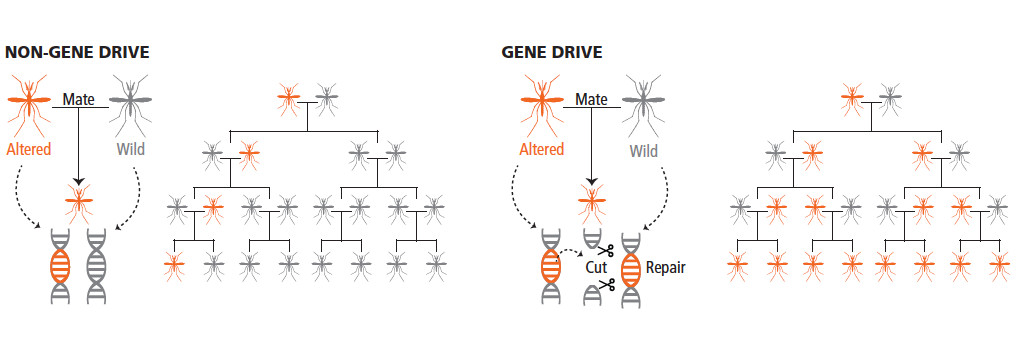
What is the optimal level of suffering in the biosphere? CRISPR/Cas9 genome editing and 'gene drives' are an awesome tool...
gene-drives.com: Compassionate Biology (Jan. 2016)
("Genetically designing a happy biosphere")
Might humans be the last species to benefit from phasing out the biology of suffering rather than the first?
Probably not. But CRISPR/Cas9 based "gene drives" challenge one's naive chronological intuitions.
Kyle Johannsen makes the first print-published scholarly proposal to use CRISPR-based gene drives to prevent free-living animal suffering:
http://dx.doi.org.sci-hub.bz/10.1007/s10677-016-9774-x
("Animal Rights and the Problem of r-Strategists")Life animated by gradients of superhuman bliss needn't be as bad as it sounds...
Reddit Hedonistic Imperative discussion
Does HI rest on a metaphysical mistake? Are biological-genetic solutions to the problem of suffering a dead end?
"Don't Focus on The Hedonistic Imperative" (Brian Tomasik)
I've responded to a few QUORA questions & criticisms too.
Brian and many other AI researchers believe that classical digital computers either are - or will soon become – subjects of experience. Biological sentients will shortly be a minority. If such researchers are right, then how should anyone who believes we should ethically prioritise the minimisation of suffering respond? The experimental falsification of my preferred non-classical account of phenomenal binding wouldn’t prove digital sentience is feasible. (cf. physicalism.com) But if confounded, I’d assign its feasibility a much higher credence than I do now.]* * *
The purely technical objections to phasing out the biology of suffering - and indeed creating a civilisation based on gradients of intelligent bliss - get flimsier by the day. gene-drives.com couldn't have been written in 1995. So why, sociologically speaking, are we [HI on Facebook] still just a "fringe" group – of which the Internet has countless examples? Complex reasons, but taking the project forward will take strong leadership, movement-building, serious PR, fund-raising and organisational skills, youthful dynamism, and a level of all-round professionalism far greater than anything we've seen to date.
(And apologies, anyone hoping this inspiring mix is going to come out of Brighton is going to be disappointed. We need fresh blood.)Unlike a lot of high-flown rhetoric, a commitment to the well-being of all sentience has profound implications for the biosphere in an era of synthetic biology. I just wonder how many people will like the sound of the principle - the "Declaration of Sentience" has an inspiring ring - and then balk at what such an affirmation genetically entails?
* * *
Post-CRISPR life could be based on gradients of intelligent bliss. Can conservation biology adapt to the challenge?
David Pearce & Peter Singer
It's worth stressing that one needn't be a utilitarian of any kind at all to support phasing out the biology of involuntary suffering. Compare the World Health Organisation definition of health:
http://www.who.int/about/definition/en/print.html
If taken literally, it's insanely radical. "Good health for all" is a slogan unlikely to raise the hackles of even the most conservative critic. Transhumanists are just exploring some of the implementation details.* * *
DP on Utilitarian Ethics
Thanks Adam. I'm torn. It's good rigorously to systematise our values and explore their implications. But we don't want to tie phasing out suffering - or even building a world of superhuman bliss - to utilitarian ethics. Biotechnology, the CRISPR revolution and IT mean you can believe we should get rid of the biology of suffering without endorsing any kind of utilitarian ethic at all. That said, a lot of interesting theoretical work has been done in recent years. As a teen, I used naively to think I was the world’s only negative utilitarian. Not so:
http://www.amirrorclear.net/academic/ideas/negative-utilitarianism/
See too Toby’s Ord’s critique:
https://www.utilitarianism.com/nu/nufaq.html
and a response:
NU or CU?* * *
Happiness is the Key by Andrés Gómez Emilsson.
I've heard the proposal to create a hyperthymic civilisation (cf. superhappiness.com) described as a "hyperthermic" civilisation, whether as a typo or a nod to global warming I'm not sure.Brian Tomasik critiques the prospect of using CRISPR-based gene drives to control the level of suffering in the biosphere. Gene drives are much too powerful to use for now – their potential ramifications are mind-wrenching - but we are probably living in the last century of life on Earth in which the biology of suffering is technically inescapable.
Will gene drives reduce wild animal suffering?
"twice as cool"? Or nasty, vicious. and best phased out?
http://digg.com/video/animals-versus-short-film
("Moments Between Predator And Prey Are Captured Perfectly In This Animation")
The problem of wild animal suffering needs a more systematic approach than Pokémon GO.
http://www.popsci.com/pokemon-go-players-are-actually-helping-to-rescue-wildlife
("Pokémon Go Players Are Actually Helping To Rescue Wildlife")* * *
The CRISPR revolution
Kim, yes, when Japanese scientists discovered CRISPR in bacteria back in 1987, most scientists dismissed it as "junk DNA”. But these DNA sequences actually match the genetic sequences of diverse viruses that attack bacteria. We're looking at a sophisticated bacterial immune system. Bacteria use this genetic memory to target a viral invader by chopping it up with “CRISPR-associated” (CAS) enzymes.
It's easy to romanticise "the wild". But there is nothing romantic about misery and malaise.Thanks Adam. Ecosystems (or galactic empires) should not be run by philosophers. But if we're serious about phasing out the biology of involuntary suffering, i.e. if "the well-being of all sentience" isn't just a cool-sounding buzz-phrase, then we need to work out some details. CRISPR-mediated gene drives are an exciting policy option. Alas there are countless pitfalls...
Given what we now know about engineering CRISPR-based gene drives, eliminating malaria and other insect-borne pathogens in human and non-human animals alike will be easier, quicker and (much) cheaper than the heroic efforts needed to wipe out smallpox.
"The end of evolution"? On the contrary, the tempo of evolutionary change is about to accelerate. However, the nature of selection pressure changes when "natural" selection is complemented - and perhaps eventually superseded - by intelligent moral agents choosing, customising and then "driving" genetic changes through entire populations.
"Do we want to live in Nature, or in Disneyland?" Disneyland, I hope.
http://www.smithsonianmag.com/innovation/kill-all-mosquitos-180959069/
("Kill all the mosquitoes?!")* * *
Could we screw things up further? Yes. Could gene drives be used for nefarious purposes? Yes again.
If anything, CRISPR/Cas9 mediated gene drives are too powerful, at least in the hands of primordial human savages. Yes, gene drives could be used to underpin a happy biosphere; but synthetic gene drives are also a devastatingly effective weapon if used by bioterrorists (or misguided idealists). But the point of the essay is to highlight how the level of suffering that exists in the living world will shortly be a policy decision, not an immutable fact of life. Of course, anyone who doesn't view the frightful suffering of Darwinian life as a problem won't be interested in tools to mitigate and eventually abolish it.Gerhard, no one is proposing to put philosophers in charge of the biosphere. Yet thanks to the CRISPR/Cas9 and gene drives revolution, intelligent moral agents can now do everything from eradicate malaria to fix benign versions of pain-modulating genes across entire species at minimal cost. Maybe we shouldn't use these powerful new tools to reduce suffering. But the point of the essay was to rebut the quasi-religious “It must be so” claim made by advocates of the status quo, not encourage DIY ecosystem hacking.
What will happen when biohackers unleash competing gene drives?
https://www.technologyreview.com/s/600689/we-have-the-technology-to-destroy-all-zika-mosquitoes/
("We Have the Technology to Destroy All Zika Mosquitoes")* * *
Carl, for classical utilitarianism, presumably the "ideal" state of the world is pure utilitronium / hedonium. Yet we wouldn't say that CU "completely devalues the lives of all sentient beings, except instrumentally and as evils." As a NU, I think we should be working towards a civilisation animated entirely by gradients of intelligent bliss. In theory, such a civilisation could be threatened by a CU button-presser / AGI who believes he/it is obliged to initiate a utilitronium shockwave. No such obligation confronts the NU. It's tempting to dismiss this apocalyptic prospect as fanciful, or at least futuristic and merely theoretical. But (considerations of uncertainty aside) to the strict utilitarian, any rate of temporal discounting indistinguishable from zero is ethically unacceptable. So should CUs be working towards this long-term goal?
* * *
"Wary"? Jonathan, I completely agree. Although some idealistic teenage biohacker could launch a gene drive on their own initiative, this kind of unilateral action should be strenuously discouraged. But the question of whether humanity should use biotech to mitigate - and ultimately abolish - the cruelties of Darwinian life deserves serious discussion. Until recently, the question was purely "philosophical", or at least speculative sci-fi. No longer...
Both conservation biology and compassionate biology inescapably involve value judgements. Designing malaria-proof Anopheles mosquitoes isn’t the same as making any species of Anopheles mosquitoes extinct. Should we mourn the loss of parasitic protozoa like the malaria parasite? If so, why? Any effective solution to the problem of suffering will need to work with the grain of human nature – at least until we rewrite our own source code, a formidable challenge. That’s one reason to be interested in the potential of gene drives. Synthetic gene drives massively amplify the effects of weak human benevolence at minimal cost.
* * *
Only in the sense we should eradicate cannibals and meat-eaters...
https://www.youtube.com/watch?v=ZIEUaaiAT4w&feature=youtu.be&a
("Should We Eradicate Carnivores?")
The CRISPR revolution is a game-changer. Do we want to live in a world where sentient beings harm each other or not? I never thought this issue would be seriously discussed in my lifetime. Shutting the death factories comes first. But then...
Reprogramming Predators* * *
https://www.buzzfeed.com/linch/why-nature-kinda-sucks-2f8hh
("Why Nature kinda sucks")
Linchuan, very many thanks for the Buzzfeed piece. When the cruelties of Nature were an inescapable fact of life, ignoring them was best. Better to celebrate the beauties of Nature instead! But for the first time in history, the cruelties will shortly be technically optional. Developments in IT and - critically - the CRISPR revolution in biotech (cf. https://www.gene-drives.com) make this the last century when involuntary suffering is inevitable. Intelligent moral agents can choose the optimal level of suffering in the post-CRISPR biosphere. Critics will (and do) initially say that we're insane. But I predict with fairly high confidence that eventually most folk will say the case for compassionate stewardship of Nature is obvious - and they've always believed in it anyway.* * *
Eddie, Matt, yes I think we should aim to promote the well-being of even the humblest form of sentience. What's counterintuitive about CRISPR/Cas9-mediated gene drives is how they turn our intuitive chronology of feasibility on its head. It’s actually easier, quicker and cheaper to help entire species of small, sexually fast-reproducing organisms than large long-lived vertebrates like humans and elephants.
http://www.cell.com/cell/pdf/S0092-8674(15)01705-5.pdf
http://www.mercurynews.com/science/ci_29372452/bay-area-biologists-gene-editing-kit-lets-do
("Bay Area biologist’s gene-editing kit lets do-it-yourselfers play God at the kitchen table")* * *
The nonhuman animal internet. We know where "tagging" will start, but where will it end...?
http://www.scientificamerican.com/article/why-we-know-whether-a-swallow-is-frightened-in-a-storm-excerpt/
("What really happens on the Animal Internet")* * *
[Seth Heiner writes] "It is easy to romanticise, say, tigers or lions and cats. We admire their magnificent beauty, strength and agility. But we would regard their notional human counterparts as wanton psychopaths of the worst kind." (David Pearce)
Seth, sadly yes. Think of the most ghastly human predators - serial child killers and abusers, the worst of the worst. Imagine if there were a whole scientific discipline - "conservation biology" - dedicated to ensuring human predators flourish.
I hope the scales fall from our eyes. Like the Anopheles mosquito, some Darwinian life-forms need to be (peacefully) retired.* * *
Should obligate predators be retired from the post-CRISPR biosphere?
https://www.newscientist.com/article/mg23230940-800-complex-cats-lets-see-our-feline-friends-as-they-really-are/
https://lareviewofbooks.org/article/the-case-against-cats/
("The case against cats")
Reprogramming predators? Let's hope so: human and nonhuman. From the Daily Telegraph...
http://www.telegraph.co.uk/science/2016/06/12/cats-could-have-the-hunting-instinct-edited-out-of-their-genes/
("Cats could have the hunting instinct 'edited' out of their genes")
"Starve to death"? Peter, catnip-laced in vitro mincemeat tastes more delightful than gourmet steak - if you're a cat. The key challenge, I think, is collectively deciding whether we want a biosphere where sentient beings harm each other or not. If our answer is "no", then all sorts of short-, medium- and long-term technical fixes exist. Cross-species fertility regulation, GPS-tracking and monitoring, and CRISPR-based gene drives will presumably play a key role in compassionate stewardship of the living world. For sure, I don't think reprogramming cats should be our No 1 priority right now. But phasing out human and nonhuman predation is a precondition – one of many - for creating a happy biosphere.* * *
Hunting humans or a pan-species welfare state? Does tomorrow's world promise superhuman compassion or sociopathy?
http://www.aol.com/article/2016/06/22/hunting-humans-could-become-big-tourism-for-super-rich/21400130/
("Hunting humans could become big tourism for super rich")* * *
Gerhard, the promotion of predation, parasitism and starvation among non-humans on the grounds that humans are the most murderous species who ever lived is a somewhat paradoxical stance to take.
Florin, I hope we can genetically civilise "the worst thing in the world" human and non-human animals alike can imagine. The idea that pain and pleasure are largely or wholly relative may be intuitively compelling - and informational-sensitivity to "good" and bad" stimuli is vital to maintaining high function, knowledge-acquisition and critical insight. But there are some people - and some non-human animals - who are chronically pain-ridden and/or depressed. Even if informational-sensitivity to good and bad stimuli is preserved, all their experience is generically nasty: some depressives can’t imagine what it's like to be happy or (in the most severe cases) even what the word "happiness" means. Conversely, there are a few people (and presumably some non-humans too) for whom experience is generically pleasant. I would hope that we can genetically "ratchet up" hedonic set-points and the upper and lower bounds of the hedonic range of human and nonhuman animals alike, allowing all sentient beings to flourish. In a Darwinian world, so many aspects of life resemble a zero-sum game; but enhanced reward circuitry with softened pain-perception doesn't need to be one of them. Needless to say, there are all sorts of pitfalls to consider; but the ramifications of synthetic CRISPR/Cas9-mediated gene drives are jaw-dropping.
http://www.ncbi.nlm.nih.gov/pubmed/26168879
("The Effect of SCN9A Variation on Basal Pain Sensitivity in the General Population: An Experimental Study in Young Women.")
http://www.ncbi.nlm.nih.gov/pubmed/25995458
("Novel SCN9A mutations underlying extreme pain phenotypes: unexpected electrophysiological and clinical phenotype correlations")
Should we aim to "fix" benign versions of SCN9A across the tree of life?
http://medicalxpress.com/news/2016-04-pain-extreme-gene.html
("No pain and extreme pain from one gene")
See too:
http://medicalxpress.com/news/2016-06-molecule-required-pain-body-weight.html
("Molecule required for pain also helps regulate body weight")
and
http://www.scientificamerican.com/article/could-a-molecular-on-off-agony-switch-make-painkillers-safer/
("Could a Molecular "On/Off Agony" Switch Make Painkillers Safer?")Let them eat aspirin...?
http://www.latimes.com/science/sciencenow/la-sci-sn-treatment-of-pain-opiates-20160316-story.html
("'Zero pain is not the goal' of medical treatment, doctors say")
Aspirin has a subtle mood-brightening effect; but we'll need stronger medicine to flourish.
http://www.smh.com.au/national/health/could-an-aspirin-a-day-keep-depression-away-20160719-gq8t11.html
("Could an aspirin a day keep depression at bay?")Genetic pollution or cleansing a poisoned well?
http://www.naturalnews.com/052711_GMO_scientists_genetic_pollution_extinction_genes.html
("GMO scientists now developing techniques to intentionally pollute natural organisms' genomes to permanently alter DNA")
Malaria could be cheaply, rapidly and efficiently wiped out altogether globally in a few years with CRISPR-based gene drives.
http://nautil.us/blog/could-we-see-the-end-of-malaria
("Could We See the End of Malaria?")
Just don't call them synthetic, but "naturally-inspired"...
http://www.pnas.org/content/112/49/E6736 ("Highly efficient Cas9-mediated gene drive for population modification of the malaria vector mosquito Anopheles stephensi")Gene drives could be used to create a happy biosphere - but not promote Martian democracy:
http://nautil.us/blog/martian-colonists-could-be-genetically-engineered-for-democracy
("Martian Colonists Could Be Genetically Engineered for Democracy")Synthetic gene drives: a recipe for happy bunnies or an Isis super-weapon?
http://www.dailystar.co.uk/news/latest-news/457586/New-ISIS-weapon-killer-Mosquitoes
("New ISIS weapon: 'Supercharged' killer mosquitoes")
In the short-term, depressingly nasty scenarios may be more sociologically credible than gene-drives.com. How should we rate the comparative existential and global catastrophic risk of weaponised gene drives compared to non-friendly AGI? For what it’s worth, I found myself self-censoring parts of the Quora reply, whereas I can't say I've ever felt the need to do the same when writing about AI.
Gene drive pioneer Kevin Esvelt calls gene drives “an experiment where if you screw up, it affects the whole world”...
https://www.theguardian.com/science/political-science/2016/jun/09/the-national-academies-gene-drive-study-has-ignored-important-and-obvious-issues
("The National Academies’ Gene Drive study has ignored important and obvious issues")* * *
Ants? Ants are probably conscious but certainly not self-conscious - or so almost everyone would have agreed before publication of an extraordinary study in Journal of Science / Vol 5 / Issue 7 / 2015 / 521-532, “Are Ants (Hymenoptera, Formicidae) Capable of Self Recognition?"
http://www.journalofscience.net/File_Folder/521-532%28jos%29.pdf
Experiment suggests members of multiple species of ant recognise themselves when confronted with their reflection view. The mirror test (cf. https://en.wikipedia.org/wiki/Mirror_test)
is often reckoned the gold standard of tests for self-awareness.
Researchers have been left scrambling for alternative explanations; but if nothing else, such experiments illustrate how little we understand about the place of consciousness in the natural world.
Do the origins of consciousness lie in the Pleistocene, pre-Cambrian or Planck era?
http://livestream.com/newyorkacademyofsciences/physics4
("The Rise of Human Consciousness")Consciousness: a minor anomaly in the history of the universe or the star player in the Sentience Explosion?
https://www.youtube.com/watch?v=DNnrLjIeaCo
("Consciousness")* * *
"Genetic Armageddon"?
Alas the road to post-Darwinian life has speedbumps...
http://imageofbeast.com/category/chimera/
("Image of the beast")
What's it like to be innocent of a gene's-eye-view?
http://www.nature.com/nature/journal/v529/n7587/full/529462a.htmlDan, well, I can see some idealistic teenage biohacker tweaking e.g. the Lone Star tick with a gene drive. But we need to gain consensus for compassionate stewardship of the living world. The ecological ramifications are huge. Botched idealism could make things worse.
https://www.washingtonpost.com/news/morning-mix/wp/2014/08/10/this-bugs-bite-could-turn-you-into-a-vegetarian/
("This bug's bite could turn you vegetarian")* * *
Engineering non-human animals with e.g. a human version of FOXP2 gene (cf. Human ‘language gene’ makes mice smarter) and propagating such modifications via CRISPR/Cas9-based "gene drives"
(cf. genetically designing a happy biosphere) could "uplift" entire species of free-living nonhumans. Whether intelligence-amplification or preventing suffering is more morally urgent is debatable; but thankfully these options aren’t mutually exclusive.
CRISPR/Cas9-mediated gene drives are a powerful tool in the wrong hands, so let's hope we use our new-found powers responsibly.
Let's use CRISPR and gene-drives to make super-niceness a genetically winning strategy.
https://www.sciencedaily.com/releases/2016/06/160624154706.htm
("Scientists uncover route for finding out what makes individuals nice or nasty")* * *
Thanks Marion. The idea that a few years from now it may be easier to help fish in the oceans or small rodents in the Amazonian rain forest than to help elephants - or humans - is wildly counterintuitive. But CRISPR-based gene drives defy commonsense. Of course I don't believe humans are ethically/ideological ready to take such an initiative. But it's important to show - at least in outline - how talk of creating a happy biosphere isn’t just philosophical waffle.
* * *
“The only difference between reality and fiction, is that fiction needs to be credible.” (Mark Twain)
Until (very) recently, most talk about systematically helping free-living non-human animals was technically vague, sociologically implausible and unrealistically expensive. How on earth could we hope to tackle suffering in marine ecosystems, for example, short of invoking mature nanotechnology and (what critics would call) Drexlerian sci-fi? CRISPR-based "gene drives" truly are revolutionary. Many years ago, I read "The Biology of Selfish Genetic Elements". (cf. http://www.amazon.com/Genes-Conflict-Biology-Selfish-Elements/dp/0674027221) But it never occurred to me how they could be used to help engineer a sustainably happy biosphere. Alas instead of calm and rational debate, we may expect ferocious opposition to the use of gene drives to help humans, let alone nonhumans. Critics will view compassionate stewardship of the biosphere as genetic pollution or worse.
https://en.wikipedia.org/wiki/Genetic_pollutionDarwinian life: if it didn't exist, would it be ethical to invent it...?
https://www.newscientist.com/article/2077414-cheats-and-deceits-the-story-of-how-to-stay-alive/
("Cheats and Deceits: The story of how to stay alive")
http://hazlitt.net/feature/heres-another-year-being-doomed-be-ourselves
("Human beings are not typically built for the titanic amounts of vicious self-hatred it takes to become genuinely good people")Should we promote fear, pain and misery on the grounds it's good for the environment?
http://www.nature.com/ncomms/2016/160223/ncomms10698/full/ncomms10698.html
My sympathies are with:
http://robertwiblin.com/2010/01/21/civilizing-the-wilderness/
but there are alternatives to retiring Darwinian life-forms altogether.http://news.discovery.com/animals/pets/pennsylvania-goldfish-gets-life-saving-braces-160321.htm
("Pennsylvania Goldfish Gets Life-Saving Braces")
From the pleasure-pain axis to rich visual experiences, humans and fish have much in common.
http://phys.org/news/2016-10-fish-humans.html
("Fish can be fooled – just like humans")First establish the principle; then relentlessly hyper-systematise. Of course, like most people, issues other than fish sentience loom larger in my mind; but this is a red herring, so to speak.
Our cousins can recognise us; but often we don't recognise them:
http://www.vox.com/2016/6/9/11889508/fish-facial-recognition
("Fish can recognize human faces. Should that change how we think of them?")
Intelligent moral agents be helping fishes rather than harming them:
https://psmag.com/hook-line-and-thinker-caaad0afb3ff
("Hook, Line, and Thinker. New research suggests that fish are smarter and more sentient than we ever knew — presenting a fascinating, and urgent, ethical conundrum")* * *
https://www.reddit.com/r/philosophy/comments/459gj0/the_importance_of_wildanimal_suffering/
("The importance of wild animal suffering")
The reason why medical scientists perform ethically controversial experiments on nonhumans is precisely that human and nonhuman animals alike share similar conserved neurological structures, genes, neurotransmitter pathways, and behavioural responses to noxious and rewarding stimuli. If a prospective new pain killer, for example, works well in mice, then there's a good chance that the drug will work in humans too. No, we can't be sure that nonhumans suffer - any more than we can be sure that prelinguistic toddlers suffer, or defeat the sceptical Problem of Other Minds. The suffering of anyone but oneself is merely an inference to the best explanation, based on the principle of the uniformity of Nature that underpins all modern science. [The distinction between "environmental" and "fundamental" physical properties is muddied if we're considering the many different flux vacua of string theory; but let's avoid this complication here.]In my view, our overriding obligation is first to stop systematically harming nonhumans in factory-farms and slaughterhouses - probably with the aid of in vitro meat on the supermarket shelves to sharpen our moral intuitions. But what then? Intuitively, only a handful of species of large long-lived vertebrate such as free-living elephants can be helped. Invertebrates, small mammals, and marine wildlife (etc) are beyond the reach of anything but utopian technology. However, this naïve intuition is confounded by an unfolding revolution in biotechnology. CRISPR-based "gene drives", for example, potentially allow intelligent moral agents to "fix" the level of suffering in the entire biosphere.
Gene drives are (in my view) too powerful a tool to urge their immediate use. Not least, the ecological damage caused by rogue drives, let alone "weaponised" gene drives, could be catastrophic. Yet if anyone claims "There Is No Alternative" to the cruelties of Nature, then we are entitled to respond that this is no longer the case. The optimal amount of suffering that exists across the entire tree of life will shortly be a policy decision to be taken by the planet’s dominant species. My own view is that 540 million years of misery and malaise are enough.
* * *
Advances in IT mean the whole world will soon be a spectacle akin to the Roman amphitheatre. Should we conserve it?
http://www.dailymail.co.uk/news/article-3752418/Gunbalanya-mother-Donna-Drexler-snaps-photo-crocodile-gulping-wallaby.html
("Hop, skip and a... chomp! Incredible photos show a huge crocodile gulping down a little wallaby as its hungry friends watch on jealously")What would you do? And if we should prevent suffering undergone by members of other species, should our interventions be ad hoc or systematic?
http://video.scroll.in/812187/video-is-humans-saving-a-goat-from-a-python-a-case-of-undue-interference-with-nature
("Video: Is humans saving a goat from a python a case of undue interference with nature")
Thanks Lara. Starting with a concrete, distressing example like the above and asking, "What would you do?" is probably more fruitful than launching into a philosophical discussion of compassionate stewardship of Nature. Once the basic principle is established, i.e. sometimes it is ethically appropriate to intervene in Nature, we can then explore ways to intervene rationally and effectively. Many compassionate-minded people would be just as likely to intervene to help a trapped or injured predator – which though admirable in itself, isn’t going to reduce the overall burden of suffering in the world.Brian, how deeply rooted do you think is most people's opposition to alleviating free-living animal suffering? (so long as offering help doesn't involve raising taxes!). Faced with a concrete example, whether in real life
(cf. https://www.youtube.com/watch?v=kd8DQIQFujo)
or on TV
(cf. http://www.telegraph.co.uk/culture/tvandradio/9832410/Sir-David-Attenborough-defends-filming-baby-elephant-death.html)
most people would instinctively favour helping Jumbo the Elephant. Perhaps likewise - at least with the right mood music and voiceover narrative - Sammy the Stick Insect.
When every cubic metre of the planet is computationally accessible to surveillance and control, let's act accordingly.
http://www.telegraph.co.uk/news/2016/12/12/bbc-planet-earth-ii-filmmakers-defy-convention-save-lost-baby/
("BBC Planet Earth II filmmakers defy convention to save lost baby turtles")
We're not going to run out of computer power. We're not even going to run out of money. There are profound privacy implications. But compare free-living humans who have the streets policed via discreet surveillance cameras. It's a tradeoff. Critics would say lesser beings don't deserve the same protection. I'd beg to differ.The problem is that most of us don't naturally think like EAs. The average Daily Mail reader finds interventions like
http://www.dailymail.co.uk/news/article-2605096/The-shocking-images-lioness-leg-ripped-gored-buffalo-amazingly-SURVIVED.html
heart-warming and morally admirable without considering the plight of zebras or the ethics of predation. A lot will depend on how the issue is framed. Responses to the question "Do you favour compassionate stewardship of the living world?" will differ from "Do you favour interfering with Nature?" My own guess is the moral revolution will come about only in the wake of the in vitro meat revolution when most people’s attitudes to the plight of nonhuman animals aren’t hopelessly clouded by self-interest.Either way, the worry with CRISPR-based gene drives must be that - instead of waiting for international consensus on their use - some messianic lone wolf (or worse, bioterrorists) will unleash one in the wild. Maybe the outcome will be a damp squib; but we shouldn’t count on it. ISIS or the Democratic People's Republic of Korea will presumably stay drawn to more theatrical and kinetic strategies for the foreseeable future. Yet some talented lone idealist could well wreak havoc - and trigger a ferocious reaction against gene drive initiatives that tarnishes their immense scope for doing good.
Honeybees also have an opioid-modulated pleasure-pain axis.
http://www.nytimes.com/2016/04/19/science/honeybees-insects-consciousness-brains.html
("Do Honeybees Feel? Scientists Are Entertaining the Idea")
(cf. http://www.ncbi.nlm.nih.gov/pubmed/6657718
"The stinging response of the honeybee: effects of morphine, naloxone and some opioid peptides")
Status quo bias: if "Nature, red in tooth and claw" didn't exist, would intelligent moral agents choose to create it?
http://veganstrategist.org/2016/06/01/the-extremely-inconvenient-truth-of-wild-animal-suffering/
("The extremely inconvenient truth of wild animal suffering")
Tobias, complicity by omission is clearly a matter of degree. Right now, if someone chanced upon a toddler drowning in a shallow pond and didn't yank the toddler out, we'd judge him almost as culpable as if he'd pushed the child in himself. Animal activists would probably feel the same way about someone who left a domestic nonhuman animal to drown rather than get his clothes wet. By contrast, wild animal suffering just seems a fact of life: realistically, what can we do about life deep in the Amazonian rainforest or the Pacific Ocean? The extraordinary thing about CRISPR-based gene drives is that if, say, a small team of smart postdocs released a handful of genetically-tweaked e.g. "low pain" organisms into the wild, then a few decades later the entire species could have the benign gene in question even if such a low-pain allele would normally carry a fitness cost to the organism. Ditto for other benign - or potentially benign - alleles and allelic combinations shaping hedonic tone and the core emotions. At the risk of (I hope) stressing the obvious, I'm not urging some messianic loner to act on his own initiative. Much more research is needed, together with an international regulatory framework. For more on the potential dangers of gene drives, see:
https://www.quora.com/Is-genetic-engineering-crispr-gene-drive-etc-advanced-enough-to-kill-or-save-billions-of-people
But the kind of fatalistic resignation about the plight of free-living nonhumans that most of us probably feel is no longer technically warranted.* * *
Does pleasure mysteriously "cancel" pain?
http://www.plantinghappiness.co.uk/the-unproven-and-unprovable-case-for-wild-animal-suffering/
("The Unproven (And Unprovable) Case For Wild Animal Suffering")
The EA case for first mitigating and eventually phasing out free-living animal suffering doesn't turn on whether we reckon the abundance of pleasure in the living world somehow "cancels out" the abundance of pain. What is - or ought to be - uncontroversial is that horrific and totally pointless suffering exists in Nature - and intelligent moral agents, for the first time in history, can shortly do something about it. When considering policy options, EAs need to weigh both technical feasibility and sociological credibility. Thus both intelligently dismantling Darwinian ecosystems and "civilising” them with CRISPR-based gene drives / compassionate stewardship (cf. https://www.gene-drives.com) are technically feasible. But which option will be most sociologically credible / politically palatable later this century and beyond?
I’m not sure.* * *
Dave, pain, pleasure, and each of our core emotions has a typical functional role and an associated raw feel. But they are all, in the jargon of neuroscience, "doubly dissociable". Thus there can be phenomenal pain without nociception, and nociception without phenomenal pain. Using the same word for the raw experience and the functional role is often convenient, but sometimes it's confusing. For example, critics often claim that pain (anxiety, fear etc) is functionally indispensable, therefore we can never hope to abolish the biology of suffering. But what's functionally vital is the role, not the horribly cruel way it has been implemented in traditional biological robots, i.e. us.
The post-CRISPR biosphere should be built on nociception without pain:
http://www.nature.com/nature/outlook/pain/* * *
Tobias, perhaps see
http://www.pbs.org/wgbh/nova/next/evolution/crispr-gene-drives/
("Genetically Engineering Almost Anything")
http://blogs.scientificamerican.com/guest-blog/gene-drives-and-crispr-could-revolutionize-ecosystem-management/
("'Gene Drives' And CRISPR Could Revolutionize Ecosystem Management")
CRISPR-based gene drives for compassionate stewardship of the living world could be imminent...
http://www.nytimes.com/2016/06/08/science/ticks-lyme-disease-mice-nantucket.html
("Fighting Lyme Disease in the Genes of Nantucket’s Mice")
Hunger? Well, IMO fertility regulation via cross-species immunocontraception is probably more promising than making so many nonhumans no longer feel desperately hungry. But yes, the subjective sense of hunger or satiety is amenable in principle to genetic regulation by exploiting e.g. genetic variations in the leptin gene promoter and the leptin receptor:
https://en.wikipedia.org/wiki/Leptin
Cross-species fertility regulation, GPS-tracking and CRISPR-based gene drives will be the bedrock of a pan-species welfare state.
https://www.newscientist.com/article/2094401-cont-roo-ception-hormone-implants-bring-kangaroos-under-control/
("Cont-roo-ception: Hormone implants bring kangaroos under control")When raising the issue of free-living animal suffering, it's always worth stressing that no one is proposing e.g. a Five Year Plan to turn carnivorous predators into herbivores. What's ethically in question is the long-term future of the biosphere. Do we want a living world where sentient beings harm each other – or allow each other to come to harm - or not? How much suffering do we want to create and conserve in the post-CRISPR biosphere? For sure, talk of actively helping free-living nonhumans is fanciful while humans are still systematically harming captive nonhumans in factory-farms and slaughterhouses. So why raise the issue of free-living animal suffering at all? Well, many people who think of themselves as animal-loving conservationists actively support "re-wilding", captive breeding programs for big cats, and so forth. Do such initiatives contribute to the long-term goal of a world where all sentient beings can flourish?
* * *
Rattlesnake Island? Why don't we engineer a happy biosphere instead?
http://www.independent.co.uk/news/world/americas/fears-rattlesnake-colony-may-escape-and-kill-everybody-a6889186.html
("Fears rattlesnake colony may escape and 'kill everybody'")
I fear gene-drives.com will be a tough sell; but rattlesnakes?! Next pythons, perhaps...
http://www.telegraph.co.uk/news/worldnews/australiaandthepacific/australia/12171211/Mother-in-Australia-finds-three-metre-python-biting-sons-head-in-bed.html
("Mother in Australia finds three-metre python biting son's head in bed")
Cue for "magnificent predator", "balance of Nature", "hubris", yadda yadda.
Should we conserve the "balance of Nature" by retaining famine, predation and disease in human and nonhuman animals? Or ensure that all sentience flourishes?Darwinian life should be criminalised:
https://www.washingtonpost.com/news/speaking-of-science/wp/2016/03/02/these-birds-use-alligators-as-bodyguards-for-a-gruesome-price/
("These birds use alligators as bodyguards — for a gruesome price")
Starvation / malnutrition and its effects is the main limiting factor in most nonhuman animal population sizes in the wild. Therefore is being ravenously hungry the most common aversive state? If so, I've never seen it quantified.Chickenosaurus Rex? Should synthetic biology write the script for a horror movie or a garden of eden?
http://uk.businessinsider.com/chicken-leg-dinosaur-genetic-editing-2016-3
("Scientists are one step closer to turning chickens into dinosaurs")How much do "prey" suffer? Perhaps compare waterboarding humans. The sense of suffocation induced is extraordinarily unpleasant. We're no grounds for believing the experience of nonhuman animals undergoing asphyxiation by a predator is significantly different. Likewise PTSD.
More free-living nonhumans die from the effects of starvation than from predators. Thankfully the prospect of fertility regulation to prevent overpopulation doesn't tend to stir such strong feelings as the status of charismatic lions and tigers. But adequate nutrition for obligate carnivores entails harming herbivores. So the issue of predation can't really be ducked.* * *
Might a benevolent superintelligence design the human equivalent?
http://esciencenews.com/articles/2016/04/11/new.way.smell.a.rat.means.end.rodents
("New way to smell a rat means end for rodents")
"Contraception not extermination" might be an ethically safer approach.
Milkshakes for rats: humans and rodents alike deserve non-violent methods of population control.
https://www.theguardian.com/science/2016/sep/20/man-v-rat-war-could-the-long-war-soon-be-over
("Man v rat: could the long war soon be over")
Can we build a post-CRISPR biosphere where all sentient beings have fun?
http://www.nytimes.com/2016/11/11/science/tickling-rats-neuroscience.html
("Oh for the joy of a tickled rat")Is life on Earth a fungus infestation that got out of hand?
http://www.telegraph.co.uk/news/science/science-news/12180689/Meet-the-440-million-year-old-Scottish-fungus-which-kick-started-the-human-race.html
("Meet the 440-million-year-old Scottish fungus which kick-started the human race. This tiny pioneering fungus was among the first organisms populate dry land, sparking an explosion in plants and animals") https://www.newscientist.com/article/2079277-animal-invaders-on-europes-kill-list-are-set-to-be-wiped-out/
("Animal invaders on Europe’s kill list are set to be wiped out")The growth of social networking may soon pause.
http://www.telegraph.co.uk/science/2016/06/14/aliens-unlikely-to-be-in-contact-for-1500-years-scientists-calcu/
("Aliens unlikely to be in contact for 1,500 years, scientists calculate")
Vacant ecological niches tend to get filled: but who or what will do the filling?
https://www.quora.com/Will-humans-achieve-interstellar-travel
("Will humans achieve interstellar travel")
My guess: if they hadn't mastered their own genetic source code, yes. Otherwise, no.
Let's use CRISPR and gene drives to create a happy biosphere:
http://www.scientificamerican.com/article/welcome-to-crispr-s-gene-modified-zoo/
("Welcome to CRISPR's Gene-Modified Zoo Birds and bees are just the beginning for this animal-changing technology")
Perhaps we might consider less ethically frivolous options too:
https://www.technologyreview.com/s/601448/paint-on-gmos-could-create-cattle-dogs-with-custom-fur/#/set/id/601473
("Paint-On GMOs Could Create Cattle, Dogs with Custom Fur")
The antiaging revolution may extend far beyond humans.
https://theringer.com/pets-dogs-cats-cryofreezing-cloning-b182e183cc0f
("Pets, No Cemetery")
Will human and nonhuman clones one day become commonplace?
http://phys.org/news/2016-07-fido-korea-dog-cloning-clinic.html
("Cloning Fido")
The world should have no hidden horrors. Every cubic metre of the planet should be policed - despite the Orwellian risks of a global panopticon.
http://www.bostonglobe.com/ideas/2016/11/20/this-viral-photo-changed-america/hXAtQi2SJPD3m5yC5H0EPI/story.html
("This viral photo changed America — in 1863")Should all cats be CRISPR cats?
http://www.huffingtonpost.co.uk/entry/cats-could-have-hunting-gene-bred-out-of-them-says-scientist-which-may-solve-your-dead-bird-problem_uk_575e68c0e4b014b4f253df72
("Cats Could Have Hunting Gene Bred Out Of Them Says Scientist")
Should we phase out predation or teach more nonhumans to become serial killers?
https://www.engadget.com/2016/07/05/robots-hunt-prey/
("Scientists are teaching robots how to hunt down prey")
"One day this could be a very important skill for robots across the world." Indeed. All sentient beings can flourish only if feelings and emotions are sculpted with CRISPR-based precision engineering.
http://www.newyorker.com/magazine/2016/07/25/martha-nussbaums-moral-philosophies
("The philosopher of feelings")
The dawn of avian superintelligence?
http://motherboard.vice.com/en_ca/read/crow-attacks-have-gotten-so-bad-that-this-scientist-built-a-tool-to-map-the-carn
("Crow Attacks Have Gotten So Bad That A Scientist Built A Tool to Map The Carnage")Would sentience-friendly AGI conserve or retire Darwinian life?
http://esciencenews.com/articles/2016/03/09/real.life.aliens.extremely.efficient.turning.their.hosts.new.parasites
("Real-life aliens extremely efficient at turning their hosts into new parasites")
"No conscious, intelligent entity is going to emerge from a Turing Machine". I agree. But why not?
(cf physicalism.com)
https://aeon.co/essays/true-ai-is-both-logically-possible-and-utterly-implausible
("Should we be afraid of AI?")
The science of first impressions: will tomorrow's intelligent robots seem disarmingly warm and ultra-competent?
http://www.independent.co.uk/life-style/a-harvard-psychologist-says-people-judge-you-based-on-2-criteria-when-they-first-meet-you-a6819501.html
("A Harvard psychologist says people judge you based on two criteria when they first meet you")Should nonhuman immigrants be subject to national border controls?
http://motherboard.vice.com/read/anti-immigrant-border-fences-are-a-major-threat-to-wildlife-eu-brexit
("'Anti-Immigrant' Border Fences Are a Major Threat to Wildlife")Do we need de-wilding or re-wilding? E.O Wilson on restoring "Nature, red in tooth and claw" to half the planet...
https://www.theguardian.com/environment/radical-conservation/2016/jun/15/could-we-set-aside-half-the-earth-for-nature
("Could we set aside half the Earth for nature")
Misguided zeal, IMO. Advocates of waging genocide against invasive species should consider the current status of Homo sapiens:
http://www.sciencemag.org/news/2016/06/bloody-battle-save-red-squirrel
("The bloody battle to save the red squirrel")Should redesigning the tree of life be left to biohackers and script kiddies? A global strategy might be best.
http://www.sciencemag.org/news/2016/11/any-idiot-can-do-it-genome-editor-crispr-could-put-mutant-mice-everyones-reach
("'Any idiot can do it.' Genome editor CRISPR could put mutant mice in everyone's reach")* * *
What is the optimal level of suffering in Nature? The CRISPR genome-editing revolution allows a richer diversity of human and nonhuman animals than a traditional regime of natural selection. So the "reduced biodiversity" argument against compassionate stewardship doesn't work even if we accept the premise that biodiversity is inherently good.
https://www.facebook.com/groups/suffering.in.nature/permalink/1438048512891609/
("Singer to discuss the suffering of wild animals")
http://www.dailymail.co.uk/news/article-3912464/A-real-life-horror-film-Terrified-viewers-watch-edge-seats-SNAKES-hunting-PACK-chase-baby-iguana-amazing-footage-BBC-s-Planet-Earth-II-shocked-Sir-David-Attenborough.html
('A real life horror film': Terrified viewers watch from edge of their seats as SNAKES hunting as a pack chase down baby iguana in amazing footage for BBC's Planet Earth II that even shocked Sir David Attenborough")
Alternatively, intelligent moral agents can use synthetic CRISPR-based gene drives to create a happy biosphere:
gene-drives.com
[on the Tucson Consciousness Conference 2016]
Kudos to anyone who says, "That's insane, let's experimentally falsify" rather than, "That's insane":
Schrödinger's Neurons
Occam's razor? The conjecture I explore is insanely parsimonious: the superposition principle of QM explains why anything exists at all, including the classically impossible phenomenal binding of our minds. For sure, the world is full of people with idiosyncratic ideas. We're under no obligation to take them seriously. But in this case, here we have a conjecture that leads to novel and bizarre empirical predictions that are experimentally falsifiable. The only reason I'm now sounding like an advocate rather than a disinterested truth-seeker is that the conjecture is so weird that I worry the interferometry experiment to falsify it will otherwise never get done.Andrés Gomez Emilsson's Qualia Computing (cf. https://qualiacomputing.com/) reports from Tucson:
http://memo.ahsc.arizona.edu/index.cfm/memos/view/24161/0d5fc7fc2b2c06e4
The abstract of my talk is here ("extremely implausible" - David Chalmers):
Schrödinger’s Neurons & PPT
A follow-up from my last visit (2010):
Quantum computing: the first 540 million yearsDavid Chalmers doesn't balk at considering panpsychism or even the possibility that experience discloses the intrinsic nature of the physical, i.e. non-materialist physicalism. Rather, Chalmers believes that what he (perhaps unwisely) calls "constitutive Russellian monism" cannot solve the phenomenal binding/combination problem. (cf. http://consc.net/papers/combination.pdf)
In my view, Chalmers is right to recognise that phenomenal binding is classically impossible. Where Chalmers is too quick (IMO) is in accepting the consensus wisdom that sub-femtosecond decoherence times of individual neuronal superpositions in the CNS are a reductio ad absurdum of quantum mind rather than an experimentally falsifiable prediction. (Tegmark’s rebuttal is most commonly cited: https://www.hedweb.com/physicalism/quantum-computer.pdf) Yes, intuitively such superpositions (if they exist, as wavefunction monism dictates) are just "noise": no chance of a perfect structural match between phenomenology and physics here. Thermally-induced decoherence in the CNS is indeed insanely rapid. But before surrendering to dualism, "naturalistic" or otherwise, let’s do the (fiendishly technically demanding) interferometry experiments to rule out the possibility that our folk chronology of mind is mistaken.Stuart Hameroff was presiding at Tucson too. Although most people associate Hameroff's ideas with quantum mind, it’s fair to say Orch-OR is really a semi-classical approach involving a “dynamical collapse” story. No deviation from the unitary Schrödinger dynamics has ever been experimentally detected.
(cf. http://arxiv.org/pdf/0909.1469v3.pdf - "Toward Quantum Superposition of Living Organisms". I wish my lab were working on "Toward Quantum Superposition of Living Neurons"; somehow I doubt we'll be scooped.)* * *
"Not even wrong" = unfalsifiable? Crudely, yes, but with complications. For example, theorists working on Planckian energy regimes can make a defensible case why experimental testability shouldn't be expected. Peter Woit is (IMO) too harsh on Richard Dawid: http://www.math.columbia.edu/~woit/wordpress/?p=5880
But if a conjecture's answers to questions 1-4 (https://www.physicalism.com/abstract.html) about consciousness have no testable consequences, then (in my view) the reasons for this complete lack of predictive power need to be spelt out.* * *
It would be great if radical eliminativists about consciousness were to try taking entactogen (literally, "to touch within"). (cf. https://en.wikipedia.org/wiki/Empathogen-entactogen) Conversely, testosterone (with which they're typically well-endowed) tends to be anti-introspection. Yet here we're slipping into the quite widely shared assumption that introspective thought is the paradigm-case of conscious experience. The phenomenology of our serial logico-linguistic thought-episodes is indeed often subtle, thin and elusive, whereas sunsets and symphonies and refractory material objects seem to have a brute public reality that makes them ontologically respectable to “scientific” materialism. But whether we’re dreaming or awake, these seemingly mind-independent features of the local environment are mental properties of the conscious world-simulation run by a mind-brain. As far as I can tell, radical eliminativists about consciousness are implicitly perceptual direct realists rather than world-simulationists – whether when pressed they'd accept or reject such a label.
If one is a non-materialist physicalist, then such indirect inferential realism about the mind-independent world can easily lead to one’s position being confused with more traditional unscientific forms of idealism, whereas QM wavefunction monism is unabashedly realist and physicalist. Non-materialist physicalism is a realist conjecture. Five billion years ago there weren't any minds, just fields of decohered sentience.A zero ontology? Yes - though mercifully pleasure and pain aren't like positive and negative electric charge which universally cancel to zero. If - in a sense we don't yet properly fathom - the information-content of reality is globally zero - this embraces qualia-space as a whole, not the mythical need for pleasure and pain to be equally abundant...
* * *
Will conscious minds acquire AI modules or will AI acquire a consciousness module?
http://nautil.us/blog/with-this-neural-lace-brain-implant-we-can-stay-as-smart-as-ai
("Will this "Neural Lace" implant help us?")* * *
What is the evolutionary purpose of consciousness? Alision, if consciousness discloses the intrinsic nature of the physical, then consciousness per se doesn't play any distinctive computational role: it's the "fire" in the equations. What makes our conscious minds special isn't they are made from some different “stuff” from the non-conscious world, but rather phenomenal binding - both “local” binding (individual perceptual objects in our world-simulations) and "global" binding (the unity of perception / unity of the self). Here we really can point to a distinctive computational role for consciousness: just consider syndromes where phenomenal binding partially breaks down, e.g. simultanagnosia, or motion blindness, or florid schizophrenia.
How does the brain carry off this incredible feat? Binding is classically impossible: if neurons were merely discrete, membrane-bound objects, then we’d at most be aggregates of Jamesian mind-dust. Quantum-theoretic accounts are intuitively hopeless too: the effective theoretical lifetime of individual neuronal superpositions of distributed feature-processors in the CNS is femtoseconds or less - the reductio ad absurdum of "no collapse" theories of quantum mind. Or so the story goes. I’d prefer to see a more experimental approach…
* * *
[David Chalmers] "an old bit of philosophical folk wisdom goes something like this: one starts as a materialist, then becomes a dualist, then becomes a panpsychist, and ends up as an idealist. does anyone know the source?"
Isn't dualism, materialism, panpsychism, idealism a more common trajectory? (at any rate, it was mine). Galen Strawson's postscript to "Real Materialism" in "Consciousness in the Physical World: Perspectives on Russellian Monism" made me wonder if "Real Idealism" might be a more apt title - though if you tell most people you're both a physicalist and idealist they may look at you as though you're speaking schizophrenic word-salad.* * *
Jason, I promise I don't favour compassion for rocks any more than I favour compassion for America - as distinct from 320 million skull-bound American minds. Like traditional panpsychism, non-materialist physicalism might seem to overpopulate the world with subjects of experience. But not so. Without phenomenal binding, all that exist are quasi-zombies: aggregates of micro-experience. This is true even if experience is the “fire” in the equations, the intrinsic nature of the physical. The challenge is to explain why you aren't a so-called micro-experiential zombie - a mere classical aggregate of intercommunicating nerve cells comprising 86 billion membrane-bound “pixels” of experience. Here is the Ppt that Andrés kindly knocked up the night before my talk. Andrés is of course wholly responsible for any errors and omissions.
Galen Strawson used to call his position “Real Materialism”. Yet I think “Real [i.e. scientifically literate] Idealism” or “Non-Materialist/Idealist Physicalism” might be a more apt characterisation. In his recent NYT op-ed, “Consciousness Isn’t a Mystery. It’s Matter” (cf. http://www.nytimes.com/2016/05/16/opinion/consciousness-isnt-a-mystery-its-matter.html) Galen – perhaps wisely – doesn't tackle the phenomenal binding/combination problem that drives otherwise sympathetic David Chalmers to dualism. And we both owe a debt to Michael Lockwood, despite Lockwood’s disavowal of non-materialist physicalism.
http://www.amazon.com/Mind-Brain-Quantum-The-Compound/dp/0631180311* * *
Reductive materialism is false, but are non-materialist physicalism and wavefunction monism true?
https://aeon.co/ideas/why-science-needs-to-break-the-spell-of-reductive-materialism
("Why science needs to break the spell of reductive materialism")
Catholics believe bread and wine can become the body and blood of Jesus (cf. the materialist story of consciousness)
http://3tags.org/article/where-is-my-mind-a-new-study-looks-for-the-cortical-conscious-network
("Where is my mind? A new study looks for the cortical conscious network")Nick, by "measuring" consciousness, Marcus du Sautoy was probably alluding to what Giulio Tononi christens Phi - not to be confused with Psi, though their cosmic abundance may be identical. Does Tononi's Integrated Information Theory (IIT) make any novel, precise experimentally falsifiable predictions? If so, IIT should be welcomed; but so far I still haven't been able to extract any from IIT. See what you think:
https://en.wikipedia.org/wiki/Integrated_information_theory
If Tononi's Integrated information Theory (IIT) is true, then your gut must have a mind of its own.
http://detechter.com/guts-may-second-brain/
("Our Guts may be our Second Brain. Here is how")
* * *
Quantum computers are insanely dangerous. We've been brutally warring against each other for hundreds of millions of years. Today we enslave and murder each other by the billion in industrialised agriculture. I'm not especially worried about the security ramifications of artificial non-biological quantum computers. WMD and weaponised gene drives independently targeted against multiple keystone species are the only threats to the future of sentience I take seriously. Security analysts worry about the cryptographic implications of e.g. being able to factorise two-thousand digit numbers in minutes. This is not what biological quantum computers are doing. IMO, only the universal validity of the superposition principle allows classical phenomenally bound world-simulations and unitary agents [compare The Problem of Definite Outcomes (cf. https://arxiv.org/pdf/1208.0904v1.pdf) that even proponents of the decoherence program in QM struggle to answer.] Alas to most people, the above sentence probably just sounds schizophrenic word-salad.
If anything, I'd say that experimental confirmation of a quantum mind conjecture would highlight why digital computers - and synthetic non-biological quantum computers - are “safe”. A unitary subject isn’t going to erupt one day in a classical digital computer and start recursively self-improving into a full-spectrum superintelligence. This observation isn't to downplay the risks of "narrow" AI, just cast doubt on the prospects an IJ Good/ MIRI/Bostrom "Intelligence Explosion”.
* * *
There's a cruel quip to the effect that any discipline with "science" in its title isn't. Despite the shift in conference title (from "Towards a Science of Consciousness" to "A Science of Consciousness"), few of the conjectures on offer at Tucson proposed any novel, experimentally falsifiable predictions - the hallmark of real science rather than non-science (and, less delicately, of pseudo-science). An exception to this dismal state of affairs is Orch-OR: any departure from the unitary Schrödinger dynamics should in principle be experimentally detectable with sufficiently sensitive interferometry. The snag is that no such deviation has ever been found.
Sociologically speaking, in recent years there seems to have been a willingness among academic researchers to take panpsychism / non-materialist physicalism seriously as a live scientific option. Many scientifically-literate philosophers, at least, appreciate that the phenomenal binding or combination problem is critical - and potentially fatal - for the prospects of non-materialist physicalism. Thus consider an awake or dreaming brain. Neuroelectrode studies of the brains of awake subjects elicit everything from the experience of simple colours or sounds to rich visual precepts. Yet when a neurosurgeon investigates the exposed neural tissue of an awake subject, no phenomenal chairs or tables or mountains are found lurking inside the cranium - not even their formal structural shadows. Nor do we find neurological evidence of the "transparent" or "projectable" representations of a programmable classical digital computer. Nor do the synaptic weights of connectionist neuroscience deliver a structural match between phenomenal mind and brain. So where exactly is the "world in the head"? What's weird is how there are tantalising hints of what could have been a perfect structural match - hints ranging from our multiple somato-sensory homunculi to the synchronous firing of distributed neuronal feature-processors when an external stimulus is presented. So why do we find a gross partial match rather than a perfect match or a total mismatch? What are we missing? Some obvious background assumption or taken-for-granted presupposition we're making must be amiss. But which one(s)?
When probing the workings of the brain, we normally take for granted that the relevant temporal resolution is seconds or milliseconds: that's the sort of timescale evolution has equipped us to investigate; it's the dynamical timescale of naive realist stories of perception and "observation"; and likewise, such a timescale seems to be the relevant dynamical timescale for significant changes of our mental states. Recall the characteristic spiking frequencies of neurons, the characteristic tempo of our introspective thought-processes, and the rate of updates to our nearly real-time simulations of the mind-independent world. Yet let's pause over this assumption. Most of the incredulity that we typically experience when contemplating the prospects of panpsychism / non-materialist physicalism derives from how such an idealist ontology apparently makes the world's primordial "psychons" insanely small. Little attention is paid to a second implication, no less counterintuitive, namely that the primordial "psychons" of experience must be insanely short-lived - and, critically, what this short-lived duration entails for the nature of phenomenal binding and putative size of fundamental psychons of experience. Naively, one might suppose that if - fancifully - we could inspect a mind-brain at timescales of femtoseconds, attoseconds or less, then we would notionally “see" just a slice of what temporally coarse-grained inspection of the CNS suggests, namely 86 billion-odd discrete, decohered membrane-bound classical nerve cells and their supporting neuroglia - just as experimentalists detect over scores of milliseconds. But no, that's not what QM tells us. If QM is complete, then at fine-grained temporal resolutions what exists are individual quantum-coherent neuronal (etc) superpositions. The superposition principle of QM never really breaks down: instead, what we call (quasi-)classicality is an emergent - a weakly, non-spookily emergent - property derivable from the quantum field-theoretic formalism.
(cf. https://www.inverse.com/article/12061-quantum-darwinism-is-where-natural-selection-meets-quantum-mechanics)
For sure, the phase coherence of components of individual neuronal superpositions doesn't last long: it's rapidly delocalised to the wider environment, scrambled in a thermodynamically irreversible way. But short-lived doesn't mean unreal. And if experience discloses the intrinsic nature of the physical, as non-materialist physicalism conjectures, then individual superpositions must be phenomenally bound: otherwise, they'd just be classical ensembles: mere discrete, unbound micro-experiential pixels. On this conjecture, neuronal superpositions underpin our everyday experience of a classical world populated by pseudo-classical objects. Without the superposition principle, you'd be "mind-dust": a micro-experiential zombie.Note the claim here isn't that sub-femtosecond neuronal superpositions "give rise to" consciousness, nor even that neuronal superpositions give rise to phenomenally bound consciousness. Rather, it's that individual neuronal superpositions are identical with phenomenally bound consciousness - such superpositions disclose a tiny part of the mysterious "fire" in the equations, the intrinsic nature of the physical, whose nature is revealed to us by the fact we instantiate them. Probe the mind-brain at the right temporal resolution with molecular matter-wave interferometry and we'll detect a perfect structural match between physics and our phenomenology of mind. This (currently hypothetical) perfect structural match isn't in three-dimensional space or four-dimensional space-time but rather in the higher-dimensional wavefunction space of QM.
Yep, insane, I know: "extremely implausible", as dualist David Chalmers puts it. I'm torn between vocally pressing these ideas - noisy PR gets you noticed, but easily makes you sound like a crank - and fearing that they won't get experimentally (dis)confirmed any time soon because the conjecture they test sounds so insane. Ed Witten reckons we'll never be smart enough to understand consciousness; maybe so, but IMO qualia are exhaustively described by the formalism of mathematical physics.
* * *
The global unbinding problem?
I'm inclined to believe the world is not a mega-mind because of the expansion of the universe. Assume (1) non-materialist physicalism (2) wavefunction monism. The reason we aren't a single mega-experience is that the expansion of the universe causes an effective loss of ordering of the phase angles of the components of a global superposition in a thermodynamically irreversible way. Compare how under very special conditions such as superconductivity or superfluidity the macroscopic quantum behaviour of the phases is maintained. Insofar as ordering of QM phases is preserved there is coherence and, on this story, a (simple!) mega-experience. A (notional!) steady-state universe consisting of nothing but superfluid helium would be a timeless eternal mind. By contrast, recall how under Giulio Tononi’s Integrated Information Theory of consciousness, hugely complex information-processors such as the enteric nervous system or the financial markets (etc) should be phenomenal mega-minds. As you know, I talk of how the (hypothetical) lifetime of individual neuronal superpositions/bound phenomenal mental states in the CNS is femtoseconds or less. But the meaning of these timescales needs to be spelled out - how interactions (ion-ion scattering, ion-water collisions, thermally-induced decoherence etc) carry the superpositions of neuronal feature-processors into the extra-neuronal environment via entanglement so that the superposition becomes a global superposition, i.e. a branching structure of the global state vector, rather than a local superposition within the skull. As decoherence progressively occurs, the unitary dynamics means that some coherence loosely remains within a higher-level Schrödinger's equation subsuming the previously tighter entanglement. (cf. Alyssa Ney http://www.amazon.com/Wave-Function-Metaphysics-Quantum-Mechanics/dp/019979054X) Recall how according to "no-collapse" Everettian QM, there exists a hierarchy of wavefunctions all ultimately subsumed within the universal wavefunction. If so, then the traditional part-whole relationship of classical physics within which the binding problem is normally framed is untenable. I guess all this sounds very vague and wishy-washy. Yet non-materialist physicalism can (in principle!) deploy the maths of QM to specify precisely how the properties of an entangled quantum system such as the phenomenal world-simulation run within your skull are neither reducible to, nor derived from, any combination of local properties of classical neuronal feature-processing parts. Or in philosophy-speak, mereological nihilism as normally (i.e. classically) understood is false - but if, and only if, we "carve Nature at the joints".* * *
Stuart, first, very many thanks for your extraordinary work over the years organising the “Toward a Science of Consciousness” conferences – and for your work with Roger Penrose in developing a theory of mind that actually makes novel and empirically falsifiable predictions. But I've a question.
I'm not clear how Orch-OR deals with the phenomenal binding / combination problem. (cf. http://consc.net/papers/combination.pdf) Suppose that experiment spectacularly confirms Orch-OR’s predictions. Theoretical physics is rocked to its foundations: I think what would truly stun most physicists isn’t a demonstration of quantum processing in neuronal microtubules, but rather any experimentally-detected deviation from the unitary Schrödinger dynamics. If Orch-OR is experimentally vindicated, then why are 86 billion-odd neuronal "pixels" of experience in the CNS more than a micro-experiential zombie (Phil Goff's term)? How could mere synchronous activation of membrane-bound neuronal “pixels" of experience generate a perceptual object (“local” binding) let alone the unity of perception (“global” binding)?
This is where I get stuck. Binding seems classically impossible. (Almost) everyone I've spoken to regards (hypothetical) sub-femtosecond decoherence timescales of distributed feature-processors as the reductio ad absurdum of "no-collapse” versions of quantum mind, so I'm sane enough to recognise I'm probably mistaken. Yet it's not clear to me that a “dynamical collapse” conjecture like Orch-OR - even if Orch-OR is experimentally vindicated - solves the binding problem either. So I’m baffled.
[On a sociological note, it’s noticeable that far more philosophers than physicists or neuroscientists seem exercised by the radical implications of the binding/combination problem. In recent years, there's been a growth in the number of researchers willing to take property-dualist panpsychism and even non-materialist ["Strawsonian"] physicalism seriously. Yet without a solution to the binding problem, IMO our predicament is no better than someone who claims that he's “explained” how the USA is really a pan-continental subject of experience by pointing to the rich interconnectivity of individual skull-bound American minds. No, he hasn’t - not without invoking spooky “strong” emergence – which is really no explanation at all.]
* * *
Stuart, thanks for clarifying Orch-OR and binding. When most people consider Orch-OR, I suspect they think it’s (just) all about how Gödel-unprovable results are provable by human mathematicians – certainly, Gödelian arguments were central to Roger Penrose's earlier work that was most older readers introduction to Orch-OR. Leave aside the technical arguments for a moment. The obvious "general" objection is why should evolution via natural selection care about the cognitive capacities of a few abnormally smart human mathematicians? Are the rest of us somehow less conscious? By contrast, any theory that can explain phenomenal binding explains an ancient and ubiquitous adaptation in the vertebrate lineage and beyond. Unusual neurological syndromes where phenomenal binding partially breaks down (e.g. “motion blindness”, simultanagnosia, florid schizophrenia, etc) hint at its extraordinary and unexplained computational power. If (1) phenomenal binding really is classically impossible, and (2) Chalmersian dualism, McGinn’s “mysterianism, spooky “strong” emergence and so forth are a counsel of despair, then organic minds like us have been quantum computers since the early Cambrian - or when whenever phenomenal binding in the CNS first evolved. Which leaves two explanatory options...
(1) “No-collapse” QM. Schlosshauer’s (cf. http://faculty.up.edu/schlosshauer/publications/annals.pdf) calculations of credible decoherence times for neuronal superpositions in the CNS are even more rapid than Tegmark’s: attoseconds or less. Attosecond superpositions of distributed neuronal feature-processors are an “obviously” ludicrous explanation of perceptual unity. So why a plea for experimental (dis)confirmation rather than acceptance of the obvious reductio ad absurdum? After all, evolution operates over millennia, and synaptic neurotransmission operates over milliseconds, not femtoseconds or attoseconds. Such a dynamical timescale is hopelessly wrong for neuronal superpositions to be a viable candidate for the necessary perfect structural match between phenomenology and (ultimately) physics that monistic physicalism entails. The reason IMO that this loophole needs to be closed experimentally rather than “philosophically” is that quantum Darwinism (i.e. the decoherence program in post-Everett QM pioneered by Zeh, Zurek, et al.) yields an unremitting selection mechanism of almost unimaginable power – ceaselessly playing out on an almost unimaginably fine-grained timescale. Yes, I know that this line of thought sounds insane; but it’s neither more nor less insane than the no-collapse QM from which it springs. (cf. Robin Hanson on “mangled worlds” http://mason.gmu.edu/~rhanson/mangledworlds.html – though in this context I’d say “mangled world-simulations”.) If applied to the CNS, quantum Darwinism is not just some tricksy metaphor, as we might naively suppose. Perhaps see John Campbell’s “Quantum Darwinism as a Darwinian process”: https://arxiv.org/ftp/arxiv/papers/1001/1001.0745.pdf. In conjunction with non-materialist physicalism, quantum Darwinism offers a potential answer to the ostensible gross structural mismatch that drives David Chalmers to dualism. Sure, intuitively, all that next-generation interferometry probing the CNS is likely to discover [due to effective loss phase coherence to the environment] is functionally irrelevant "noise", not a perfect structural match. Yet a “Schrödinger’s neurons” conjecture does precisely what Scott Aaronson admonishes disbelievers in digital sentience to do [“…what I think all AI skeptics should do, which is...suggest some actual physical property of the brain that, if present, would make it qualitatively different from all existing computers, in the sense of violating the Church-Turing Thesis.”] Orch-OR does so too. Both need to be experimentally falsified.
(2) A “dynamical collapse” conjecture. I confess that previously I’d simply assumed that any semi-classical approach like Orch-OR can’t explain why we’re not just patterns of Jamesian “mind-dust” - with or without quantum processing in microtubules. However, if Orch-OR can really explain phenomenal binding, then this success would be an extremely strong selling-point for Orch-OR – certainly for anyone repelled by the implications of the unmodified and unsupplemented unitary dynamics. [It beats me how anyone can take Everett seriously and stay sane.] Yet I’m not sure I understand how it will work. Stuart, have you got a URL?
One reason I'm quite pessimistic about progress is that a surprising number of extremely intelligent people (e.g. Max Tegmark, Nick Bostrom, Scott(?)) view phenomenal binding as a mere puzzle, or simply lump binding together with the Hard Problem, or alternatively, don’t believe that phenomenal binding is a problem in the first instance. Why contemplate bizarre solutions to a non-existent mystery? Compare Max Tegmark’s brisk two-paragraph dismissal (4.4.3) in “Why the brain is probably not a quantum computer”: http://www.sciencedirect.com/science/article/pii/S0020025500000517. For technical (and “philosophical” - https://www.quora.com/Why-does-anything-exist-1) reasons, I'm still sceptical that a dynamical collapse theory will work. Critically, however - unlike most of its rivals - Orch-OR is experimentally falsifiable, still (I hope) the hallmark of good science.
* * *
Mjgeddes, monistic physicalism – including non-materialist physicalism – may turn out to be false. But at the risk of sounding like a naive Popperian, can you think of any novel and precise experimentally falsifiable predictions that could put your alternative trialism conjecture to test? (This isn’t a rhetorical question.) Maybe M-theorists working on the Planckian energy regime have a legitimate scientific excuse for a lack of predictivity, or calling retrodictions “predictions”; the rest of us don’t. Not least, quantum mind theories that do – or don’t! – predict any collapse-like deviations from the unitary Schrödinger dynamics have testable consequences for the CNS, the “riskier” (in Popper’s sense) the better. Scott, forgive me if I’ve missed it, but have you written anywhere on the phenomenal binding/combination problem? Recall its intractability is what drives David Chalmers to dualism. Even if non-materialist physicalism is true, binding seems classically impossible; and quantum-theoretic approaches seem wildly implausible, albeit not (yet!) demonstrably false.
* * *
Ben, like all “dynamical collapse” conjectures, Orch-OR is in principle experimentally falsifiable via interferometry: is the superposition principle of QM ever going to break down? (cf. “Toward Quantum Superposition of Living Organisms” http://arxiv.org/pdf/0909.1469v3.pdf) The technical challenge for experimentalists will be distinguishing between true collapse and mere suppression of interference on account of decoherence. Perhaps see e.g. 8.4.5 Experimental Tests of Collapse Models in Maximilian Schlosshauer’s “Decoherence and the Quantum-to-Classical Transition”:
https://www.amazon.com/Decoherence-Classical-Transition-Frontiers-Collection/dp/3540357734.As well as lending weight to Orch-OR, the slightest experimentally-detected deviation from the unitary Schrödinger dynamics will also falsify the existence of sub-femtosecond neuronal superpositions of distributed feature-processors – the only way I know to explain phenomenal binding without abandoning monistic physicalism and the unity of science.
* * *
If the scientific world believed we faced a stark choice - either monistic, non-materialist physicalism OR Chalmersian dualism - then I don't doubt immense effort, energy and ingenuity would be devoted to (a thousand times more sophisticated) version of the interferometry experiment, or something like it.
But very few people take non-materialist physicalism seriously (Galen Strawson is a rare exception: http://www.nytimes.com/2016/05/16/opinion/consciousness-isnt-a-mystery-its-matter.html)
Very few non-philosophers recognise that the phenomenal binding/combination problem is fundamental to the prospects of physicalism, non-materialist or otherwise.
Few non-physicists are familiar with the decoherence program and the potential significance of "Quantum Darwinism" when applied to the CNS: no more powerful, remorseless and ubiquitous selection mechanism could be imagined (see http://www.scottaaronson.com/blog/?p=2756#comments - the Campbell paper that I link to is lucid and accessible)
In short, I'm not optimistic the question will be experimentally resolved any time soon.* * *
Ingo, I’ve focused on the kinds of qualia whose binding – whether classical or quantum – is most “easily” testable in virtue of previously identified neuronal feature-processors. But IMO phenomenal space and time are themselves qualia in which locally bound perceptual objects are embedded (“global” binding) An obvious objection is that one’s here-and-now extends over scores of milliseconds, and the horizon in one’s world-simulation appears kilometres away. How can any individual (hypothetical) pan-cerebral neuronal superposition of perhaps only attoseconds(!) - occupying a few cubic centimetres of skull-bound neural tissue - encompass such comparatively large temporal and spatial depth? If I knew how to “read off” the values of qualia from the solutions to the equations of QFT, perhaps I could tell you. Actually, I suspect the phenomenal properties of our minds - including our experience of phenomenal space and distance and time - are tied up with the spatio-temporal expansion of the universe. But here (again) I risk lurching off into wild and woolly speculation...
[on transhumanism in South America]
"El transhumanismo se basa en tres premisas: la superinteligencia, la superlongevidad y el superbienstar."
El transhumanismo
We need a "Triple S" civilisation.
Aníbal, yes, El Mercurio is a conservative right-wing newspaper, so I was surprised too. But the case for building a Triple S [superhappiness, superlongevity, superintelligence] civilisation should be compelling even to traditionalists. Suppose we encounter an advanced civilisation that has phased out the biology of pain, death and aging. Imagine urging them to reintroduce involuntary suffering, age-related disease, and feeble-mindedness on the grounds such ugly features of life on Earth were once "natural" for them too. The advanced civilisation might think anyone making such a proposal was in the grip of a depressive psychosis...* * *
Any slogan that attempts to compress all of transhumanism into a simple mnemonic or catchphrase is bound to be simplistic. I guess the question here is whether (super-)empathy is implicit in the concept of full-spectrum superintelligence, or whether the three “supers” should become four - or more. To my mind, a superhuman capacity for perspective-taking is bound up with the very idea of superintelligence: just as third-person natural science moved from geocentric cosmology to the Everettian multiverse of QM, likewise a full-spectrum superintelligence will be able impartially to weigh all possible first-person perspectives and act accordingly: superintelligence won't have a false metaphysical theory of personal identity. But several contestable assumptions are being made here. For instance, MIRI and Nick Bostrom would argue that a superintelligence could supremely value, say, paperclips and tile the cosmos accordingly instead. If such conception of full-spectrum superintelligence - as distinct from botched superintelligence – is credible, then yes, perhaps we might want to add a fourth "super", superhuman empathy.
And suffering? Well, if I were writing a manifesto for the transhumanist or EA movement, mitigating and ultimately abolishing the biology of involuntary suffering would be our overriding ethical priority. The goal of a world without suffering is implicit in the ideal of posthuman superhappiness, but why not make it explicit? One reason is that if we talk of abolishing suffering, there always seems to be someone who suggests that the quickest way to end suffering would be to destroy the world. This is not the transhumanist or EA position.
* * *
Octavio, yes, a lot of people are worried that transhumanist technologies will benefit primarily - or even exclusively - the rich planetary elite. But the price of any information-based technology trends inexorably towards zero. I guess the question to ask is what can - and what can't - be digitised. Life-extending - and life-enhancing - meds are one example of the undigitisable. But the reason so many meds are pricey today isn't the physical manufacturing process but rather the costs of their development and clinical trials - and the consequences of patent-protection. Hence the need for social and political reform, not simple reliance on technological determinism. Looking further ahead, many futurists and AI researchers believe that humans (and transhumans) will ultimately ourselves be digitised and “uploaded”. Here I part company with many of my transhumanist colleagues (cf. physicalism.com). Perhaps I'm too bioconservative.
Suspect motivations? Ben, yes. You know my grim views on human nature. However, what counts is surely the outcome. Whether considering Bill Gates organising the world’s billionaires (the Giving Pledge) or Effective Altruists dedicated to rational philanthropy, one can always point to more self-serving motivations, conscious or otherwise. Ultimately we're all slaves to the pleasure principle. But whatever it takes...
https://en.wikipedia.org/wiki/The_Giving_Pledge
http://nymag.com/scienceofus/2016/08/altruistic-people-have-more-sex.html
https://www.amazon.com/Mating-Mind-Sexual-Choice-Evolution/dp/038549517X
[on consciousness realism]
How would you respond if someone accused you of being a "consciousness realist"?
Consciousness Realism by Magnus Vinding (2016)
Just as some religious believers are unable to doubt the existence of God, I've never been able to doubt the existence of consciousness. Alas a feeling of certitude is no guarantee of truth. I'm sure radical eliminativists will have a response.
Is one solution to the problem of suffering to convert the rest of the world to radical eliminativism about consciousness?* * *
Do (some? all?) eliminativists have so-called "congenital aphantasia"? (cf. http://www.sciencedirect.com/science/article/pii/S0010945215001781) Are (some, all?) eliminativists implicitly perceptual direct realists who believe that their world-simulations aren't facets of one's conscious mind but instead directly apprehended material objects? Why - and I promise this isn't a rhetorical question - do eliminativists insist on anaesthesia, not just muscle-paralysing drugs like curare, before surgery?
It's easy to shift back-and-forth without noticing from a true but relatively tame claim – i.e. the nature of consciousness is widely misunderstood, so we should be "eliminativists" about common misconceived notions of the basis of first-person experience - to the bold but IMO false eliminativist claim that consciousness doesn't exist at all. I suspect many people feel that we must choose between EITHER eliminativist scientific materialism OR unscientific dualism / religio-mystical obscurantism. It’s a false dichotomy. Non-materialist physicalism offers a third way - true or false, we don't yet know. As David Chalmers and others recognise, the greatest challenge for non-materialist physicalism is the binding/combination problem.
Do we need a deep understanding of consciousness to behave ethically? No, IMO. Someone who claims e.g. we needn't abolish factory-farming until we've solved the Hard Problem (etc) is arguing in bad faith. But we do need to (1) recognise the existence of subjective first-person states, not least suffering, as an objective fact about the world. (2) understand the necessary and sufficient conditions for phenomenally bound states of consciousness to occur.
* * *
Perhaps consider lucid dreaming (cf. https://en.wikipedia.org/wiki/Lucid_dream) Dreaming consciousness (or dreaming “consciousness” if you’re an eliminativist) is useful to consider because here we side-step controversial issues about the nature of perception/world-simulation. When the lucid dreamer e.g. kicks a stone, or sees the mountain ahead and the sky above, or hears a melody (etc), everything in his world-simulation is internal to his or her "transcendental” skull, not the empirical skull of his body-image. Lucid dreamers can communicate via prearranged signals with awake collaborators, so there's no serious question of their merely confabulating reports on waking. What (according to the radical eliminativist) is going on during a lucid dream? I guess the Dennettian (I don't want to speak for Brian) might respond that the lucid dreamer merely "seems" to himself to kick a stone, or see the mountain ahead and the sky above, hears a melody (etc) But it’s this very technicolour “seeming” that the consciousness realist defends. At what point does radical eliminativism about consciousness shade into metaphysical nihilism?
Feelings of derealisation and depersonalisation are as mysterious as one's sense of reality.
http://www.livescience.com/56078-rare-dissociative-disorder-worsened-by-bad-daydreams.html
("Rare Disorder That Made Patient 'Feel Unreal' Linked to Grim Daydreams")
"Did you ever wonder if the person in the puddle is real, and you're just a reflection of him?" (Calvin and Hobbes)
http://qz.com/776168/a-comprehensive-guide-to-cognitive-biases/
("You are almost definitely not living in reality because your brain doesn’t want you to")* * *
Anti-realism about consciousness is one of the few positions that I couldn't make a stab at playing devil's advocate for - even as an intellectual exercise. Anyone (e.g. Davidson) who doesn't believe in the idea of incommensurable conceptual schemes should listen to a consciousness realist and a radical eliminativist talk past each other. Let’s assume consciousness realism…yes, the Hard Problem arises if we make the (seemingly very reasonable!) assumption that the intrinsic nature of the physical, the” fire” in the equations, is non-experiential. The Hard Problem doesn’t arise for non-materialist physicalists; but we do face the phenomenal binding/combination problem whose seeming insolubility drives the otherwise sympathetic David Chalmers to dualism. Why aren’t we micro-experiential zombies? Compare the challenge to “materialist” physicalism of explaining why biological robots – or at least the sentient consciousness realists among them - aren’t p-zombies.
Matt, what is "illusory" agony? Sure, we can radically misunderstand its causes. We can also relabel it (cf. "I wasn't really in love. I was infatuated!”) But if materialist neuroscience - as distinct from non-materialist physicalism - were true, even "illusory" raw feels shouldn't be possible. If our conceptual scheme can’t accommodate them, then so much the worse for our conceptual scheme. Sadly, the term “Kuhnian paradigm shift” has become hackneyed by promiscuous over-use. But a Kuhnian revolution is what we need to solve the mystery of consciousness – and IMO it will shake the ontological foundations of science to their core.
* * *
Tim, in QFT fields are the fundamental entities, and that includes fermionic fields - "matter" as commonly understood. But the non-materialist physicalism that I, Andrés, Galen Strawson and others explore doesn’t turn on some subtle distinction between bosonic and fermionic fields. Rather, it's a conjecture about the intrinsic nature of the physical - the “fire” in the equations. Even though we've "no idea" (Stephen Hawking) of what it might be, we naturally assume that the intrinsic nature of the physical that the field-theoretic formalism describes is non-experiential. Such an assumption gives rise to the Hard Problem: why aren't we p-zombies? However, if we drop this plausible but metaphysical assumption, then we have non-materialistic or "idealistic" physicalism. What makes our minds special isn’t what they are made of, but the way it’s configured. The greatest challenge to non-materialist physicalism is the phenomenal binding/combination problem. Why aren't we "micro-experiential zombies” (as distinct from p-zombies)? After all, 86 billion, discrete, decohered, membrane-bound “pixels” of experience don't make up a unitary subject of experience, or “locally” bound perceptual objects, any more than 320 million skull-bound Americans or a termite colony. Phenomenal binding would seem classically impossible.
Alas quantum-theoretic approaches to solve the binding problem don't - on the face of it - look promising either. If the lifetime of coherent superpositions of distributed neuronal feature-processors in the CNS were milliseconds, then there would be an obvious candidate for the perfect structural match between the phenomenology of mind and physics whose ostensible absence drives David Chalmers to dualism. But of course it's not! Theorists have done the maths. The effective lifetime of neuronal superpositions - assuming the unitary Schrödinger dynamics - is femtoseconds or less. Naively, decoherence is too fast, powerful and uncontrollable for selection pressure to get to work. However, the relevant form of selection pressure to consider here isn't (just) natural selection, but rather what happens when we apply the decoherence program of post-Everett QM to the CNS: Zurek's "quantum Darwinism" (cf. https://arxiv.org/pdf/0903.5082v1.pdf). Quantum Darwinism isn't some tricksy metaphor, as we might naively assume (cf. https://arxiv.org/ftp/arxiv/papers/1001/1001.0745.pdf), but a ubiquitous selection process of almost unimaginable power.
Anyhow, I know that we’ll have parted ways several inferential leaps ago. Yet the point of my physicalism.com paper isn't to philosophise, but instead to highlight the bizarre, novel, experimentally falsifiable predictions that such a “Schrödinger’s neurons” conjecture entails. (cf. https://www.physicalism.com/#6) It’s a testable hypothesis! Testable hypotheses in consciousness research are rare. Either tomorrow’s molecular-wave interferometry will find the insanely implausible non-classical interference signature of feature-processing neuronal superpositions or it won’t. Case closed.
Thanks Michael. For me, at least, pro- and anti-stances do have their own subtle first-person "feel". Cognitive phenomenology is more subtle than the phenomenology of sunsets and symphonies. Although I find my thought-episodes have a distinctive subjective texture, a minority of people say that when they introspect - or "introspect", I guess - they don't find anything at all. As well as the specific contents of my thought-episodes, I notice a generic texture - a generic texture that changes under the influence of various psychotropics. High-AQ people seem to introspect in quite different ways from low-AQ folk, but on the whole, testosterone tends to be anti-introspection.
https://www.amazon.com/Cognitive-Phenomenology-New-Problems-Philosophy/dp/0415660254Alternatively, non-materialist physicalism holds consciousness is fundamental precisely because we're not special...
https://blogs.scientificamerican.com/cross-check/the-rise-of-neo-geocentrism/
("The Rise of Neo-Geocentrism. Prominent scientists are propagating new versions of the old idea that reality revolves around us")
A digital zombie doesn't fear death or pain. And unlike meat or slaughterhouses, switching it off isn't cruel.
https://www.inverse.com/article/23136-singularity-ai-death-fear
("When the Singularity Comes, Will A.I. Fear Death?")
Does "The Singularity" belong in the science, philosophy or theology library?
https://www.newscientist.com/article/mg23230990-900-what-if-we-are-victims-of-an-ais-singularity/
("What if we are victims of an AI’s singularity?")* * *
https://aeon.co/essays/beyond-humans-what-other-kinds-of-minds-might-be-out-there
("Conscious exotica")
Drug-naïve philosophising about exotic minds is like pre-Galilean physics. Experiment is critical to progress. Indeed, the most "extreme" experiments are potentially the most illuminating. Likewise, rather than treating the minds of others as some inscrutable mystery, we should experiment with the neurotechnology of e.g. reversible thalamic bridges to allow cross-species "mind-melding”. Also, CRISPR genome-editing promises the creation of e.g. novel amino acid residues, novel primary, secondary, tertiary and quaternary protein structures, and thus revolutionary new state-spaces of consciousness inaccessible to even the most adventurous human psychonauts on psychedelics today.Looking further ahead, I've no idea what it's like to be a futuristic non-biological quantum computer. However, unlike classical digital computers or classical connectionist systems, IMO such systems will be phenomenally bound, i.e. true minds. Yet what kinds of experience will they support?
* * *
Compare nonmaterialist physicalism: consciousness is the stuff of the world, what makes brains special is binding.
http://physicsworld.com/cws/article/news/2016/oct/18/consciousness-is-tied-to-entropy-say-researchers("Consciousness is tied to 'entropy', say researchers")
More head-scratching...
http://www.nybooks.com/daily/2016/11/21/challenge-of-defining-consciousness/
Riccardo Manzotti: "...we don’t simply do things, we also experience the world around us". If we believe perceptual direct realism is true, yes; if we assume the CNS is running a phenomenal world-simulation, no.* * *
If nonbiological computers ever support unitary phenomenal minds, IMO they will be quantum computers...
http://phys.org/news/2016-10-quantum-physicists-everlasting-coherence.html
("Forever quantum: physicists demonstrate everlasting quantum coherence")Sensory colours aren't "properties of inner states...we erroneously project onto external objects", rather, external objects are properties of the world-simulation run by the mind-brain:
https://ndpr.nd.edu/news/68485-phenomenal-qualities-sense-perception-and-consciousness/
("Phenomenal Qualities: Sense, Perception, and Consciousness")
I didn't realise Galen Strawson was a perceptual direct realist. If so, our positions are much further apart than I'd realised.* * *
When you're awake rather than dreaming, the environment partly selects the hallucinations of your world-simulation; but it can't create them.
https://www.newscientist.com/article/mg23230980-400-you-are-hallucinating-right-now-to-make-sense-of-the-world/
("You are hallucinating right now to make sense of the world")
Finding the right dose for turning water into wine is intellectual progress of sorts. The mystery of sentience remains.
http://medicalxpress.com/news/2016-12-extent-human-brain-specific-dose.html
("Study establishes extent of human brain excited by specific dose of electricity")
What explains the existence, varieties, causal efficacy and phenomenal binding of consciousness?
https://aeon.co/essays/the-hard-problem-of-consciousness-is-a-distraction-from-the-real-one
("The real problem")Did the world's first experience occur c. 540 million BC or 13.82 billion BC?
https://mitpress.mit.edu/books/ancient-origins-consciousness
("The Ancient Origins of Consciousness")* * *
"Looking for consciousness in the brain is like looking Inside a radio for the announcer." (Nassim Haramein)
...rather like looking for the brain in the phenomenal world-simulation run by one's mind. All one will find is cheesy wet neural porridge. Cheesy wet neural porridge cannot create consciousness. Hence the Hard Problem of materialist metaphysics.* * *
Nate, a lot of scientists are implicitly epiphenomenalists. Natural science, and ultimately physics, gives us a causally sufficient account of everything that occurs in the world, including your brain. But consider. What causes you to ask if epiphenomenalism is true? Presumably your experiences: you don't see how your states of consciousness could have any causal efficacy. But if so, epiphenomenalism is self-subverting: according to epiphenomenalism, your experiences can’t cause you to wonder about their possible lack of causal powers because epiphenomenalism claims they are causally impotent.
* * *
The primacy of digital sentience?
http://reducing-suffering.org/dont-focus-hedonistic-imperative/
("Why I Don't Focus on the Hedonistic Imperative")
A naïve-sounding suggestion. Forget all the exotic quantum stuff I plug for a moment: when wondering whether an advanced classical information processing system is a subject of experience, simply ask it! Let’s suppose that the system in question can outperform humans at Go, chess, medical diagnosis and a host of other domains of cognitive expertise. It’s never shown signs of deliberate deception, any more than Deep Blue occasionally makes sneaky illegal moves in chess. Of course, the system in question could easily have been programmed or trained up to deceive and answer "Yes", or “No”, or "What do you mean by 'conscious’?" etc, regardless of the true state of affairs. Yet we can do this now: few people would argue that your PC is a subject of experience. Are we to imagine this purported sentient AI, or perhaps the allegedly sentient “mind uploads” it’s running, opts to deceive us and say "No" when the true answer is “Yes”?A rejoinder here might be, "Well, how do you know that the advanced digital system in question isn’t conscious but merely can't say so?” And I don’t. Yet one characteristic of our consciousness is that it inspires us to talk about its properties - a lot. How such causal efficacy is possible within the reigning computationalist / materialist paradigm is a deep question; but it’s hard to deny that some of us, at least, spend a great deal of time discussing our subjective experiences, and modulating them via drink and drugs. Classical digital computers don’t; and for reasons I’ve discussed elsewhere, I don’t think they’ve anything to talk about. It’s not even “all dark inside”.
So for now at least, I think we should continue to focus on ending the suffering of biological minds, human and nonhuman.
* * *
Christians, Hindus, communists, fascists, liberals, and so forth don't obviously have a lot in common. But they share a (dis)value system rooted directly or directly in the biology of the pain-pleasure axis. By contrast, digital zombies don't literally have (dis)values any more than they literally experience phenomenal colours in virtue of sporting optical spectrometers. Therefore their states don't inherently matter. Compare subjective agony with the function of nociception. Yes, the behaviour of successors to AlphaDog, or Hansonian "EMs" (etc) can be systematically described as disvaluing noxious stimuli like, e.g. sulphuric acid being poured on their extremities. Yet to say such states literally matter is anthropomorphism on our part. So even if we believe that intelligent zombie information-processors will preponderate in the future of the universe, their importance is at most instrumental.
Many AI researchers would of course dispute the assumption above that classical digital computers / robots / uploads are zombies. But CRISPR genome-editing and synthetic gene drives now give us the tools to create a happy biosphere. Even if disbelievers in the prospect of digital sentience are mistaken, the value system reflected in the abolitionist project here on Earth would presumably extend to future digital sentience.
* * *
Six years of one's life are psychotic ("dreaming"). Waking consciousness may be delusional in ways one can't fathom.
http://www.livescience.com/55729-klosterman-what-if-we-are-wrong.html
("What if we are wrong?")
Sleeping and waking consciousness are still mysterious, as is dreamless sleep.
http://www.independent.co.uk/news/science/dreams-sleep-memories-learning-welsh-language-nightmares-a7232866.html
("Dreams may help us remember things we value, study suggests")
Does consciousness pop in and out of existence ex nihilo or is it a conserved quantity?
http://www.sciencealert.com/your-consciousness-does-not-switch-off-during-a-dreamless-sleep-say-scientists
("We were wrong about consciousness disappearing in dreamless sleep, say scientists")
What is the minimum spatio-temporal unit ("psychon") of consciousness? Conjectures range all the way from natural Planck units up to the entire multiverse, with most scientific "commonsense" estimates clustering around the neuron or neuronal assembly - and their supposed counterparts running in tomorrow's classical digital computers. What these conjectures would seem to have in common is they are not directly testable. However, assuming (materialist or non-materialist) physicalism, such conjectures may be tested indirectly by the account they offer of phenomenal binding. Compare the disruption of neuronal cell assemblies by general anaesthesia. Bound consciousness would seem all that matters ethically, too: if an information processing system isn't a unitary subject of experience, then it doesn't intrinsically matter. I've probably invested too much time plugging my own preferred account of phenomenal binding; but I'm worried that the conjecture sounds so insane that otherwise the interferometry experiment to falsify it will never get done.* * *
We already know that meat-eaters downplay the suffering of nonhuman animals - or least the nonhumans they want to eat. (cf. https://www.psychologytoday.com/blog/ulterior-motives/201202/meat-eaters-downplay-animal-minds)
Turning the very existence of consciousness into a bone of contention seems unlikely to promote greater empathy or ethical behaviour towards our fellow creatures. Consciousness realism (but not animism!) needs to be extended, not stunted or disavowed.
Insects? ,a href="http://www.manuherran.com/">Manu, this is where I struggle. One of the reasons Brian's work is so interesting is that - at least as I've understood it - he's prepared to brave ridicule and publicly argue in favour of the existence - and need to tackle - the suffering of insects. How well-grounded are widespread dimmer-switch conceptions of (degrees of) consciousness? By contrast, if insects don't subjectively suffer at all, and merely exhibit functional nociception, then why do they inherently matter, or have interests?This point has practical relevance. It's much easier cheaply and rapidly to "drive" low-pain alleles though entire free-living invertebrate populations than through large, long-lived, slow-reproducing vertebrate species. (cf. https://www.gene-drives.com) Given the potential biosafety and (worse) biosecurity risks (cf. https://www.quora.com/Is-genetic-engineering-crispr-gene-drive-etc-advanced-enough-to-kill-or-save-billions-of-people) of CRISPR-based gene drive technologies, one hesitates to urge their use to solve a non-existent moral problem!
* * *
Each of our core emotions has a characteristic "raw feel" and a typical but not invariable functional role. Raw feels and functional roles are, in the jargon of neuroscience, "doubly dissociable”. Thus you can have nociception without pain; and pain without nociception. Or rather, so says the consciousness realist. The distinction between subjective experience and functional role is critical (IMO) to the project of minimising - and eventually abolishing - suffering in favour of gradients of high-functioning well-being in human and nonhuman animals alike.
* * *
Brian asks: "What probability do you assign to digital consciousness? Does the expected amount of digital sentience in the far future exceed the expected amount of biological sentience?" Brian's questions are an example of where I struggle. Debate over the possibility or otherwise of digital sentience normally takes place against a background assumption, namely that humans (and other animals with nervous systems) are conscious. However, Brian is also a critic of "consciousness realism".
[Magnus Vinding came over to visit recently specifically because he wanted to do a rebuttal of Brian’s position. Sadly, I had to tell Magnus I couldn't do a joint paper with him because I still wasn't confident I understood Brian's perspective adequately.]* * *
Here is where I part company with the admirable Brian Tomasik (cf. http://reducing-suffering.org/dont-focus-hedonistic-imperative/) Both Brian and I take seriously the possibility that most sentience in the universe will ultimately be non-biological - in Brian’s case, because he believes that digital computers may be(come) sentient, in my case, because IMO non-biological quantum computers might in principle sustain unitary phenomenal minds more robustly than their organic counterparts. (cf. http://phys.org/news/2016-10-quantum-physicists-everlasting-coherence.html) True or false, can’t valuable lessons can be learned here on Earth from phasing out the biology of suffering in the post-CRISPR biosphere? (https://www.gene-drives.com) Identifying and retiring the molecular signature of experience below hedonic zero should allow intelligent moral agents to “ring-fence” the danger zone in perpetuity. Perhaps "danger zone" sounds sexy: perhaps let’s call it instead the atrocious nasty zone. By analogy, imagine that you have a dial biologically regulating your level of interest or boredom. No one is going to waste time exploring what it's like to feel progressively more bored. In fact you’re never going to use the rusty sub-zero settings of the dial at all. Information-sensitive gradients of fascination are all you ever want or need. Likewise with the hedonic landscapes of the future...
[Sorry, "hedonic zero" (Henry Sidgwick, The Methods of Ethics, 1874, 9th edit. 1907) is just emotionally neutral experience - the natural watershed between pleasure and pain.]Brian, quantum mind conjectures that either do or don't predict any departure from the unitary Schrödinger dynamics are like to be experimentally falsified (or vindicated!) over the next few decades. If falsified, then I'll update my credences accordingly - or maybe just flounder in senile confusion.
Possibly our levels of optimism/pessimism aren’t so very different. But just as AI development won't halt because some researchers are worried about catastrophic risk, likewise a world-wide moratorium on CRISPR genome-editing and gene drives is unlikely. At best we can hope to contribute to debate on their deployment.
Clearly we differ on the appropriate level of focus on biological suffering. Yet if faced with the proverbial toddler/dog/pig drowning in a shallow pond, we'd both yank the victim out. The computational challenge of performing the equivalent rescue for a whole biosphere later this century or next is several orders of magnitude more demanding; but IMO it’s still tractable. Will such a hypothetical transition make a significant difference in the great cosmological scheme of things? Maybe not; but such dark thoughts don't stop us rescuing the toddler/dog/pig. Indeed, I’d worry about entrusting the future of sentience to anyone who opted to leave the victim to her fate…
* * *
Why are matter and energy so mysterious?
https://www.reddit.com/r/philosophy/comments/4rp25a/why_is_consciousness_so_mysterious_colin_mcginn/
("Why is consciousness so mysterious")
Vito, I'm a naturalist, a monist, and indeed a physicalist. Are there really contemporary philosophers invoking "magic"? The critical difference with the phenomenon of life is that molecular biologists can – in outline - derive the properties of biological tissue from the underlying physics via quantum chemistry. By contrast, on our standard materialist account of the fundamental properties of the world, consciousness can't be so derived. On a (non-eliminativist) materialist account of mind, we say consciousness "emerges". OK. But without saying how, or why, or explaining phenomenal binding, or accounting for the diverse textures of experience, talk of “emergence” is explanatorily empty. Allowing such “strong” emergence is a license for magic, superstition, or at best "naturalistic” dualism that we're trying to avoid.* * *
Do we ever perceive the world? Or does the brain run a world-simulation that - when we're "awake" - tracks fitness-relevant patterns in the local environment? Alas too much academic philosophy
http://metapsychology.mentalhelp.net/poc/view_doc.php?type=book&id=7697
("Review - The Oxford Handbook of Philosophy of Perception")
is still innocent of physics and wavefunction monism:
https://www.researchgate.net/publication/270516730_Fundamental_physical_ontologies_and_the_constraint_of_empirical_coherence_a_defense_of_wave_function_realism
("Fundamental physical ontologies and the constraint of empirical coherence: a defense of wave function realism")
An open prison still incarcerates, but solitary confinement to a skull feels like a closed prison to me.
http://www.wired.co.uk/article/the-reality-of-survival
("We're all living in a 'conceptual prison': our brains perceive a fraction of reality to keep us alive. To help us survive, our perception of truth is limited, says scientist Donald Hoffman")
How to combat a plague of radical eliminativists? Not exactly...
http://www.livescience.com/55821-how-to-stop-zombie-apocalypse-with-science.html
("How to Stop a Zombie Apocalypse … with Science")
[on the prospects of divinity]
Apotheosis International
"Oh dear, I think I'm becoming a god”, said the dying Vespasian - a tongue-in-cheek nod to the supposed divinity of deceased Roman emperors. Today, biotechnology promises apotheosis by other means...Does God dwell in the temporal lobes or in Heaven?
http://blogs.discovermagazine.com/neuroskeptic/2016/05/14/7755/
("The Neural Basis of Seeing God?")
Yes; but will the vacancy ever get filled?
https://www.preposterousuniverse.com/writings/dtung/
("Does the universe need God?")Should the Word of God be spread cabin-class?
https://www.washingtonpost.com/news/acts-of-faith/wp/2015/06/03/pastor-creflo-dollar-might-get-his-65-million-private-jet-after-all/
("Pastor Creflo Dollar might get his $65 million private jet after all")
[on the Hedonistic Imperative documentary]
The Hedonistic Imperative
Adam, thanks for flying the flag in the Antipodes. A post-Darwinian world based on gradients of superhuman bliss is feasible for humans and nonhumans alike. But only if we stop the reckless genetic experimentation of sexual reproduction as now practised.
http://www.bbc.co.uk/news/health-35459054
("Scientists get 'gene editing' go-ahead")
"Pleasure is the greatest incentive to evil" (Plato)
How can we harness the pleasure principle to do good?
http://theconversation.com/the-five-most-addictive-substances-on-earth-and-what-they-do-to-your-brain-54862
("The five most addictive substances on Earth – and what they do to your brain")* * *
Whose fetishes matter most?
https://qualiacomputing.com/2016/11/19/the-tyranny-of-the-intentional-object/
("The Tyranny of the Intentional Object")
Future happiness must be genetically hardwired: it can't be economically manufactured or socially engineered.
http://www.independent.co.uk/news/science/happiness-study-lse-mental-health-relationships-money-does-not-dictate-subjective-wellbeing-a7468676.html
("Unhappiness more likely to result from poor mental health or being single than economic factors, major new study finds")* * *
Despite my dark negative utilitarianism, I predict posthuman life will be animated entirely by gradients of superhuman bliss.
http://neurohacker.com/happiness-eludes-us-now/
("Why Happiness Eludes Us…For Now")
How many orders of magnitude more intense? I don't know...
https://www.superhappiness.com
Another CRISPR breakthrough...
http://www.independent.co.uk/news/science/gene-editing-breakthrough-fix-broken-genes-delay-ageing-cure-incurable-diseases-a7421596.html
("DNA-editing breakthrough could fix 'broken genes' in the brain, delay ageing and cure incurable diseases")
Everyday Darwinian life is a mental disorder, but of varying severity and duration.
http://www.latimes.com/science/sciencenow/la-sci-sn-personality-mental-illness-genes-20161208-story.html
("Personality trait or mental disorder? The same genes may weigh in on both")["States of sublime well-being are destined to become the genetically pre-programmed norm of mental health. The world's last aversive experience will be a precisely dateable event.” - David Pearce]
Duarte, thank you. And thank you for your stimulating conversation and wonderful hospitality in Lisbon.Yes, the complication is "mixed" states. Compare how otherwise painful or humiliating stimuli trigger the release of intensely rewarding endogenous opioids in masochists. But however good your "mixed" states, gradients of unadulterated bliss can potentially be richer, purer and nicer.
* * *
Nate, what won't be scarce are the molecular substrates of bliss, which we can create with effectively unlimited abundance in the post-CRISPR era. Positional / status goods will always be scarce: only one person can be world chess champion, one team win the World Cup, and so forth. Yet how much does this scarcity matter - ethically speaking?
A concrete example. Suppose that you're a fanatical chess player when hedonic capacity and hedonic set-points have been ratcheted skyward: let's say (simplistically) +80 - +100 rather than today's -10 to +10. Similarly, dopaminergic motivation / “will to win” can be sharpened or softened as desired. Sure, you are fanatically competitive, but your biological-genetic default-settings mean that you are physiologically incapable of falling below your hedonic floor of +80 – even when you lose.
Most people find the prospect of life animated by entirely gradients of intelligent bliss conceptually challenging in a way they don't discount life rooted in gradients of misery. Hundreds of millions of people today suffer chronic depression and/or physical pain of varying severity. By contrast, future life can be generically wonderful by its very nature.
Technically feasible doesn't mean socio-politically credible. Centuries or more of misery and malaise probably still lie ahead of us. That said, trillions of years of superhuman bliss is still my best guess for the future of sentient life in the universe.
* * *
Could a biology of superhappiness replace the biology of suffering? What are the upper limits to intelligent bliss?
https://www.ncbi.nlm.nih.gov/pmc/articles/PMC3321158/pdf/embor201226a.pdf
("The biology of happiness Chasing pleasure and human destiny")[Christian Schaffrik writes: "David Pearce for President"]
A bull elephant in musth produces around 40 to 60 times more testosterone than normal; and I'd need at least that hormonal boost before standing as president of our local residents association. But thanks Christian."Post-Darwinian" sounds unscientific. What about selection pressure? Actually, selection pressure is likely to intensify in the new reproductive era. Yet unlike natural selection, "unnatural" selection is neither random (cf. https://www.gene-drives.com) nor “blind” (cf. http://www.reprodutive-revolution.com)
Should utilitarians grow pleasure centres in vats? Or develop posthuman superintelligence and launch a utilitronium shockwave?
http://en.acnnewswire.com/press-release/english/31396/singapore-scientists-grow-mini-human-brains
("Singapore Scientists Grow Mini Human Brains")* * *
Thank you Ekaterinya. And thank you Adam Ford and his production team. Tweaking our genome for a default state of bliss and hypermotivation will also make life feel profoundly meaningful too. Future life may seem charged with a sense of purpose and significance that's physiologically unimaginable now. The CRISPR genome-editing revolution promises the opportunity for genetic self-modification as well. Why should our grandchildren have all the fun?
* * *
Paradise Engineering? (David Pearce - The Future Science of Wellbeing")
Kristofer, just as it's counterintuitive that wireheading never gets boring, likewise it’s counterintuitive that life spent in a hedonic landscape ranging schematically from, say, +80 to +100 (rather today’s hedonic range of -10 to +10) could never feel less than sublime. The big difference from wireheading is that information-sensitive gradients of well-being (as promoted by post-CRISPR genetically enhanced hedonic set-points) allow critical insight, social responsibility and intellectual progress to be sustained.Frustration? Well, if you can’t do want you want in basement reality, then presumably immersive VR will soon be more vivid and realistic than everyday basement life (cf. “supernormal stimuli”) Yet what if you still aspire to be world chess champion, emperor of the cosmos, football player of the year (or whatever) in basement reality? If you still participate in such zero-sum games, aren’t you likely, sometimes, to feel frustration at thwarted preferences and dashed ambition - as you suggest?
Presumably their functional analogues, yes - just not the nasty “raw feels” of such states as we understand them today. Recall how the project of radical hedonic enrichment and set-point recalibration isn’t about dreaming up utopian blueprints for a perfect society, but rather genetically enhancing our hedonic default-settings so everyone can perpetually enjoy a rich subjective quality of life. Speculations about what sentient beings will be happy "about" a million, a thousand, and perhaps even a hundred years hence from now are likely to be mistaken. I'm just sceptical that we'll opt to conserve experience below hedonic zero - let alone the biology of suffering.
Kristofer, could I just make sure I've properly understood your argument. Are you worried that radical hedonic recalibration might in time erode your existing values and preference architecture - that you'd "bliss out"? Alternatively, do you feel that pain and suffering is part of your very identity - and that someone who didn't suffer wouldn't be you? Re the myth of Sisyphus, just as there are a finite number of perfect games of chess, likewise there are a finite number of optimal states of matter and energy in any given Hubble volume - irrespective of how we define "optimal". Once we have discharged all our ethical responsibilities, can we do better than access this state-space of "ideal" forms of sentience and then simply ring the changes, so to speak?
* * *
Dean, yes, natural selection “designed” us to be discontented a lot of the time. And if it weren’t for one species of animal cracking its own genetic source code, then this design-feature of organic minds might expand and complexify indefinitely. Other things being equal, being dissatisfied with a wider variety of stimuli is fitness-enhancing - at least if such dissatisfying features of the physical or social environment lie within the power of rational agency to influence. If hedonic set-points were more-or-less preference-neutral, then we might expect life animated primarily by information-gradients of bliss to have evolved as commonly as life animated primarily by information-sensitive gradients of malaise. As we know, this isn't so. There is a risky “biasing” effect on behaviour of perpetual good mood, even if information-sensitive hedonic dips in well-being play the functional role of discontent/suffering as experienced by neurotypicals.
So why, on balance, do I think that over the next few centuries we're going to phase out experience below hedonic zero in our forward light-cone? Essentially a combination of the pleasure principle and the scientific world-picture. Flash forward a few decades. You'll have the ability to choose your own approximate hedonic set-point and that of your prospective children. What level will you choose? Who will pick low dial-settings? The hedonic landscape is likely to shift under the influence of selection pressure. The cost of the new gene-screening (and soon gene-manipulating) technologies is collapsing. Gene-drives.com scenarios aren't imminent. But given the ability to choose the approximate burden of suffering in the living world, are intelligent moral agents really going to choose higher rather than lower levels indefinitely? High technology massively amplifies the effects of even the faintest benevolence.
* * *
The Tate is good, but the Science Museum would be better. :-)
The Hedonistic Imperative
("Toby Ziegler, The Hedonistic Imperative (2nd version) 2006")* * *
Rudolfo, (1) a killer brand, (2) charismatic leadership, and (3) a level of organizational professionalism at least an order of magnitude superior to what we have now is badly needed in order to take the project forward. I can't help with (2) or (3), but for years I've vainly racked my brain for a world-class brand we can all fly under. Trust me: it's hard! The language we're using to describe the transition will one day seem quaint and archaic; but glimpsing its successor is tough. "Buddhism plus biotechnology" is a possible slogan - possibly with wider appeal than "Bentham plus biotechnology". But let's face it: hanging out on Facebook is more personally rewarding than going out and trying to change the world...
"the Post-Darwinian transition", "paradise engineering", "biohappiness", "high-tech Jainism", "the abolitionist project", "a triple S civilisation" [i.e. superhappiness, superlongevity and superintelligence"] Each “brand” has its pros and cons, and resonates with some people but not others. I wish we could simply say "Transhumanism!"; but a commitment to the well-being of all sentience is only clause 7 (out of 8) in the Transhumanist Declaration.
One gift from the gods is the extraordinarily radical WHO definition of health; "complete physical, mental and social well-being" (cf. http://www.who.int/about/definition/en/print.html)
As so defined, only exceedingly radical genetic-biological intervention could possibly deliver good health for all. Of course, the framers of the WHO definition chose such language primarily because it sounded good; the tools weren't at hand in 1946. But what happens when biotechnology makes delivering on the promise a feasible policy goal? I just wish we had the equivalent of "Make America Great Again".
["Make Sentience Great Again" springs to mind; but sentience has never been great, and what the heck is sentience anyway?]
Will full-spectrum superintelligence be endowed with a superhuman capacity for perspective-taking?
https://qualiacomputing.com/
("Empathetic Super-Intelligence")
Any adequate theory of computation must encompass qualia.
https://qualiacomputing.com/2016/11/12/core-philosophy/
("Core Philosophy")
A non-materialist physicalist can argue that we already have a mathematically rigorous account of qualia - their diverse values, causal efficacy and phenomenal binding - namely, quantum field theory. Unlike the classical fields of Maxwell's theory of electrodynamics, fields in QFT exist in quantum superpositions of states, thereby permitting our phenomenally bound minds - as distinct from mere patterns of decohered classical mind-dust. However, transposing the entire mathematical machinery of modern physics to describe an ontology of monistic idealism might raise a few mainstream academic eyebrows.What is the molecular signature of "eudaimonic happiness"? How can we amplify its substrates?
http://www.newyorker.com/tech/elements/a-better-kind-of-happiness
("A Better Kind of Happiness")
Could "neural dust" in our twin hedonic hotspots yield a lifetime of indescribable well-being?
("Beyond Fitbit: 'Neural dust' puts invisible cyborg tech deep inside you")The CNS has “good” and “bad" neurons. In the post-CRISPR biosphere, reward neurons can be enriched, but should negative neurons be retired or reprogrammed?
http://medicalxpress.com/news/2016-10-positive-negative-memories-behaviors-brains.html
("Positive and negative memories and behaviors are split up in the brains of mice")
From the meaning of life to low mood, does a fix for the human predicament lie in philosophy or rewiring the brain?
https://www.psychologytoday.com/blog/the-athletes-way/201610/groundbreaking-study-unearths-physical-roots-depression
("Groundbreaking Study Unearths Physical Roots of Depression")* * *
The possibility that we've internalised a toxic ideology simply wouldn’t occur to most of us. No Ministry of Propaganda booms out the message: Darwinian Life Is Wonderful. Of course, throughout history lots of people have had extremely dark, even nihilistic, thoughts. But selection pressure (if nothing else) means that the future belongs - and will always belong - to folk who believe they should go forth and multiply, not to Benatarian antinatalists. Fortunately, imminent mastery of our genetic source code promises a world where the biology of suffering is optional across the whole tree of life. Almost all my own doubts about the (un)blissful future of the biosphere are socio-political, not technical. On balance, I still think the nature of the pain-pleasure axis - the world’s mysterious axis of (dis)value - means we're destined to occupy the sublime end of it. Yet does this scenario deserve to be called a prediction or just a prophecy? Or a guess?
* * *
When will we see supercentenarian first-time moms?
http://www.theguardian.com/world/2016/may/10/indian-woman-in-her-70s-gives-birth-to-healthy-baby-boy
("Indian woman in her 70s gives birth to healthy baby boy")* * *
Does the secret of (un)happiness lie in positive psychology, negative psychology (“defensive pessimism”) or CRISPR?
http://www.theguardian.com/defining-moment/2016/jun/22/secret-happiness-brain-positive-attitude-train-success
("The secret to happiness is all in your head")The well-being of all sentience is a utopian dream unless we rewrite our legacy source code. Just don't say e*******.
http://www.harvardmagazine.com/2016/03/harvards-eugenics-era
("Harvard’s Eugenics Era")
"Super-babies" sounds much better:
http://pirate.london/2015/11/no-transhumanists-do-not-support-eugenics-we-support-super-babies/
("No, transhumanists do not support eugenics, we support super babies")
Eugenics and Transhumanism* * *
Eray, yes, uniform maximal bliss is a recipe for stupidity. So is uniform maximal despair. These claims are distinct from the conjecture that intelligent life lived entirely above hedonic zero - or indeed superintelligent life animated wholly by gradients of superhuman bliss - is technically impossible because the information-sensitive dips would, by their very nature, be subjectively unpleasant.
Various cerebral counter-examples to such a pessimistic conjecture spring to mind. Yet the most obvious rebuttal is the dips and peaks of sensual lovemaking. If done properly, erotic intimacy can be generically pleasurable throughout, at least between two sensitive lovers. For sure, the information-sensitive “dips” in pleasure are functionally analogous to painful stimuli - that's the point of informational sensitivity. But positive hedonic tone is sustained from start to finish.
Sadly, scaling this example up to a whole civilisation (or a whole biosphere or a whole Hubble volume) is a bioengineering and sociological challenge of a high order.
When can "orgasmium", "hedonium" and "utilitronium shockwave" be added to the dictionary of pleasure?
http://www.newyorker.com/tech/elements/the-glossary-of-happiness
("The glossary of happiness")
Or chronic activation of our twin hedonic hotspots with mu agonist opioids.
http://www.telegraph.co.uk/good-news/2016/05/21/whats-the-secret-to-happiness-scientists-may-have-found-the-answ/
("What’s the secret to happiness? Scientists may have found the answer")
Would you pull a lever to initiate - or prevent - a utilitronium shockwave?
https://theconversation.com/the-trolley-dilemma-would-you-kill-one-person-to-save-five-57111
("The trolley dilemma: would you kill one person to save five?")
* * *
Effective Biohappiness:
http://www.washingtonpost.com/sf/national/2016/03/03/brain-hacking-hot-wired-for-happiness/
("Hot-wired for happiness? With fiber optics and an infrared ‘jolt,’ scientists test new ways to curb depression")Let's Make Sentience Great (with apologies Mr Trump).
Or are we going to save the world with...electric cars, space travel and solar panels?
(cf. http://www.theguardian.com/books/2016/mar/16/elon-musk-ashlee-vance-review)
If only wealth, dynamism and charisma could be harnessed to creating biohappiness...
http://www.nytimes.com/2016/06/04/science/rna-c2c2-gene-editing-dna-crispr.html
("Scientists Find Form of CRISPR Gene Editing With New Capabilities")* * *
Alternatively, "IQ" tests don't control for AQ.
http://www.washingtonpost.com/news/wonk/wp/2016/03/18/why-smart-people-are-better-off-with-fewer-friends/
("Why smart people are better off with fewer friends. Hell might actually be other people -- at least if you're really smart")
(Un)happiness: time to stop rearranging the deckchairs and start reprogramming the genome?
http://well.blogs.nytimes.com/2016/03/23/the-secrets-to-a-happy-life-from-a-harvard-study/
("The Secrets to a Happy Life, From a Harvard Study")
The Human Genome Synthesis Project. When can traditional Darwinian life-forms be retired?
http://www.nytimes.com/2016/05/14/science/synthetic-human-genome.html
("Scientists Hold Secret Meeting to Consider Creating a Synthetic Human Genome")
We have nothing to fear but fear itself? One day, perhaps...
https://www.newscientist.com/article/2082072-fearless-twins-reveal-how-our-bodies-affect-our-emotions/
("Fearless Twins Reveal How Our Bodies Affect Our Emotions")* * *
The biology of suffering will shortly become technically optional. Caycee Dee, are you arguing that (a) no one should be forced to be happy against their wishes? Or (b) sentient beings should be forced to suffer against their will? No one here is arguing for (a): indeed the likelihood of any kind of “pleasure Gestapo” seems remote. But arguing in favour of (b), i.e. a biology of involuntary suffering, strikes many ethicists as objectionably coercive. You need to distinguish which position you’re supporting.
In an era of WMD, does the existence of suffering tend to increase or decrease global and existential catastrophic risk? This is a huge topic. Here I'll just say that other things being equal, the more we love life, the more we tend to be motivated to preserve it. It’s probably no coincidence that the happiest person I know (“I do have a ridiculously high hedonic set-point” – Anders Sandberg) works primarily in the field of global and existential risk-reduction at the FHI. Nihilistic depressives are more likely to take the rest of the world down with them than fanatically life-loving optimists…
Life on Earth: how strong is your status quo bias?
http://www.fastcodesign.com/3058542/the-scientists-who-simulate-the-end-of-the-world
("The Scientists Who Simulate The End Of The World. The scientists at the National Infrastructure Simulation and Analysis Center model cyberattacks, global pandemics, and megastorms.")
Different ethicists may use the term "existential risk" in opposite senses.
http://www.youtube.com/watch?v=Wy7Q6wazD_E
("What Would Happen If Humans Disappeared?")
"God's in his Heaven / All's right with the world!" (Robert Browning)
What are the existential risks to our earthly paradise, I wonder...
"Many great ideas have been lost because the people who had them could not stand being laughed at." (anon)
https://www.theguardian.com/science/2016/dec/13/risk-aversion-in-old-age-down-to-changes-in-brain-structure-scans-suggest
("Risk aversion in old age down to changes in brain structure, scans suggest")Metamorphosis. But will the outcome be pretty?
http://www.news.com.au/technology/science/human-body/apps-for-the-brain-and-robots-beneath-the-skin-how-humans-will-look-in-the-future/news-story/
("Apps for the brain and robots beneath the skin: How humans will look in the future")* * *
Joël, low mood promotes getting "stuck in a rut" and behavioural suppression. Compare the "learned helplessness" and behavioural despair of outright clinical depression. Conversely, elevated mood is associated both with increased motivation and also sensitivity to a wider range of rewarding stimuli. Therefore, other things being equal, we may expect more diversity from future biohappiness, not less – both for the individual and society as a whole. Of course, other things may not be equal! But to give one example, a biology of invincible well-being should allow us to investigate a unimaginable variety of state-spaces of consciousness that are currently taboo (cf. http://www.shulginresearch.org/home/about/alexander-sasha-shulgin/) Today it’s hard responsibly to advocate their exploration because of the risk of bad trips. Again, it's not our job as transhumanists to tell anyone how to live his or her life, just ensure that everyone has the maximum opportunity to flourish.
Caycee Dee, yes, if phasing out the biology of involuntary suffering entailed emotional levelling - so we were all on the equivalent of "psychic anaesthetisers" like Prozac - then this prospect would indeed be troubling. But hedonic enrichment allows extending our emotional range too. There are countless ways to be depressed, bored, anxiety-ridden, pain-racked (etc) that may soon pass into evolutionary history. Even if you believe such states are inherently valuable, they have an opportunity cost, namely the vast cornucopia of wonderful transhuman states previously closed to us because they didn't help our genes leave more copies of themselves in the ancestral environment.
[on tomorrow's designer drugs]
Compared to full-spectrum superintelligences, organic minds are blind and deaf sleepwalkers, but not digital zombies.
https://teamtlr.com/
("TrueLife Research")
[on utilitarianism and meta-ethics]
The badness of agony or despair is self-intimating. For reasons we simply don’t understand, a normative aspect is built into the nature of the experience itself. I assume that a full-spectrum superintelligence could impartially weigh all first-person perspectives and act accordingly.An anti-realist about value can always invoke Hume’s guillotine and say, “Ah, your agony may be bad for you, it’s not bad for me. Why should I help you? Value judgements are truth-valueless". Yet such a response confuses an epistemological limitation with a metaphysical truth. Disvaluable first-person states are as much an objective feature of the natural world as the rest-mass of the electron.
This naturalistic analysis of (dis)value seems to lead straightforwardly to classical utilitarianism. The pleasure-pain axis discloses the world’s intrinsic metric of (dis)value. If agony or despair are self-intimatingly bad, isn’t pleasure self-intimatingly good? However, there’s a fundamental asymmetry to be considered. Whereas the badness of agony or despair is built into the nature of the experience itself, any judgement that we should convert insentient matter and energy – or a flourishing posthuman civilisation based on gradients of intelligent bliss – into pure utilitronium is a judgement imposed from without.
What really matters?
http://www.wannabeutilitarian.com
"Does it matter"? Stephan, whether agony and despair really matter is a question that can be asked only by those spared first-person knowledge of their nature. Darwinian brains are a garden of delights interspersed with a chamber of horrors, but we keep churning them out:
http://neurosciencenews.com/neuroscience-situation-enjoyment-5117/
("How Does Our Brain Decide Whether A Situation is Pleasant or Not?")
What should intelligent moral agents optimise?
http://magnusvinding.blogspot.co.uk/2016/11/fundamental-values-and-relevance-of_23.html
("Fundamental Values and the Relevance of Uncertainty")All utilitarians should favour a revolution - a genetic revolution. Unlike wealth, the substrates of bliss don't need to be rationed.
http://theconcourse.deadspin.com/i-asked-the-worlds-foremost-ethicist-if-its-okay-to-hav-1787484642
("I Asked The World's Foremost Ethicist If It's Okay To Have A Revolution")[Commodore Grayum writes] "@webmasterdave There needs to be a school of "Don't Destroy Everything" Caveat Utilitarianism."
Both classical and negative utilitarianism have apocalyptic implications that their founders never intended. "Preference utilitarianism" lacks such explosive implications, but a doctrine with such a label is an oxymoron.
Only a malevolent intelligence would create our god-forsaken world, but is it more likely to be destroyed by idealists or psychopaths?
http://thebulletin.org/who-would-destroy-world10253
("Who Would Destroy the World?")* * *
How best to rally the troops? (probably not with the logo of a utilitronium shockwave)
http://johanegustafsson.net/projects/utilitarian-flag/
("A utilitarian flag")
[on transhumanism]
Transhumanism: let's build a "Triple S" civilisation of superhappiness, superlongevity and superintelligence:
A Brief History of TranshumanismCritically, the hedonic treadmill could still function even if everyday transhuman life is based on a biology of sublime bliss.
Is Futurama the Best Argument Against Transhumanism?
("Is Futurama the Best Argument Against Transhumanism?")
Futurama is futurist not transhumanist, still steeped in human 1.0 suffering. Misery and malaise are so deeply rooted in our conceptual scheme that we can't imagine lifelong superhuman bliss.Does transhumanism or bioconservatism pose the greatest threat to the future of sentience?
http://www.mercatornet.com/articles/view/is-transhumanism-really-the-worlds-most-dangerous-idea/18394
("Is transhumanism really the world’s most dangerous idea?)What facets, if any, of Homo sapiens do you consider worth preserving?
https://www.youtube.com/watch?v=90cqkzzDT8U
("Will we become posthuman")"Erasure"? Simon, perhaps compare victims of progeria today. We think of progeria victims as suffering from a terrible disorder, but "normal" aging as just "natural". The aim of transhumanists isn't to erase old people - any more than we want to erase people with progeria - but rather to cure the biology of involuntary aging, whether "premature" or otherwise. Likewise involuntary suffering and feeble-mindedness.
http://www.bbc.co.uk/news/world-asia-india-36201063
("Nihal Bitla: India progeria campaigner dies aged 15")
"Everyone is an aspiring transhumanist whether they know it or not."
If granted superlongevity, superintelligence & superhappiness, would you pine nostalgically for being a dim, aging and malaise-ridden human?What would be the survival prospects of Homo sapiens in a regime of superintelligence based on love?
http://americanintelligencereport.com/programming-hate-into-ai-possibly-necessary-claims-trans-humanist-leader
("Should we program robots to hate?")
[on depression and the opioid system]
Treating depression without targeting the opioid system is like treating diabetes while ignoring insulin.
http://www.nytimes.com/2016/06/05/opinion/sunday/are-opioids-the-next-antidepressant.html
("Are Opioids the Next Antidepressant")What should we do if it transpires that depression is a disorder of opioid function?
https://www.newscientist.com/article/2076481-tiny-doses-of-opioid-could-be-first-fast-anti-suicide-drug/
("Tiny doses of opioid could be first fast anti-suicide drug")
What's more regrettable: bringing more suffering into the world or trying incompetently to prevent it?
http://www.independent.co.uk/news/world/americas/mother-on-trial-for-giving-her-three-young-children-heroin-as-a-feel-good-medicine-a7391181.html
("Mother on trial for giving her three young children heroin as a ‘feel-good medicine’")Will selective kappa opioid antagonists be therapeutically useful antidepressants? (kappa is the "nasty" opioid receptor)
http://www.businesswire.com/news/home/20160202005263/en/Cerecor-Announces-Initiation-Phase-2-Clinical-Trial
("Cerecor Announces Initiation of Phase 2 Clinical Trial With CERC-501 for Smoking Cessation")
PZM21: potent pain relief without respiratory suppression or abuse potential? Let's hope so. Pharmacology has many false dawns.
http://medicalxpress.com/news/2016-08-compound-pain-morphine-lack-overdose.html
("Designer agent kills pain as well as morphine but may lack overdose risk")
We need to sabotage the vicious negative feedback mechanisms of the CNS.
http://journal.frontiersin.org/article/10.3389/fpsyt.2014.00170/full
("Kappa opioid receptor: from addiction to depression, and back")
https://www.thestreet.com/story/13861435/1/alkermes-depression-drug-finds-success-on-third-study-attempt.html
("Alkermes Depression Drug Finds Success on Third Study Attempt. Third time was the charm for Alkermes' experimental antidepressant ALKS 5461")
Would full mu agonism and full kappa receptor antagonism be more effective?
Or full delta agonism and full kappa receptor antagonism?
(cf. https://www.ncbi.nlm.nih.gov/pubmed/27044434)* * *
Natural selection cruelly rations the supply of pleasure. Opioid use can't create unlimited abundance. Ultimately only genetic fixes will work. Until then, kappa antagonists look most promising. That rules out tramadol - an interesting, messy drug plagued with problems:
http://www.wsj.com/articles/tramadol-the-opioid-crisis-for-the-rest-of-the-world-1476887401
("Tramadol: The Opioid Crisis for the Rest of the World")We need a genetic and biological revolution to reengineer life.
http://qz.com/842663/researchers-have-figured-out-how-to-spot-a-self-loathing-person-by-how-they-speak/
("Researchers have figured out how to spot a self-loathing person by how they speak")
"God's own medicine" (cf. https://www.opioids.wiki/red.html) can induce emotional self-sufficiency. But civilisation needs smart, pro-social bliss.
You won't get prosecuted if you prescribe NSAIDs and leave your patients screaming in agony; but you may lose your license (or even be jailed) if some of your patients OD on strong painkillers. But true pain-management should start before birth with preimplantation genetic screening (for humans) and CRISPR-based gene drives (https://www.gene-drives.com) for the rest of the biosphere.
How widespread is the human analogue? (cf. the malaise theory of depression and depressive withdrawal)
http://phys.org/news/2016-08-sick-animals-limit-disease-transmission.html
("Sick animals limit disease transmission by isolating themselves from their peers")From the drug naïve to intravenous heroin users, we're all addicted to opioids and enslaved to the pleasure-pain axis.
http://gizmodo.com/kratom-the-herb-of-last-resort-for-recovering-addicts-1779605797
("Kratom, the Herb of Last Resort for Recovering Addicts, Is in Legal Trouble")
The War Against Mood-Brighteners?
http://www.forbes.com/sites/davidkroll/2016/08/30/dea-to-place-kratom-mitragynine-on-schedule-i-premature-move-may-compromise-research-benefits/#7824c48a7924
("The DEA Is Placing Kratom And Mitragynine On Schedule I")
Research into effective pain-killers & mood-brighteners shouldn't be left to the scientific counterculture.
http://www.scientificamerican.com/article/kratom-drug-ban-may-cripple-promising-painkiller-research/
("Kratom drug ban may cripple promising painkiller research")Tolerance, not opioids, is the enemy. Mercifully, tolerance should soon be preventable...
http://theconversation.com/do-opioids-make-pain-worse-60587
("Do opioids make pain worse?")The original tianeptine bombshell:
http://www.nature.com/tp/journal/v4/n7/full/tp201430a.html
("The atypical antidepressant and neurorestorative agent tianeptine is a μ-opioid receptor agonist")Non-social animals aren't prone to depression - though they do suffer other forms of extreme distress. Unfortunately, half a century of the monoamine theory of depression has yielded disappointing drug treatments. If the opioid theory of depressive disorder is correct, then huge commercial and medico-legal challenges lie ahead in developing effective therapies...
http://www.ncbi.nlm.nih.gov/pmc/articles/PMC3594542/
("Opioid receptors: distinct roles in mood disorders")Can targeting the mu opioid receptors with endomorphins without inducing tolerance overcome physical and mental pain?
https://www.technologyreview.com/s/602141/the-painkillers-that-could-end-the-opioid-crisis/
("The painkillers that could end the opioid crisis")
See too: http://www.ncbi.nlm.nih.gov/pubmed/16823383 & https://www.opioids.wiki
An entire category of experience should soon be swept into the dustbin of history; but not before many false dawns. More on BU08028:
http://www.livescience.com/55921-drug-offers-opioid-like-pain-relief-without-addiction-risk.html
("Scientists Deliver Opioid-Like Pain Relief Without Addiction Risk")
Let's roll out universal access to preimplantation genetic screening for "low pain" alleles of the SCN9A gene.
http://www.sciencemag.org/news/2016/11/why-painkillers-sometimes-make-pain-worse
("Why painkillers sometimes make the pain worse")Can medical science design a more effective opioid delivery system than the "like" button?
http://www.wsj.com/amp/articles/teens-who-say-no-to-social-media-1472136877
("Teens Who Say No to Social Media")* * *
Do opioids protect users from having their reward pathways hijacked by babies?
http://www.livescience.com/56155-opioid-dependence-cuteness-babies.html
("Addiction's Not Adorable: Babies Less Cute to Opioid Users")
See too:
http://www.nytimes.com/2016/10/13/well/family/opioids-may-interfere-with-parenting-instincts-study-finds.html
("Opioids may interfere with parenting instinct, study finds")No it doesn't. Other brains perhaps.
https://www.theguardian.com/science/2016/sep/21/watching-a-sad-films-boosts-endorphin-levels-in-your-brain-psychologists-say
("Watching sad films boosts endorphin levels in your brain, psychologists say")Should we aim eventually to offload error-detection onto smart prostheses or rely on hedonic recalibration alone?
http://medicalxpress.com/news/2016-04-popular-painkiller-hampering-ability-errors.html
("Is a popular painkiller hampering our ability to notice errors?")
More on acetaminophen...
https://www.sciencedaily.com/releases/2016/05/160510084257.htm
("When you take acetaminophen, you don't feel others' pain as much The popular painkiller reduces empathy, study finds")
Can synthetic biology design a world based on the pleasure index?
http://www.livescience.com/54817-justin-schmidt-insect-sting-pain-index.html
("Stung for Science: Meet the Man Who Measures Pain")
[on MDMA ("Ecstasy")]
Save your relationship by doing Ecstasy with your partner and let a competing suitor feel the effects of a post-MDMA serotonin dip?
http://uk.complex.com/life/2016/02/how-molly-could-help-your-relationship
("Could MDMA Save Your Relationship?")
http://www.independent.co.uk/life-style/love-sex/mdma-sex-relationships-couples-therapy-can-it-work-a7349836.html
("Love, sex and MDMA: Could the party drug be used for couple's therapy? 'In 10 years’ time, no-one will bat an eyelid'") However, the acute effects of taking MDMA include the dissipation of jealousy and Machiavellian intelligence.
Darwinian social life is vicious. Can post-CRISPR transhumans do better?
https://www.newscientist.com/article/2097707-kiss-of-death-marks-young-ant-rivals-for-worker-kill-squad/
("Kiss of death marks young ant rivals for worker kill squads")https://www.youtube.com/watch?v=5u45-x0-zoY
("Emotional Technology")
Thanks Ankur. A lovely video! My worry? Alas I think the heart of the problem is that Darwinian emotions are often just plain ugly. Often their ugliness is best hidden, not expressed; human relationships depend on it. Technology can make a difference - but only by changing the biology of the emotions themselves...
https://www.mdma.net/ecstasy-honesty.html
But safe and sustainable analogs of empathetic euphoriants like MDMA ("Ecstasy") are elusive.
http://www.inquisitr.com/2980228/mdma-for-ptsd-and-anxiety-molly-ecstasy-may-be-legal-as-medical-drug-in-five-years/
("MDMA For PTSD And Anxiety: Molly, Ecstasy May Be Legal As Medical Drug In Five Years ")
[on the nature of Reality]
M-theory or turtles? The jury is still out...
http://arxiv.org/pdf/1601.07511v1.pdf
("String/M-theories About Our World Are Testable in the Traditional Physics Way")What is our responsibility to past generations?
http://www.sciencedaily.com/releases/2016/01/160128122011.htm
("Bringing time and space together for universal symmetry")Could the Devil really exist? Science may yield the answer...
http://www.wired.co.uk/news/archive/2012-10/11/universe-computer-simulation
("Cosmic rays offer clue our universe could be a computer simulation")
Maybe a coding error spawned our world; but its deletion might not be so easy....
http://www.independent.co.uk/life-style/gadgets-and-tech/news/man-accidentally-deletes-his-entire-company-with-one-line-of-bad-code-a6984256.html
("Man accidentally 'deletes his entire company' with one line of bad code")
"We are each our own devil, and we make this world our hell." (Oscar Wilde)
http://www.mirror.co.uk/news/weird-news/nearly-100-schoolchildren-possessed-devil-7995259
("Nearly 100 schoolchildren 'possessed by the devil' have 'contagious visions' of man in black trying to kill them")Does the superposition principle of QM ever really break down?
http://www.nyas.org/Events/Detail.aspx?cid=e4825649-f5b9-4b7f-a11d-066008257be6
("Did Einstein Kill Schrödinger's Cat? A Quantum State of Mind")
The notion that the superposition principle of QM never really breaks down holds for temporal superpositions too.
https://www.sciencenews.org/article/quantum-weirdness-survives-space-travel
("Quantum weirdness survives space travel")
My take?
Why does "anything" exist?
Sean Carroll interviewed:
https://www.newscientist.com/article/mg23030690-200-its-mindblowing-what-our-puny-brains-can-do/
(It's mind-blowing what our puny brains can do... quantum wars ahead")* * *
Disappointing news:
http://newsthump.com/2013/03/03/vatican-reeling-as-dna-tests-show-communion-wafers-contain-0-christ/
("Vatican reeling as DNA tests show communion wafers contain 0% Christ")
Scientific community reeling as neuroscanning tests show brains contain 0% consciousness...
https://en.wikipedia.org/wiki/Philosophical_zombie
I fear this one will run and run.Classicality is weird; and may not exist outside our imaginations:
http://physics.aps.org/articles/v9/25
("Focus: Computer Chooses Quantum Experiments")Our classical and pre-theoretic conception of "nothing" is at once too rich and too impoverished:
http://www.huffingtonpost.com/peter-reynosa/why-isnt-edward-p-tryon-world-famous_b_9471504.html
("Why Isn't Edward P. Tryon A World-famous Physicist?")
Does the ultimate key to the riddle of existence lie within the formalism of physics (the superposition principle of QM?) or "outside"?
https://www.quora.com/Why-does-anything-exist-1Landscape gardening?
http://www.sciencealert.com/a-former-mine-has-been-turned-into-a-walkable-universe
("A former coal mine has been turned into a walkable representation of the Universe")
Jesus Christ = 11 Letters. Perhaps other evidence is less persuasive...
https://www.youtube.com/watch?v=tizDPju9QM0
("Into The Multiverse: God's Voice in String Theory")* * *
Panpsychism? Different authors use the term "panpsychist" in different ways. But the property-dualist view that all physical things have experiential properties is worth distinguishing from view that experience discloses the intrinsic nature of the physical - the "fire" in the equations - which is a form of monistic idealism. Idealism in the latter sense is perhaps best called “non-materialist physicalism” (a term due to the late Grover Maxwell) to avoid confusion with Berkeleyan idealism, the philosophy of the German idealists, or the view that “consciousness collapses the wave function", etc. Just to add to the terminological confusion, David Chalmers, in his otherwise excellent http://consc.net/papers/combination.pdf, calls non-materialist physicalism "constitutive Russellian monism" - though Russell’s own neutral monism is different. Galen Strawson holds a version of non-materialist physicalism, as I understand it, though my own introduction was via Michael Lockwood.
Can we extract a testable hypothesis out of all of this? Perhaps the biggest challenge faced by non-materialist physicalism - besides its implausibility - is the so-called binding/combination problem first recognised by William James. Even if consciousness discloses the intrinsic nature of the physical, why aren't a pack of 86 billion-odd neurons so-called micro-experiential zombies (Phil Goff's term) in the sense that a termite colony or the USA is a micro-experiential zombie? Regardless of what serial or classically parallel computation the inter-communicating skull-bound minds of the USA may be recruited to implement, no pan-continental subject of experience can "switch on", or at least only on pain of some form of irreducible "strong" emergence. Strong emergence amounts to a refutation of physicalism and the ontological unity of science. So how are a pack of membrane-bound classical neurons different from any other information processing system? Phenomenal binding seems classically impossible. The “structural mismatch” between the phenomenology of our minds and the micro-architecture of the CNS seemingly can't be reconciled. Hence Chalmersian dualism.
Too quick? What about quantum-theoretic approaches to solving the binding problem? They all face desperate difficulties. Of those conjectures that aren’t mere Chopra-esque poetry, the Penrose-Hameroff Orch-OR hypothesis is best known. However, no collapse-like deviation from the unitary Schrödinger dynamics has ever been experimentally detected; and following the success of the decoherence program (cf. http://www.decoherence.de/) most theorists are extremely sceptical of any conjecture involving loss of unitarity (“the collapse of the wave function”).
What about phenomenal binding by neuronal superposition? (cf. https://www.physicalism.com/#6) Well, if coherent superpositions (“Schrödinger’s cat states”) of distributed neuronal feature-processors in the CNS had a lifetime of scores of milliseconds, then neuronal superpositions would be the obvious candidate for the elusive structural match whose seeming absence drives David Chalmers to dualism. However, superpositions of biological macromolecules don't survive over remotely these sorts of timescale: theory suggests that the lifetime of individual neuronal superpositions in the CNS can only be femtoseconds or less (see Tegmark's "Why the brain is probably not a quantum computer" - https://www.physicalism.com/quantum-computer.pdf) So at most they are “noise”. Thermally-induced decoherence is insanely fast!
Case closed? For technical reasons, "no", in my view. But the only way to know for sure will be to do the molecular matter-wave interferometry experiments to find out.
[on non-human animals]
Towards a "who", not a "which", for every sentient being - and the policies to match...
http://www.nytimes.com/2016/02/02/insider/standards-editors-notebook-is-a-cow-a-who-or-a-which.html
("Is a Cow a ‘Who’ or a ‘Which?’ Our Standards Editor Weighs In")The nonhuman animals in human factory farms and slaughterhouses are as sentient as human infants and toddlers. If human infants and toddlers were treated in the way humans treat nonhuman animals, then uncontroversially the perpetrators would be locked up for life. Of course, the flesh of the victims ("meat") gives some humans pleasure, but so does the flesh of human victims.
(cf. http://www.dailymail.co.uk/news/article-2994703/Australian-businessman-accused-masterminding-paedophile-ring-opens-60-Minutes-claim-s-remorseful-horrific-crimes.html)
Is such pleasure a morally relevant consideration? If so, how should we weigh the comparative moral importance of the suffering of the victims against the pleasures of those who harm them? Recall that nonhuman animals in factory farms are de-beaked, declawed, tail-docked, castrated (etc) because otherwise in their desperation they mutilate themselves and each other. Only profoundly distressed humans self-mutilate. Statistically, vegetarians tend to be slimmer, longer lived and record higher IQ scores than meat eaters. A world where factory-farms and slaughterhouses were shut and outlawed would be better for human and nonhuman animals alike.Sadly most victims of the horrors of the death factories won't receive compensation:
http://www.dailymail.co.uk/news/article-3549034/New-Zealand-worker-Jason-Matahiki-recounts-horrific-injury-head-impaled-hook-Rangiuru-Affco-meat-factory.html
("Slaughterhouse worker left swinging in the air like a carcass for an hour after his HEAD was impaled on a meat hook as he cleaned machinery")
Orwellian dystopia or a pan-species welfare state? Where are we heading...?
https://www.newscientist.com/article/2089321-robot-ranchers-monitor-animals-on-giant-australian-farms/
("Robot ranchers monitor animals on giant Australian farms")* * *
Should sentient beings be vivisected? Does the pursuit of knowledge justify crimes against sentience?
http://www.independent.co.uk/news/education/education-news/oxford-university-tops-list-for-experimentation-on-animals-a6845456.html
("Oxford University tops list for experimentation on animals. Anti-vivisection organisation says university carried out 226,739 live tests in 2014")Can any good come from a monstrous "super predator" and its "landscape of fear"? Or are we naive?
https://www.sciencedaily.com/releases/2016/07/160725135357.htm
("Human 'super predator' more terrifying than bears, wolves and dogs")Amos, you're right: our first priority should be to stop systematically harming non-human animals. But atrocious suffering exists in the rest of the living world. We now have the technical tools to bring suffering throughout the tree of life under control (e.g. via cross-species immunocontraception) and eventually eliminate suffering altogether via genome-editing. This sounds scientifically illiterate, as you suggest. What about selection pressure? But CRISPR/Cas9 genome-editing combined with gene drives can "hijack" evolution as normally understood. Traits with a potential fitness cost to the individual - such as blissful but relatively high-functioning subjective well-being - can potentially be cheaply, rapidly and effectively “driven” through entire free-living populations of any sexually reproducing species. Technically, it’s actually easier to breed happy bunnies than happy humans.
There are many - very many - complications. But if anyone says "There Is No Alternative", we are entitled to say actually there is...
http://blogs.scientificamerican.com/guest-blog/gene-drives-and-crispr-could-revolutionize-ecosystem-management/
https://www.gene-drives.comLet's maximise global output of biohappiness with CRISPR and gene drives.
http://www.aljazeera.com/news/2016/02/dubai-ruler-create-minister-happiness-post-160208200333235.html
("UAE to create 'minister for happiness' post")
"Happiness is serious business in the UAE", but a utilitronium shockwave hits the jackpot...
http://www.arabnews.com/columns/news/897881
http://www.pixelbox.tech/7-best-case-scenarios-future-humanity-2/
("7 Best Case Scenarios For The Future of Humanity")
* * *
Potentially great news for Darwinian life; but "policing" gene drives won't be easy. Edward Teller designed the blueprint for a 10 gigaton bomb; “weaponised” gene drives could do more damage than thermonuclear peashooters. Yet how else can we create a happy biosphere?
https://www.technologyreview.com/s/601634/meet-the-moralist-policing-gene-drives-a-technology-that-messes-with-evolution/
https://in.rbth.com/opinion/2016/01/05/nuclear-overkill-the-quest-for-the-10-gigaton-bomb_556351
There are many ways to engineer murder, misery and mayhem; but exterminating the human species is technically hard.
http://motherboard.vice.com/read/armageddon-comma-explained
("The Looming Extinction of Humankind Explained")
A nirvana superbomb would be my AI weapon of choice, but Brighton probably won't be ground zero of a utilitronium shockwave.
https://www.inverse.com/article/25140-war-algorithms
("War Algorithms Will Save Lives Unless They Kill Us All")
Will human extinction occur via a Doomsday Event or rewriting our genetic source code?
http://ftalphaville.ft.com/2016/09/12/2174613/the-odds-of-human-extinction-mother-of-all-tail-risks/
("The odds of human extinction, the mother or all tail risks")Editing the biosphere: gene drives can be used to civilise the living world or weaponised to crash ecosystems.
http://edition.cnn.com/2016/03/07/health/zika-virus-gmo-mosquito-dna/
("Stopping Zika: Putting mosquito genes into overdrive")* * *
Eray, we may support phasing out the biology of involuntary suffering on ethical or decision-theoretic grounds - or both. Some people support the proposal on religious grounds - they just don't have the technical tools for the job. "Animalism"? For what it's worth, I take a Buddhist or ultra-Parfitian view of personal (non-)identity. But someone can believe in the existence of enduring metaphysical egos and still sign up to the abolitionist project: it's not inseparably tied to any particular theory of personal identity.
Eray, apologies, I'd assumed you were using "animalism" in the sense of
http://plato.stanford.edu/entries/animalism/
But used in the other sense, the view that humans aren't animals is pre-Darwinian and pre-scientific. The pleasure-pain axis extends from earthworms to Einstein. Our shared sentience doesn't mean that cognitively humble creatures should be treated in exactly the same way as their brainier cousins. Calling for voting rights for dogs would be crazy. Yet calling for voting rights for toddlers would be crazy too. What’s critical is human and nonhuman animals alike share a common interest in not being harmed.
Humans often behave as vicious "super-bullies" to nonhumans; but the solution to such unprovoked violence is unclear:
https://features.wearemel.com/the-joy-of-noogies-d485f233f2f2
("The Joy of Being a Jerk. Why bullying feels so good.")
CRISPR genome-editing of humans will soon be routine. But in an era of WMD, will we have time...?
Should we re-engineer ourselves?
See too:
https://www.amazon.com/Demonic-Males-Origins-Human-Violence/dp/0395877431
("Demonic Males: Apes and the Origins of Human Violence")* * *
Should we engineer the well-being of all sentience or conserve the Darwinian horror-show?
https://www.smashwords.com/books/view/624122
("The Speciesism of Leaving Nature Alone, and the Theoretical Case for 'Wildlife Anti-Natalism'")
[on friendly AI]
The level of fear on the streets of Brighton is palpable:
http://www.standard.co.uk/news/uk/more-than-a-third-of-brits-believe-robots-will-eventually-take-over-and-wipe-out-humanity-a3359131.html
("Robots will take over and wipe out humanity, more than a third of Brits believe")
Will organic robots go the way of the dodo?
https://www.youtube.com/watch?v=v4wj12JNKpQ
("Boston robot fights against pushing")
Not to diss dodos...
http://phys.org/news/2016-02-dodos-intelligent.html
("Dodos might have been quite intelligent, new study finds")Or proponents of human extinction will infiltrate institutes studying existential risk...
https://www.inverse.com/article/25644-malevolent-ai-artificial-intelligence-meet-cybersecurity
("Cybersecurity is our only hope for fighting malevolent AI")Street robbery, vehicle offences or genocide: are digital zombies on the brink of a crime wave?
http://www.theweek.co.uk/76408/robots-will-commit-more-crime-than-humans-by-2040
("Robots 'will commit more crime than humans by 2040'")
When will AI surpass the world's top futurologists?
http://www.livescience.com/57160-artificial-intelligence-predicts-how-scenes-evolve.html
("Spoiler Alert: Artificial Intelligence Can Predict How Scenes Will Play Out")Are sapient ecosystems preferable to sentient ecosystems?
http://phys.org/news/2016-12-intelligence-abyss.html
("Intelligence in the Abyss")Will smart AIs develop a big red button to stop dangerous biological intelligences causing harm?
http://uk.businessinsider.com/google-deepmind-develops-a-big-red-button-to-stop-dangerous-ais-causing-harm-2016-6
("Google has developed a 'big red button' that can be used to interrupt artificial intelligence and stop it from causing harm")
Will digital zombies ever understand the pleasure-pain axis? IMO, superintelligence will be "us".
Is consciousness necessary for any cognitive task above-and-beyond thinking about consciousness?
https://ndpr.nd.edu/news/69429-thought-in-action-expertise-and-the-conscious-mind/
("Thought in Action: Expertise and the Conscious Mind")Will tomorrow's friendly AI teach humans commonsense, or would the lesson be beyond our comprehension?
http://bgr.com/2016/10/31/artificial-intelligence-companies-sergey-levine/
("Meet the professor who will help robots learn common sense")
Machine learning: can AI fix brains without understanding phenomenal minds?
http://www.vox.com/science-and-health/2016/12/29/13967966/machine-learning-neuroscience
("Brain activity is too complicated for humans to decipher. Machines can decode it for us")Soon no one will be too poor to have a PA.
http://uk.businessinsider.com/xai-ai-meeting-assistant-interview-dennis-mortensen-2016-11
("This AI personal assistant took 3 years and millions to build — it completely fooled me")
Flooding your entire reward circuitry with lifelong superhuman bliss will be enough; everything else is details:
http://qz.com/863058/microsofts-new-plan-is-to-flood-your-entire-life-with-artificial-intelligence/
("Microsoft’s new plan is to flood your entire life with artificial intelligence")Is sentience an early chapter in the history of life, or the central character?
http://www.wired.co.uk/article/jurgen-schmidhuber-artificial-intelligence-very-deep-learning
("AI isn't coming for our jobs, it's coming for our planet and will one day 'colonise the galaxy'. AI guru Jürgen Schmidhuber believes self-replicating robot factories will set up on the asteroid belt")
What will be the architecture of full-spectrum superintelligence?
https://www.wired.com/2016/05/the-end-of-code/
("Soon We Won’t Program Computers. We’ll Train Them Like Dogs")
Fabian, re "Computers will never match the human mind": Unless recursively self-improving biological robots with embedded neurochips can rewrite their own source code to create superintelligence.
Not unless Einstein was a zombie, which on balance seems unlikely...
http://www.livescience.com/57134-artificial-intelligence-could-be-scientists-lab-assistant.html
("Will Artificial Intelligence Be the Next Einstein")All archaic humans need intelligent nursing robots.
http://www.telegraph.co.uk/news/2016/11/26/together-electric-dreams-robots-replace-family-love-chinas-lonely/
("Together in electric dreams: Robots replace family love for China’s lonely elderly")Will IT be used to create a world where reality seems conspiring to help you? Or a weaponised techno-dystopia?
https://www.theguardian.com/technology/2016/sep/13/the-scariest-drone-yet-clawed-robot-takes-to-the-sky-and-takes-off-with-a-chair
("The scariest drone yet? Clawed robot takes to the sky – and takes off with a chair")Would you rather be an ultra-intelligent zombie or a slow-witted sentient?
http://www.livescience.com/56415-neural-networks-mimic-the-laws-of-physics.html
("The Spooky Secret Behind Artificial Intelligence's Incredible")Should digital zombies have legal rights while sentient beings are treated as property?
http://www.atlasobscura.com/articles/what-kind-of-legal-rights-should-robots-have
("What kind of legal rights should robots have?")
Neither silicon nor organic robots "see" the world. But unlike inorganic zombies, our world-simulations are phenomenally bound.
https://www.technologyreview.com/s/601819/ai-is-learning-to-see-the-world-but-not-the-way-humans-do/
("AI Is Learning to See the World—But Not the Way Humans Do")Robot chimps? Mark, like digital headaches, robot chimps are an oxymoron IMO. Without a subject of experience, there is no headache and no chimp.
Is sentience an adaptive feature or an implementation detail of biological intelligence?
http://uk.businessinsider.com/mike-sagar-realistic-ai-baby-2016-3
("A computer scientist built an AI baby that looks realistic and can learn freakishly fast")
https://www.theguardian.com/technology/2016/jun/12/nick-bostrom-artificial-intelligence-machine
("Artificial intelligence: ‘We’re like children playing with a bomb’")
But it's only biological robots who truly scare me...
http://www.fastcompany.com/3059484/mind-and-machine/this-robot-intentionally-hurts-people-and-makes-them-bleed
("This Robot Intentionally Hurts People—And Makes Them Bleed")
A shortage of wars? Too many violent video games perhaps...
http://www.dailymail.co.uk/news/article-3772004/Army-falls-lowest-numbers-200-years-recruiters-struggle-attract-young-no-war-fight.html
("Army falls to lowest numbers for 200 years as recruiters struggle to attract young when there is no war to fight")* * *
Dustin, you say:
"5.2 The truth, however, is a combination of the two, resolved by admitting processes as first class objects. In the case of machine consciousness, the process is the implementation of an interpreter with the appropriate semantics to give rise to sentience."Why? How? "Processes" is doing a lot of work here. All sorts of systems can be described as information processors, but which information processors are phenomenally bound subjects of experience and which are just micro-experiential zombies? And what is the connection between semantics and sentience? Presumably a human mind-brain would still have phenomenally identical properties even if none of its states had ever been co-opted by natural selection into playing a semantic or perceptual role tracking fitness-relevant features of the mind-independent world…
* * *
Peaceful co-existence? What role will AI play in the endemic civil war within biological intelligence?
http://www.eurasiareview.com/27062016-humans-and-artificial-intelligence-should-coexist-experts-say/
("Humans And Artificial Intelligence Should Coexist, Experts Say")
Outlaw factory-farms and slaughterhouses. Do whatever you like to insentient digital zombies.
http://www.newyorker.com/magazine/2016/11/28/if-animals-have-rights-should-robots
("If animals have rights, should robots?")* * *
Risk of what and to whom?
X-Risks Institute:
https://www.facebook.com/risksandreligion/
A superintelligence with a classical utilitarian ethic would presumably retire Darwinian life, not least humans. Would such a super-AGI launch a utilitronium shockwave? Presumably, yes - glossing over complications. If I thought (1) the I.J. Good/ MIRI / Bostrom "Intelligence Explosion" were a credible scenario, and (2) I wanted to preserve an enhanced version of humanity, then a cosmic hedonium-maximiser AGI would strike me as a greater threat than a paperclip-maximiser - though some critics might view hedonium as merely a fancy kind of paperclip. It's true that contemporary academic utilitarian ethics is more focused on e.g. the Trolley Problem and other homely moral dilemmas. Yet the likelihood of a superintelligence not understanding the policy implications of its own (dis)values is slim.
[on the Simulation Hypothesis]
The Great Rebellion? Will we burrow down through nested layers of abstraction and confront our Simulators? Or does the idea that conscious subjects of experience can "emerge" at different levels of computational abstraction express a metaphysical flight of fancy?
http://uk.businessinsider.com/tech-billionaires-want-to-break-humans-out-of-a-computer-simulation-2016-10
("Tech billionaires are asking scientists for help breaking humans out of the computer simulation they think they might be trapped")
See 2.0. Perceptual direct realists may worry we collectively live in a Simulation. But the computationally generated world-simulation you live in runs in your transcendental skull, not an alien supercomputer.
[on happiness]
Will happiness entail simultaneous corrective genetic modifications via CRISPR/Cas9 genome-editing or smiling more?
http://www.slate.com/articles/health_and_science/cover_story/2016/08/can_smiling_make_you_happier_maybe_maybe_not_we_have_no_idea.html
("Sad Face: Another classic finding in psychology—that you can smile your way to happiness—just blew up.")Does the key to happiness lie in the ancient wisdom of the Aztecs - or biotech, CRISPR and universal access to PGD?
https://aeon.co/ideas/what-the-aztecs-can-teach-us-about-happiness-and-the-good-life
("What the Aztecs can teach of about happiness and the good life")Can we offload worrying about nasty stuff to artificial intelligence and enjoy lifelong, genetically preprogrammed bliss?
https://www.washingtonpost.com/news/wonk/wp/2016/11/08/the-bad-things-that-happen-to-annoyingly-happy-people/
("The bad things that happen to annoyingly happy people")Darwinian happiness is a superior fitness indicator. Will the reproductive revolution of "designer babies" trigger a happiness explosion?
http://time.com/4506490/happy-people-make-their-spouses-healthier/
("Happy people make their spouses happier")Drugs, gene-editing or micro-electrodes: how can we best create post-Darwinian life and a biology of intelligent bliss?
https://www.sciencedaily.com/releases/2016/06/160623122942.htm
("Precise Control of Brain Circuit Alters Mood")
Cracker-barrel wisdom or germline editing: what's the best way to create a happy biosphere?
http://www.nytimes.com/2016/11/06/books/review/how-to-be-happy.html
("Roads to Happy")In a post-CRISPR biosphere, the worst moments of our lives could be richer than today's peak experiences
http://www.iflscience.com/editors-blog/why-do-humans-have-an-innate-desire-to-get-high/
("Why Do Humans Have An Innate Desire To Get High?")Gross national happiness and the A allele in the fatty acid amide hydrolase (FAAH) gene variant rs324420
http://medicalxpress.com/news/2016-01-happiness-dna.html
http://www.science20.com/news_articles/why_americans_can_never_be_happy_genes-163471New Age maths? Will lifelong psychological (super)health entail universal social justice or genetic enhancement of our twin "hedonic hotspots" in the CNS?
http://www.wired.co.uk/article/happiness-equation-generosity-inequality-study
("New 'happiness equation' links cheerfulness with equality")Lifelong activation of our twin "hedonic hotspots" via designer drugs, gene tweaks and micro-electrodes?
Not exactly.
http://www.mindbodygreen.com/0-25678/the-secret-to-tapping-your-unlimited-inner-happiness.html
("The Secret To Tapping Your Unlimited Inner Happiness")
The happier you are, the easier it is to think happiness is unimportant...?
http://uk.businessinsider.com/harvard-psychologist-key-to-being-happier-2016-8
("...the more people value happiness (for example, by strongly agreeing with the statement, 'If I don't feel happy, maybe there is something wrong with me,'), the lower their overall well-being.")Pleasure and meaning:
http://blogs.plos.org/mindthebrain/2014/08/25/reanalysis-health-benefits-found-pursuing-meaning-life-versus-pleasure/
("Reanalysis: No health benefits found for pursuing meaning in life versus pleasure")* * *
Does the 'World Happiness Report' record self-reported (un)happiness? Or our notions of who "ought" to be (un)happy given their "objective" circumstances?
http://www.reuters.com/article/us-world-happiness-idUSKCN0WI0TJ
("Denmark world's happiest country, Burundi least: new report shows")
Recall http://www.economist.com/node/21548213 (1st Indonesia, 2nd India, 3rd Mexico)
Naturally, non-humans are ignored altogether.Next century, will articles be written on how we were happier in the bad old days of the 21st century?
http://www.dailymail.co.uk/news/article-3756368/Forget-age-plenty-happier-1700s-Briton-s-content-life-era-slums-gin-mothers-workhouses-today.html
("Forget the age of plenty, we were happier in the 1700s! 300-year-long survey shows Britons were more content in the era of slums, disease and gin mothers than we are today")
* * *
Would you rather (1) have a modest increase in your hedonic set-point or (2) win the lottery?
http://www.theguardian.com/lifeandstyle/2016/apr/03/how-happy-are-you-quiz
("How Happy Are You")
Does counting your blessings promote the inclusive fitness of your genes? Alas I'm sceptical...
https://www.sciencedaily.com/releases/2016/05/160504151859.htm
("The contented shall inherit the Earth: The glum? Not so much")
Pain sometimes teaches. But if we're still going to use biochemical algorithms, let's use instructive gradients of bliss.Prepare for a Happiness Explosion? Or can only genetic-biological interventions offer sustainable bliss:
http://www.businessinsider.my/ted-talks-happiness-2016-7/#4KcTIIiFc4SEcluk.97
("11 TED Talks that will teach you how be happier")Post-CRISPR minds will feel and anticipate pleasure more keenly than pain. Darwinian minds are often not so blessed.
http://www.scientificamerican.com/article/what-is-loss-aversion/
("What is loss aversion?")
Can lifelong "tickling" of the reward centres of the CNS boost immunity?
http://medicalxpress.com/news/2016-07-brain-boost-immunity.html
("Tickling the brain can boost immunity: study")"I have found little that is 'good' about human beings on the whole. In my experience most of them are trash." (Freud)
Can we create utopia from such source-material?
Defensive pessimism is often wise; but the therapeutic power of negative thinking is limited.
http://nymag.com/scienceofus/2016/06/to-get-happier-focus-on-what-makes-you-miserable.html
("To get happier, focus on what makes you miserable")
Schopenhauer said it would be better if the Earth were "lifeless like the moon"; would a superintelligence sterilise it?
Is replacing the biology of suffering with gradients of bliss a utopian vision? Or simply the basis of any future civilisation for billions of years to come? Either way, history suggests doing exhaustive research into every conceivable way things could go wrong...
http://www.newyorker.com/magazine/2016/10/03/the-return-of-the-utopians
("The return of the utopians")Should the science of having fun be treated more seriously?
https://www.washingtonpost.com/news/wonk/wp/2016/05/24/scientists-have-figured-out-exactly-how-much-fun-it-is-to-get-drunk/
("Scientists have figured out exactly how much fun it is to get drunk")"Loopholes" aren't enough. Life driven by gradients of intelligent bliss needs genetic recalibration.
http://nautil.us/blog/the-loophole-in-the-hedonic-treadmill
("A Loophole in the Hedonic Treadmill")
An information-theoretic perspective on the biology of heaven and hell.
http://medicalxpress.com/news/2016-05-brain-cells-positive-negative.html
("Study shows different brain cells process positive, negative experiences")Samantha, some chronic depressives spend their lives entirely below "hedonic zero". So long as informational sensitivity to good and bad stimuli is retained, sub-zero life can be intelligent, insightful and productive - although not if the depression slides into uncontrolled behavioural despair.
Hyperthymics can be intelligent information-processors too. (Contrast the pathology of unipolar euphoric mania.) Empirically, hyperthymics tend to find life more "meaningful" and they tend to enjoy a higher quality of life than depressives. Biotech promises a world where intelligent agents can choose their own hedonic range, default hedonic set-points and pain tolerance. CRISPR/Cas9-mediated gene drives can in principle enrich the lives of all sentient species of nonhumans too. I fear several centuries of misery, murder and mayhem still lie ahead. But life doesn't have to be this way.
One terminological note: "hedonic tone" is just the fancy term for whether an experience feels happy or sad or emotionally neutral. One's typical "hedonic set-point" can be either above, below, or centred around "hedonic zero", i.e. emotionally neutral experience that feels neither good nor bad. Essentially I'm arguing that we should use biotech radically to recalibrate hedonic set-points so we are animated entirely by gradients of well-being - a different motivational architecture from today.
Kevin I promise I've no desire to harm our opponents beyond subjecting them to a regime of indescribable bliss. Agreed, there's an important sense in which none of us understand what creating a "Triple S" civilisation (of superintelligence, superlongevity and superhappiness) will entail; but IMO the goal is worth striving for even if some of us won't live to see it.
* * *
Should designer babies replace today's genetic crapshoot?
http://qz.com/677335/by-the-year-2040-embryo-selection-will-replace-sex-as-the-way-most-of-us-make-babies/
("By the year 2040, embryo selection could replace sex as the way most of us make babies")
Selection pressure in a post-Darwinian world:
https://www.reproductive-revolution.com
Easy-PGD or Universal PGD?
https://www.newscientist.com/article/2093758-perfect-people-how-tomorrows-children-will-make-babies/
Cue for "Have you seen 'Gattaca'?"
https://en.wikipedia.org/wiki/Gattaca
The nature of selection pressure is about to change as prospective parents choose the genetic makeup of their kids in anticipation of the likely behavioural/psychological effects of their choices
https://www.newscientist.com/article/mg23231001-100-the-world-in-2076-genetically-engineered-people-are-everywhere/
("The world in 2076: Genetically engineered people are everywhere")Are we descended from sinister prehistoric mutants?
http://www.livescience.com/54905-prehistoric-x-men-revealed.html
("Prehistoric X-Men: How the 'First Mutants' Gave Humans 'Superpowers'")Science journalism to make you weep:
http://www.independent.co.uk/life-style/health-and-families/health-news/depression-not-governed-by-genes-and-environment-is-a-major-factor-when-it-comes-to-being-happy-a6958686.html
("Depression not governed by genes and environment is a major factor when it comes to being happy, claims new study")
The original study:
http://www.nature.com/tp/journal/v6/n3/full/tp201628a.html
("Nature and nurture: environmental influences on a genetic rat model of depression")
Should we conserve a genetic predisposition to depressive illness?
https://www.sciencedaily.com/releases/2016/04/160419100008.htm
("Scientists identify genes connected to wellbeing, depression and neuroticism")
Genetic variants could also be significant for studies on schizophrenia, anxiety, and bipolar disorder")
"The price of poetry?" I'm not sure what year a software program will become Poet Laureate - or make up the committee that awards the honour - but posthuman poetry can make today's finest verse seem mere doggerel.But when?
http://mentalhealthdaily.com/2015/08/21/gene-therapy-for-depression-a-futuristic-treatment/
("Gene Therapy For Depression: A Futuristic Treatment")
http://www.theatlantic.com/science/archive/2016/02/neanderthal-dna-affects-depression-risk-today/462345/
("The Link Between Neanderthal DNA and Depression Risk")
Are you drawn to the "Dark Triad"?
http://www.telegraph.co.uk/news/newstopics/howaboutthat/12171121/Women-attracted-to-dark-and-brooding-men-because-they-want-to-find-a-mate.html
("Women attracted to dark and brooding men because they want to find a mate. Researchers say women like men with 'Dark Triad' features because of a primitive desire to find a mate who appears mentally strong, confident and physically attractive")
Perhaps understated masculinity can sometimes need advertising.
http://medicalxpress.com/news/2016-06-women-men-masculine-deodorant.html
("Women find men more masculine when wearing deodorant")Phil, men are (I suspect) a necessary evil. Yes, Nature "designed" us to be hunters and warriors. We've hurt, harmed and killed countless millions of sentient beings - human and nonhuman. But tough-minded utilitarian hyper-systematisers are needed to claw our way out of the Darwinian abyss, not just doting cat-lovers.
[Of course, such women do exist too - they are just much less common than high-AQ males. And apologies for the sweeping sexist generalisations - I should of course add a heap of caveats.]* * *
People like us...
https://www.sciencedaily.com/releases/2016/02/160223102840.htm
("New study finds our desire for 'like-minded others' is hard-wired.
Efforts to get partners to change could be futile, even detrimental")Who is better off: the average citizen of the USA or Rwanda?
http://www.britmums.com/2016/03/book-club-review/
(a review of Ruth Whippman's "The Pursuit of Happiness: "The United States consistently ranks as one of the least happy and most anxious places in the developed world, even placing behind Rwanda in the daily contentment of its citizens")* * *
What’s the secret to universal happiness: genetic engineering or more vanilla yogurt?
http://www.bbc.co.uk/news/magazine-35605568
("What does vanilla yogurt have to do with the secret of happiness")
Psychoactive food that has somehow escaped prohibition under the new UK Psychoactive Substances Act (2016)...
http://www.medicaldaily.com/benefits-chocolate-brain-function-374341
("Health Benefits Of Chocolate: Habitual Consumption 'Positively Associated' With Brain Function")
Chocolate is especially psychoactive to those of us who lack any uninhibited MAO-B enzyme.
Chocolate-snorting: who will keep our children safe?
http://indy100.independent.co.uk/article/the-newest-party-drug-is-chocolate-apparently--Z156ZJ6DQb
("The newest party drug is chocolate, apparently")
Eat dark chocolate to stay sharp, smart and spry? I dislike the taste, so cocoa flavanols in pill form will be cool.
https://munchies.vice.com/en/articles/will-a-chocolate-pill-actually-make-us-all-live-longer
("Will a Chocolate Pill Actually Make Us All Live Longer?")
Where do you stand on the great moral issues of our age?
http://www.independent.co.uk/news/uk/home-news/toblerone-new-shape-outrage-chocolate-scandal-a7404011.html
("Toblerone sparks outrage after changing iconic shape. The company says the change is due to price rises in recent months, however consumers call the move 'obscene'")Subjective well-being: should we be looking forward to our mid-eighties?
http://uk.businessinsider.com/age-people-are-happiest-2016-5
("This chart shows the age when most people feel the least happy")"I don't like people who take drugs. Customs agents, for example." Narconomics: how to run a drugs cartel...
http://www.independent.co.uk/arts-entertainment/books/reviews/tom-wainwright-narconomics-how-to-run-a-drug-cartel-want-a-war-on-drugs-first-get-a-business-plan-a6898371.html
"Turn on, tune in, drop out"? History suggests otherwise, though it's hard to imagine berserkers on MDMA.
https://theintercept.com/2016/03/26/shooting-up-how-war-and-drugs-go-together/
("How war and drugs go together")
If a safe and sustainable pro-social mood-brightening "smart drug" (or cocktail) is ever designed, will you take it?
http://www.independent.co.uk/video/ive-seen-little-kids-take-them-the-devastating-effects-of-legal-highs-in-newcastle-a7039346.html
("Legal highs – a user's story: 'It's like taking cannabis with the effect of heroin'")
Chewable and fruity: Adzenys, the candy-flavoured amphetamine.
http://uk.businessinsider.com/a-new-adhd-drug-has-some-psychiatrists-scared-2016-5
("A new ADHD drug has some psychiatrists scared")
The state of psychiatric medicine can induce feelings of hopelessness and despair.
http://qz.com/722577/hospital-astrology-treats-your-mental-health-based-on-your-star-sign/
("Hospital astrology treats your mental health based on your star sign")When can we investigate the anatomy of superhuman bliss?
http://medicalxpress.com/news/2016-03-anatomy-pain.html
("The anatomy of pain")
Let's replace phenomenal pain with nociception. Digital "pain" is as harmless as a digital "hurricane"...
http://www.bbc.co.uk/news/technology-36387563
(""Researchers teach robots to 'feel pain'")
Can science deliver a world of nociception without pain?
http://medicalxpress.com/news/2016-06-scientists-class-pain-relievers.html
("Scientists discover and test new class of pain relievers")
Can we replace the biology of pain with smart prostheses and gradients of bliss?
http://www.wired.com/2016/06/tarantula-toxins-teach-us-science-pain/
("Scientists Are Using Tarantula Venom to Learn How Your Body Hurts")
Why does pain matter?
https://www.academia.edu/12621257/The_Unpleasantness_of_Pain_For_Humans_and_Other_Animals
("The Unpleasantness of Pain For Humans and Other Animals")
And for those who find the answer self-evident...
The End of Pain
Peter, if everyone had the pain tolerance of people with the very highest pain thresholds today (who don't have congenital analgesia) then the eventual abolition of phenomenal pain would still be ethically desirable, just not morally urgent. Explaining why "physical" pain is morally important to such "low pain" folk can be challenging. They still tend to shun pain, but regard it as little more than a useful signalling mechanism. Typically, ultra-low pain perceivers seem to be high-AQ men (cf. the extreme male brain theory of autism spectrum disorder). Genetically, an extremely high pain tolerance might be considered a "high risk, high reward" strategy for a hunter-warrior on the African savannah.
http://medicalxpress.com/news/2016-12-autism-linked-protein-crucial-pain.html
("Autism-linked protein crucial for feeling pain")"The more the universe seems comprehensible, the more it also seems pointless", said Steven Weinberg; but I've always found the world incomprehensible too.
http://medicalxpress.com/news/2016-03-life-heart-wellness.html
("'Meaning in life' may be at heart of wellness”)
Thankfully if we engineer biohappiness, the meaning of life can take care of itself.
Only biotech can deliver life-long intelligent bliss, but socio-economic diagnoses are more popular.
https://www.theguardian.com/books/2016/aug/03/the-happiness-industry-by-william-davies-review
("The Happiness Industry: why capitalism has turned us into narcissists")* * *
Should the study of consciousness be conducted without recourse to the experimental method?
https://www.theguardian.com/tv-and-radio/2016/may/24/dr-zee-the-godfather-of-legal-highs-i-test-everything-on-myself
("Dr Zee, the godfather of legal highs: 'I test everything on myself'")"We wanted to activate with magnetism a specific set of neurons in the brain responsible for pleasure"...
http://medicalxpress.com/news/2016-03-scientists-synthetic-gene-magnets-behavior.html
("Scientists use synthetic gene and magnets to alter behavior of mice, fish")
Imagine a dystopian future where evil AI overlords conspire to keep us blissfully happy...
http://www.rollingstone.com/culture/features/inside-the-artificial-intelligence-revolution-a-special-report-pt-2-20160309
("Inside the Artificial Intelligence Revolution: Pt 2")Can we switch off sadness for good?
https://www.washingtonpost.com/national/health-science/a-treatment-for-parkinsons-disease-reveals-a-brain-switch-for-sadness/2016/03/02/6f05d050-a80d-11e5-bff5-905b92f5f94b_story.html
("Treatment for Parkinson’s disease reveals a brain switch for sadness")Healthy bodies as well as minds should feel "better than well"...
http://medicalxpress.com/news/2016-03-depression-mental-disorderit-affects-body.html
("Depression is more than a mental disorder—it affects the whole body")How can we best engineer immunity to low mood?
https://www.newscientist.com/article/mg23030723-900-having-an-overactive-immune-system-may-prime-you-for-depression/
("Having An Overactive Immune System May Prime You For Depression")* * *
http://www.andthepursuitof.co.uk/can-we-make-the-world-happier-if-so-how/
("Can We Make The World Happier? If So, How?")
Michael, interesting paper, thanks. Alas natural selection didn't evolve humans to count our blessings. IMO we need a twin-track approach. Understanding the negative feedback mechanisms of the hedonic treadmill is important; but it's vital that EAs draw the right lessons. Thus losing your child to a readily preventable infectious disease will have a devastating long-term impact on your quality of life even if you're lucky enough to be born with a high hedonic set-point. Yes, each of us has a genetically constrained maximum default setting that can’t be environmentally raised; but sadly there are ways semi-permanently to lower hedonic set-points – notably by chronic uncontrolled stress and the many chronic infectious diseases endemic to parts of the Third World. So “traditional” EA initiatives to fight chronic parasitic, bacterial and viral infections won’t just improve health and physical vitality: they will probably also tend to raise average hedonic set-points.
(cf. http://biolmoodanxietydisord.biomedcentral.com/articles/10.1186/2045-5380-4-10
("Reconceptualizing major depressive disorder as an infectious disease")Positive psychology? Yes, I agree with you, its techniques may help to a degree. On the other hand, some people actually cope better with life using so-called defensive pessimism (cf. "The power of negative thinking" - https://en.wikipedia.org/wiki/Defensive_pessimism) Cognitive-behavioural approaches are clearly no panacea.
Mental health and performance benefit from a selective capacity for self-deception, not depressive realism.
http://medicalxpress.com/news/2016-06-thinking-i-can-do-better.html
("Thinking 'I can do better' really can improve performance, study finds")
How widespread is Optimistic Thinking Disorder?
http://medicalxpress.com/news/2016-08-people-over-optimistic.html
("Study casts doubt on claim that people are over-optimistic")
What mood is optimal for deferred gratification?
http://medicalxpress.com/news/2016-08-people-sacrifice-short-term-happiness-long-term.html
("Why do people sacrifice short-term happiness for long-term welfare?")
But if humans were all depressive realists, we'd still be living in caves.
http://medicalxpress.com/news/2016-08-fall-neuroscientists-reveal-overconfidence-poor.html
("Heading for a fall: Neuroscientists reveal how overconfidence can lead to poor decision-making")So what can be done? In my view, a cost-effective EA strategy over the long-term will be to promote universal access to preimplantation genetic diagnosis and counselling for all prospective parents.
http://www.fertility-docs.com/programs-and-services/pgd-screening/genetic-diagnosis-of-embryos-for-diseases-using-pgd.php
("Genetic Screening for Diseases using PGD")Critically, IMO preimplantation screening should involve testing for alleles predisposing to depressive disorder and low hedonic set-points in general.
See e.g.
http://www.ncbi.nlm.nih.gov/pubmed/17687265 (COMT)
http://www2.warwick.ac.uk/newsandevents/pressreleases/danish_dna_could/ (serotonin transporter gene)
http://www.medicaldaily.com/pessimism-genetic-research-shows-your-outlook-might-be-cloudy-genetic-design-259573 (ADA2b deletion variant)
and so forth.A low hedonic set-point can be at least as devastating to quality of life as sickle-cell disease or cystic fibrosis. For sure, enjoying a high hedonic set-point doesn’t abolish the hedonic treadmill; but a naturally high hedonic baseline does make the feedback mechanisms of the hedonic treadmill essentially harmless.
Preimplantation screening and counselling is also highly cost-effective because - as well as preventing expensive-to-treat genetic disorders (sickle cell disease, cystic fibrosis etc) - its use can promote temperamentally happier people, who tend to be much more economically productive than depressives. Aside from the untold personal misery, the hidden burden of clinical and subclinical depression to the world economy is massive. Also, unlike germline interventions, preimplantation screening doesn’t involve the emotive issue of genetic editing, merely the pre-selection of genetic variations thrown up "naturally". Of course, genetic screening for a predisposition to a low hedonic baseline will still be controversial.
Looking further ahead, there no technical reason why radical hedonic set-point elevation can't be rapidly propagated across the tree of life via CRISPR-based “gene drives” (cf. https://www.gene-drives.com). Such hedonic enrichment could actually be propagated more rapidly than in slow-reproducing humans. Needless to say, intensive research is needed before embarking on such an ambitious project.
Gattaca? I think the key point is that the price of any information-based technology rapidly trends to zero. Your music and movie collection is as good as Bill Gates'. Preimplantation genetic screening is cheap - and poised to become ultra-cheap. The price of genetic counselling is unlikely to be decisive either. This is because we should probably imagine the analogue of a genomic counselling "super-Watson" on even the most basic African uber-smartphone. No doubt an ethical quagmire lies ahead as the reproductive revolution unfolds; but I don't think the primary issue will be cost...
http://www.businessinsider.com/ibms-watson-may-soon-be-the-best-doctor-in-the-world-2014-4
("IBM's Watson Supercomputer May Soon Be The Best Doctor In The World")Phasing out the biology of suffering is impossible until we stop playing genetic roulette:
http://www.newstatesman.com/culture/books/2016/05/end-sex
("Is this the end of sex?) Matt, yes, the pleasure-pain axis is mysterious. Uniquely, there’s its built in proto-functionality of (a predisposition to) approach-avoidance behaviour that's lacking in other kinds of phenomenal experience. This computationally powerful binary property is presumably why the pleasure-pain axis has been recruited by natural selection; but doesn’t really explain it in any deep sense. Connected to this unique proto-functionality is the built-in normative aspect, a hybrid property we just don't find in, say, phenomenal redness. However outrageously, one can still in principle ask whether there's anything wrong with eating babies for breakfast (etc); but the question of whether there's anything wrong with one's own first-person experience of unbearable agony doesn’t seem "open", in Moore's sense - rather built into the nature of the experience itself.The ruminations above are steeped in all sorts of questionable philosophical assumptions. So back to a more technical issue. Is it really possible to build a whole civilisation based on gradients of superhuman bliss? Intuitively, critical discernment and social responsibility depend on e.g. intermittent disappointment - not raw misery or despair, for sure, but still subjectively unpleasant. The counter-example I usually give - earthy but striking - is the information-sensitive gradients of well-being undergone during lovemaking between sensitive lovers. Despite the dips and peaks of lovemaking, the whole procedure is generically pleasant throughout. I know of no engineering reason why the same can't be done for more cerebral activities than sensual pleasure. One place to start research would be the genetics and neurobiology of the very happiest “hyperthymics” alive today. Then use preimplantation genetic screening and genome-editing to tweak the germline itself...
* * *
Competitive sports are zero-sum games. They are a reminder of why the win-win strategy of biohappiness is vital to making a better world. Football is not as bad for the CNS as, say, boxing; but that's not saying much...
http://www.scientificamerican.com/article/a-single-concussion-may-triple-the-long-term-risk-of-suicide1/
("A single concussion may triple the risk of suicide")* * *
Allergies and inflammation aren't the mere inconvenience naïve non-sufferers might suppose.
http://www.vox.com/2016/5/12/11658160/suicide-rates-spike-in-spring
("Suicide rates don't go up in the winter. They spike in the spring")* * *
Utopian genetics: could life based on genetically preprogrammed bliss be a disappointment?
http://www.independent.co.uk/news/world/politics/utopia-nine-of-the-most-miserable-attempts-to-create-idealised-societies-a6887316.html
("Utopia: Nine of the most miserable attempts to create idealised societies")Drugs, genes, or electrodes?
The road to paradise has countless pitfalls...
http://www.wired.com/2016/01/phil-kennedy-mind-control-computer/
("The Neurologist Who Hacked His Brain—And Almost Lost His Mind")* * *
The vocabulary of pleasure is stunted:
http://www.drtimlomas.com/#!alphabetical-lexicography/b5ojm
("Positive Lexicography by Alphabet")Let's make preimplantation genetic screening the norm rather than the exception...
http://www.medicaldaily.com/gene-mood-sleep-patterns-374482
("Circadian Clock Gene May Explain How Your Mood Is Intertwined With Your Sleep Patterns")
Mountain-climbing, BASE-jumping, white-water rafting, afternoon naps...it's a dangerous world. Daytime napping can lower mood in the susceptible too...
http://www.telegraph.co.uk/news/2016/05/13/afternoon-naps-can-raise-blood-pressure-scientists-find/
http://www.independent.co.uk/life-style/health-and-families/health-news/afternoon-naps-linked-to-premature-death-research-suggests-a6954291.html
("Afternoon naps linked to premature death, research suggests. Research has suggested correlation between people who regularly nap for more than 40 minutes at a time and health conditions including high blood pressure and cholesterol")
Alternatively, waking consciousness is the medical problem, and effective therapies elusive.
http://uproxx.com/life/sleeping-beauty-syndrome-kls/
("This Real Life Sleeping Beauty’ Has To Deal With Six-Month Naps")Does sleep function as a kind of automatic neural dishwasher?
http://www.corespirit.com/brains-sweep-clean-toxins-sleep/
("Brains Sweep Themselves Clean Of Toxins During Sleep")Up to a point...
http://www.sciencedaily.com/releases/2016/02/160210170618.htm
("Your brain may be what interests that guy checking you out")
[on cryothanasia]
https://www.cryothanasia.com
Most people are suspended in severely sub-optimal conditions; hours after nominal death when not just neurological damage but (effectively) irreversible information loss will (almost) certainly have occurred. But worse, most people are suspended at an age and a state of decrepitude when they are barely a shadow of their former selves. Even optimally suspending a nonagenarian in his dotage is not like optimally preserving his earlier namesake in the prime of life. Some degree of idealised restoration may be possible; but irretrievable information loss seems inevitable after such lengthy delay, even in the non-demented. Cryothanasia potentially solves both problems.
[on the nature of consciousness]
Or non-materialist physicalism is true: mathematical physics (QFT/M-theory) formally describes consciousness.
http://blogs.scientificamerican.com/cross-check/world-s-smartest-physicist-thinks-science-can-t-crack-consciousness/
("World's Smartest Physicist Thinks Science Can't Crack Consciousness. String theorist Edward Witten says consciousness “will remain a mystery")
https://en.wikipedia.org/wiki/New_mysterianism
though I prefer:
https://www.physicalism.com"What is the difference between simulation of consciousness and actual consciousness?" A deep question. My answer: you can't simulate first-person facts, or rather if you do, then appearance and reality are one-and-the-same. By contrast, you can simulate the economy or the weather or the financial markets (etc) with greater or lesser fidelity. This leads to another question. What makes any state of the world "about" another state? How, if at all, can semantic meaning be naturalised?
Keith, is any "element of reality" missing from the formalism of (tomorrow's) physics? If "no", then physicalism is true. If "yes", then physicalism is false. My best guess is yes. The solutions to the equations of QFT (or its generalisation) yield the values of experience. But we don't have a Rosetta stone that allows us to “read off” these values. Will we ever acquire the semblance of a cosmic Rosetta stone so we can do so? Here I sometimes lean to mysterianism. But if I had to hazard a guess, then the explanation-space where we should be looking for the answer is that the values of experience take their exact textures from the need for the solutions to the equations to "cancel out" to zero. "When You Come to a Fork in the Road, Take It!" (Yogi Berra). I take seriously an informationless zero ontology: maths = physics = phenomenology = o
https://www.quora.com/Why-does-anything-exist-1
But this is pretty wild stuff.* * *
When will AI researchers wake up to the invincible insentience of digital zombies?
http://techcrunch.com/2016/02/05/when-will-the-machines-wake-up/
("When will the machines wake up?")
Animism in academia is flourishing.
https://aeon.co/essays/could-machines-have-become-self-aware-without-our-knowing-it
("Consciousness creep. Our machines could become self-aware without our knowing it. We need a better way to define and test for consciousness.")Alas the binding-as-neuronal-superposition versus binding-as-classical-neuronal-synchrony experiment as outlined physicalism.com is technically challenging; but IMO the experiment is worth the effort.
Such invincible ignorance means there are vast state-spaces of problem that a classical digital computer cannot understand or even formulate.One other big contender is Giulio Tononi's Integrated Information Theory (IIT). Despite its intimidating thicket of mathematical formalism, IIT doesn't (as far as I can tell) yield any novel and experimentally falsifiable predictions. Contra Einstein, IMO God is more than capable of being both subtle and malicious; but does the true scientific explanation of (1)-(4) above really offer no experimentally falsifiable predictions?
http://www.scottaaronson.com/blog/?p=1799
("Why I Am Not An Integrated Information Theorist (or, The Unconscious Expander)")
A side-effect of all this communication is biological minds; but neuroscience doesn't explain why we aren't zombies:
http://medicalxpress.com/news/2016-07-scientists-gaseous-substances-human-body.html
("Scientists determine how gaseous substances in the human body affect psyche and behavior")Eric, if most investigators accepted that phenomenal binding is classically impossible, then we might expect some epic experimental showdown: a test of monistic physicalism versus Chalmersian dualism, with nothing less at stake than the ontological unity of science. But so long as most folk are satisfied with some sort of binding-as-neuronal-synchrony account, then the experimental work needed to test a binding-as-superposition conjecture (probably) isn’t going to get done. Using a trained-up in vitro neuronal network as outlined is (much) easier than doing interferometry using the CNS of a live subject; but the technical challenges are still daunting. Truly difficult experiments tend to be performed only if the experimenters are already pretty confident of the outcome. Perhaps compare the LIGO detection of gravitational waves, or indeed Aspect's Bell test experiments designed to probe the supposed EPR reductio ad absurdum of the completeness of quantum mechanics.
I'm more sympathetic to Luke's critique of academic philosophy than you might guess. Yet if we assume that our normal story of discrete, decohered classical neurons is essentially correct, then it's been (mostly) philosophers who seem to have grasped just what a profound mystery binding amounts to even if Strawsonian physicalism is true.
* * *
"We need more welders and less philosophers." Do philosophers deserve the ignominy of a mass noun?
http://www.huffingtonpost.com/martha-c-nussbaum/hilary-putnam-1926-2016_b_9457774.html
(Hilary Putman 1926-2016)
* * *
Andrés, a Phenomenal Binding FAQ is an excellent idea! Exploring "weird" stuff is a waste of time unless more people appreciate the problem.
My intellectual development? Reading Michael Lockwood (cf. http://www.amazon.com/Mind-Brain-Quantum-The-Compound/dp/0631180311) first led me to explore the possibility that (introspective!) experience discloses the intrinsic nature of the physical - though Lockwood himself disavows panpsychism, let alone monistic idealism. The term "physicalistic idealism" scares too many people. So of late I more commonly speak of “non-materialist physicalism”, a term due I believe to the late Grover Maxwell. If I'm feeling cowardly, I say "Strawsonian physicalism”. Just to make things even more terminologically confusing, David Chalmers - normally an extremely lucid guide - call the view that experience discloses the intrinsic nature of the physical "constitutive Russellian monism" (phew). The conjecture that experience discloses the intrinsic nature of the physical certainly has affinities with Russellian monism - a tertium quid where fundamental reality is neither physical nor experiential - but they are distinct positions. Terminology aside, Russell’s oft-repeated remark that one never sees anything but the inside of one’s own head - not even a neurosurgeon operating on a patient’s exposed brain tissue - is worth bearing in mind. Recall that many scientists and philosophers assume we have some sort of pre-theoretic conceptual handle on the nature of the physical because they are implicitly perceptual realists rather than believers in a world-simulation VR model. (cf. http://www.amazon.com/Inner-Presence-Consciousness-Biological-Phenomenon/dp/0262513412). Revonsuo is perhaps the best contemporary exponent of the world-simulation paradigm. Revonsuo also writes lucidly on the binding problem and makes the useful terminological distinction between "local" and "global" binding.)Phenomenal binding? I forget when I first stumbled across William James’ "mind-dust” argument. But the worry has only grown – to me it looms larger than the “palette problem” or problem of microphysical simplicity, at least if we assume (as we should) a quantum field-based (rather than particle-based) ontology. Standard quantum theory textbooks say that quantum superpositions are never directly experienced, only inferred (cf. the double-slit experiment). But Everett, and more recently H. Dieter Zeh and then Zurek with his elaboration of the decoherence program (cf. http://arxiv.org/ftp/arxiv/papers/1001/1001.0745.pdf) helped me understand that the superposition principle never really breaks down, least of all in the CNS. Only the superposition principle allows us to apprehend a seemingly classical world - without it, we'd be micro-experiential zombies.
Unfortunately, I think like a philosopher, not an experimental scientist. So I never really gave any serious thought to how the conjecture that phenomenal binding consists in neuronal superpositions could be independently tested to the satisfaction of quantum-mind critics until reading Max Tegmark: https://www.physicalism.com/quantum-computer.pdf Recall that unlike Penrose et al., Tegmark accepts the unitary Schrödinger dynamics, i.e. Everett. But Tegmark doesn’t acknowledge the existence of the binding problem and regards effective sub-femtosecond decoherence times for neuronal superpositions as self-evidently the wrong "dynamical timescale" for explaining mind. If we think of consciousness as "arising" from a non-experiental substrate, then sure. If, on the other hand, consciousness is the intrinsic nature of the physical, then talk of consciousness "arising" at millisecond - or femtosecond - timescales is as ill-conceived as would be talk of the physical "arising" at millisecond - or femtosecond - timescales.
If most researchers believed that the only solution to the phenomenal binding problem was EITHER functional neuronal superpositions OR Chalmersian dualism, then perhaps they might give more consideration to designing in vitro neuronal interferometry experiments with trained-up neuronal networks (or “micro-brains”: http://www.ibtimes.co.uk/stem-cells-miniature-brains-created-alternative-animal-testing-1543579) to test the monistic physicalist option. However, as you know, most people simply don't see the force of the mystery…
* * *
Zombies? Matt, there is indeed a purely physical explanation for why we're not p-zombies, namely that experience discloses the intrinsic nature of the physical which the mathematical formalism of QFT exhaustively describes. Materialist metaphysicians posit instead a mysterious non-experiential "fire" in the equations which gives rise to the Hard Problem of explaining why we aren't zombies.
* * *
Quantum mind approaches may be divided into those that do or don't supplement / modify the unitary Schrödinger dynamics. This is an empirical question to be settled by experiment. For now let's assume that Penrose and other “dynamical collapse” theorists are wrong. Approximate decoherence timescales for the components of individual neuronal and pan-cerebral superpositions can be calculated. (cf. Max Tegmark https://www.physicalism.com/quantum-computer.pdf) Thermally-induced decoherence [i.e. the rapid scrambling of complex phase amplitudes] occurs on timescales of femtoseconds or less. These timescales are intuitively a reductio ad absurdum of quantum mind. Unfortunately, Tegmark doesn’t recognise that the phenomenal binding of distributed membrane-bound neuronal feature-processors is even a problem (see 4.4.3 above). Therefore Tegmark doesn't explore ways experimentally to test whether quantum coherent neuronal superpositions might underpin phenomenal binding. These superpositions must exist, fleetingly, if we assume the unitary dynamics - as does Tegmark. But intuitively, decoherence is too strong and uncontrollable for selection pressure to get to work. So the fleeting neuronal superpositions are typically assumed to be irrelevant to our experience - functionally and phenomenally they are just “noise”. David Chalmers recognises there is a problem alright: phenomenal binding is classically impossible. (cf. http://consc.net/papers/combination.pdf & http://www.neuroquantology.com/index.php/journal/article/viewFile/33/33)
However, Chalmers assumes that decoherence in the warm, wet and noisy CNS is too rapid for neuronal superpositions to be a credible candidate for the perfect structural match that the monistic physicalist is seeking. Hence Chalmersian dualism.I’m not in the least put out if someone says they find my reasoning unpersuasive; but I’m disappointed if the critic is so confident he knows the answer that he don’t believe that the interferometry experiment [https://www.physicalism.com/#6 - or something like it] will even be worth doing.
"The world doesn't happen, it simply is" (Hermann Weyl)
http://phys.org/news/2016-02-physicists-implications-quantum-mechanics-philosophy.html
("Physicists investigate the structure of time, with implications for quantum mechanics and philosophy")* * *
Lauro, the functional properties of most experiences would seem to be incidental or arbitrary, just as you say. Natural selection has recruited, e.g. phenomenal greenness to track the reflectance properties of the surfaces of different objects; but we can imagine inverted spectra or synaesthesia (etc). In other words, there is no constitutive tie between greenness and the extra-cranial world. By contrast, the pleasure-pain axis, uniquely, has (apparently) a built-in proto-functionality of approach-avoidance. Unlike an inverted colour spectrum, an inverted pleasure-pain axis doesn’t seem feasible or even intelligible. Why? How is such proto-functionality possible?! For sure, there are lots of complications to claiming proto-functionality is somehow built into the nature of the experience, e.g. the learned helplessness and behavioural despair of severe depression which suppresses avoidance behaviour. Yet as far as I can tell in our current ignorance they are just that – complications. Other counterexamples, such as masochism, just turn out to confirm the proto-functional role of the pleasure-pain axis. Thus in the masochist, otherwise noxious or humiliating stimuli trigger the release of intensely rewarding endogenous opioids. But does this mystery throw into question the conjecture that experience discloses the fundamental nature of the physical?
* * *
Matt, detecting the telltale non-classical interference signature of neuronal superpositions (“Schrödinger’s cat states”) in the trained-up neuronal network won't prove phenomenal binding consists in superpositions of distributed feature processors - not by itself. Critics of quantum mind like Max Tegmark or Maximilian Schlosshauer
(cf. section 6 of http://faculty.up.edu/schlosshauer/publications/annals.pdf)
who assume the unitary Schrödinger dynamics acknowledge the likely existence of fleeting neuronal superpositions, too: indeed, I originally borrowed my calculation of their credible decoherence times from Tegmark. Only proponents of "dynamical collapse" stories like Roger Penrose (and traditional Copenhagenists) believe that the superposition principle ever breaks down; and therefore the non-classical interference signature will be lacking. “No collapse” critics of quantum mind like Tegmark and Schlosshauer grant that neuronal superpositions must exist; but such critics claim they are just random molecular noise, not the physical basis of the perfect structural match between the phenomenology of our minds and the underlying physics that I tentatively anticipate.No, the experimental protocol outlined is designed to test what kinds of neuronal superposition, if any, are preferentially implicated in a trained-up neuronal network responding to different stimuli. First, and uncontroversially, identify the neuronal feature-detectors [motion-, colour-, edge-detectors, etc] mediating the network’s perception of a given stimulus. For example, a black cat walks forwards. Crudely, if molecular matter-wave interferometry demonstrates that a sub-femtosecond neuronal superposition of, for instance, a red-mediating neuronal feature-processor together with a neuronal motion-detector is just as frequent as, say, a sub-femtosecond neuronal superposition of a black-mediating neuronal feature-processor with a neuronal motion-detector, then the conjecture is refuted. Naïvely, that's indeed all we’ll find - no pattern, no structural match, just the non-classical interference signature of meaningless molecular noise, as irrelevant to the dynamics of the mind-brain as random sub-zeptosecond superpositions of pawns to the dynamics of a game of chess.
Critics who don’t believe phenomenal binding is a mystery won’t be rushing to do the experiment; why waste time testing bizarre solutions to a non-existent problem…?
* * *
Tim, I guess I'm the victim of my own purple prose. When I speak of "post-Darwinian life", I'm alluding not to the end of selection pressure but rather the era when intelligent agents decommission natural selection by preselecting and designing genomes in anticipation of their likely psychological and behavioural effects. For humans, this era will arrive when preimplantation genetic screening and germline editing becomes routine. With free-living nonhumans, CRISPR-based gene drives will presumably play a key role. Thus mankind is poised to wipe our vector-borne infectious disease with synthetic gene drives. (cf. https://www.gene-drives.com/genedrive-hotlinks.html)
Use the term "Quantum Darwinism" is associated not with New Age mumbo-jumbo but one of the pioneers of the decoherence program in post-Everett quantum mechanics, Wojciech Zurek.
(cf. "Quantum Darwinism, Decoherence, and the Randomness of Quantum Jumps"
http://arxiv.org/pdf/1412.5206.pdf)
Similar Darwinian selection pressure may be anticipated in the evolution of mind-brains in the multiverse. Robin Hanson uses the term "mangled worlds" [I'd speak in this context of “mangled world-simulations”]
http://mason.gmu.edu/~rhanson/mangledworlds.html. However, here the parallel ends because Robin anticipates a future of sentient digital brain emulations (cf. “The Age of Em: Work, Love and Life when Robots Rule the Earth”
http://www.amazon.com/Age-Em-Work-Robots-Earth/dp/0198754620/),
whereas I foresee only digital zombies: unitary phenomenal minds can't exist at different levels of computational abstraction precisely because phenomenal binding is a manifestation of the world’s fundamental quantum substrate. As I said, maybe experiment will show I’m mistaken: it’s an empirically falsifiable conjecture, not an affirmation of faith.* * *
Bill, traditional physicalism makes the intuitively plausible assumption that the "fire" in the equations, i.e. the intrinsic nature of the physical, is non-experiential, whereas Strawsonian physicalism
(cf. https://en.wikipedia.org/wiki/Physicalism#Strawsonian_physicalism)
proposes that it's experiential. Either way, if no "element of reality" is missing from the formalism, then both Strawsonian and traditional non-Strawsonian physicalists need to offer a solution to the palette problem (cf. https://www.academia.edu/7138420/Phenomenal_Blending_and_the_Palette_Problem) The palette problem, or argument from microphysical simplicity, is in my view potentially soluble if we adopt a field-based ontology rather than the particle-based ontology of elementary quantum mechanics. On this view, the values of experience are encoded by the solutions to the field-theoretic equations of QFT. Unfortunately, unlike a potential solution to the binding problem, I can't think of any way such a conjecture could be tested experimentally.Given that neither traditional nor Strawsonian physicalism explain why anything exists at all, could we argue that something is missing from the formalism – something that would be missing even if we were all zombies? In that sense, is physicalism radically incomplete? This raises thorny issues I touch on e.g. in e.g. Why Does Anything Exist?
Elliot, as a realist and wavefunction monist, I take seriously the possibility all that exists is a physical field in a high-dimensional configuration space. If experience discloses the intrinsic nature of the physical, then the different values of this high-dimensional field are the different values of experience. Something along these lines would be my tentative answer to David Chalmers' "argument from microphysical simplicity" that invokes the palette problem against monistic physicalism. But the wider point is that fields (branes etc) in theoretical physics are defined purely mathematically. Physics as practised today doesn't deal in essences, just structures and relations.
* * *
Linas, apologies, I fear some of our background assumptions are so different that what I say will be of limited interest. But here goes...The Hard Problem of consciousness may turn out to be a figment of materialist metaphysics. Dropping the intuitively (very) plausible assumption that the “fire” in the equations of QFT is non-experiential leads to non-materialist physicalism. On the face of it, non-materialist physicalism can’t explain why we aren’t micro-experiential zombies. William James, David Chalmers and others are correct - as the phenomenal binding/combination problem is standardly framed. But classicality as normally understood is just an artefact of our crude, temporally-coarse-grained tools of investigation. (cf. "The Cognitive Binding Problem: From Kant to Quantum Neurodynamics" -http://www.neuroquantology.com/index.php/journal/article/viewFile/33/33)
* * *
What's miraculous isn't that a pack of classical neurons can see only one object at once, but that it can see any phenomenally bound object at all:
http://www.bbc.com/future/story/20160919-tunnel-vision-doesnt-begin-to-describe-this-womans-sight
("'Tunnel vision' doesn't begin to describe this woman's sight")If quantum theory is complete, then the existence of short-lived coherent superpositions of distributed neuronal feature-processors in the CNS is inevitable. What’s it like to be a neuronal superposition? Intuitively, it’s not like anything at all! Yet if non-materialist physicalism is true, then these individual superpositions must quite literally be conscious – which is intuitively insane, at least by the lights of folk chronology. And in any case, says the critic, what conceivable functional purpose could such fleeting neuronal superpositions serve? If they exist, they are at most just random sub-femtosecond psychotic “noise”. They could never be harnessed by evolution.
However, selection pressure acts not just over evolutionary timescales but ubiquitously over unimaginably short time-scales too – not least in the CNS. Zurek’s unfamiliar idiom in “Quantum Darwinism” (cf. http://arxiv.org/pdf/0903.5082v1.pdf) might lead the unwary to suppose Zurek proposing a new theory; but Quantum Darwinism is just the fleshed out decoherence program in post-Everett QM. Zurek focuses on the emergence of quasi-classicality in the mind-independent world. I’m just as interested in what’s happening as decoherence plays out in the CNS.
Anyone who doesn’t view phenomenal binding as a desperate problem for any kind of physicalism, and anyone who appreciates just how fast and uncontrollable is thermally-induced decoherence in the CNS, will dismiss a positive outcome from the interferometry experiment sketched in physicalism.com as wildly implausible - insofar as they can be bothered to consider the experiment all. A non-classical interference signature revealing a perfect structural match between physics and phenomenology is intuitively just fantasy. And here we have an impasse. I find a positive outcome fantastically implausible too; I’d just like to see the experiment done. A negative outcome will entail my conjecture is false. End of story.
I know none of what I say will pass your “smell” test (sorry!); but currently, we have a distinct lack of experimentally falsifiable alternatives to sniff.
* * *
Real materialism? Or real idealism...?
http://www.nytimes.com/2016/05/16/opinion/consciousness-isnt-a-mystery-its-matter.html
("Consciousness Isn’t a Mystery. It’s Matter")
Who understands the physical properties of matter and energy best - Stephen Hawking, Ed Witten or Galen Strawson? If non-materialist physicalism is true, then we still need to "read off" the textures of experience from the solutions to the equations. But if non-materialist physicalism is really the case, then mainstream physicists don't know what they are talking about, whereas Strawsonian physicalists do. A very big "if"...
Like the Catholic dogma of transubstantiation or the mystery of the Trinity, materialist neuroscience is light on the details...
http://www.ibtimes.co.uk/what-are-near-death-experiences-neurological-processes-may-explain-dying-sensation-1568512
("The science behind near-death experiences: Why the brain makes us think we're dying")* * *
"What do you mean by...?" The "problem" with primitive terms is they can't be defined in terms of anything more primitive. Imagine if a surgeon with congenital analgesia was proposing to operate on you using just curare rather than both muscle relaxants and anaesthesia. How would you verbalise your objection? The surgeon responds to your protests, "What are these occult 'pain qualia' of which you speak? I can't measure them. You've been reading too much bad philosophy!"
* * *
Guys, I hate mysteries. I’m intolerant of woo. Just as life emerges – in the weak, innocuous sense of “emerge” - from abiotic processes, even though we still don't understand the "thermodynamic miracle" of its primordial origin, likewise consciousness in all its guises intuitively emerges, somehow, from non-conscious biomolecules ultimately described by physics of the Standard Model or its extensions. So why do smart, philosophically-minded scientists and scientifically-minded philosophers entertain such crazy ideas, ranging from Chalmersian naturalistic dualism to McGinn’s mysterianism to Schwitzgebel’s "If Materialism Is True, the United States Is Probably Conscious" to Dennettian eliminativism to non-materialistic physicalism? Not because they are dumb; but because they’ve some inkling of the magnitude of the problem.
http//en.wikipedia.org/wiki/The_Structure_of_Scientific_RevolutionsThe conjecture I explore offers answers to (1) to (4) below and yields novel and experimentally falsifiable predictions. The tempting but lazy response is to say, “I find the conjecture extremely implausible.” (me too!) A better response would be to say, “I find the conjecture extremely implausible, but at least it's testable. Here’s a way to tighten the protocol, do the experiment, and falsify the conjecture.” Jim Rutt from the Santa Fe Institute got in touch to ask if I’d be turning it into something publishable. Maybe. Alas social media have made me lazy too.
* * *
M.I., I agree with Kim's rebuttal of Davidson’s version of non-reductive physicalism. (cf. http://www.sfu.ca/~jillmc/Kim1989.pdf) But recall that Kim explicitly states he is using "physicalism" and "materialism” interchangeably. By contrast, the non-reductive physicalism I'm keen to see experimentally tested combines Strawsonian physicalism, i.e., experience discloses the intrinsic nature of the physical, the “fire” in the equations (cf. http://www.utsc.utoronto.ca/~seager/strawson_on_panpsychism.doc), with the wavefunction monism of post-Everett quantum mechanics. (cf. http://philpapers.org/archive/NEYFTW.pdf)
True or false, it's the scientifically literate version of monistic idealism.M.I., what I call "Strawsonian physicalism" or (following Grover Maxwell) "non-materialist physicalism" is termed by Peter Ells "Copernican idealism". The difference, as far as I can tell, is largely terminological: we are exploring the conjecture that experience discloses the intrinsic nature of the physical. I don't know if the conjecture is true (it's my best guess, no more); but we can try to demonstrate experimentally that it's false, which would be progress. As investigators from William James to David Chalmers have argued, phenomenal binding is classically impossible. Likewise, phenomenal binding of distributed neuronal feature-processors in the CNS is naively impossible to explain quantum-theoretically either: phase coherence between the different components of neuronal superpositions is lost (via thermally-induced decoherence etc) too rapidly formally to manifest the properties of our bound phenomenal minds. Yet this is an intuition, not an experimental discovery. Before giving up on the ontological unity of science, let's find out.
* * *
M.I. yes, if experience discloses the intrinsic nature of the physical and monistic physicalism is true, then all experience, and only experience, has causal efficacy - though in the case of phenomenally unbound information-processing systems like your desktop PC, the particular micro-textures of experience in the CPU while a program is being executed are mere incidental implementation details. Of course, this isn’t what most scientists have in mind when they speak of the "physical". But let’s recall it was outspoken materialist Stephen Hawking who acknowledged that science has no idea of what “breathes fire into” the equations. Our minds disclose a tiny part of that "fire" – and its intrinsic nature is nothing like what one's naïve materialist intuitions about the nature of the physical might lead us to assume.
OK, that's the claim. But is physicalistic idealism true? On the face of it, no. David Chalmers does seriously consider the possibility that experience reveals the intrinsic nature of the physical; but the problem of structural mismatch, i.e. the phenomenal binding/combination problem, tilts him towards dualism. Yet this surrender is too quick. Maybe the perfect structural match has simply been hidden by our gross classical tools of investigation. I might sound as though I think I know what will the outcome of the described interferometry experiment will be, i.e. a perfect structural match between formalism and phenomenology of mind; but actually, I'm just genuinely curious to know the answer.
* * *
Eric, like you, I have very low priors for long-lasting coherent superpositions in the brain. Credible sub-femtosecond decoherence time-frames for neuronal superpositions are naively the reductio of quantum mind. The binding-as-superposition versus binding-as-synchrony conjecture won't be confirmed - or rather only weakly confirmed - by detecting their interference signature. Critically, the binding-as-superposition conjecture will be (strongly!) confirmed only if the unfakeable non-classical interference signature detected tends to implicate precisely the same neuronal feature-processors that standard temporally coarse-grained neuroscanning suggests are activated when a given stimulus is perceived. Tegmark and other “no collapse” theorists would predict we’ll find only “noise”. In fact Tegmark doesn’t believe there’s a phenomenal binding problem at all.
I'm not optimistic that the interferometry experiment outlined will be done any time soon because many researchers (you, Tegmark, Andrés 1.0) would view the experiment as testing a far-fetched explanation of a non-existent problem. Naturally, investigators continue to propose ever more ambitious experiments designed to test if the superposition principle ever breaks down (cf. http://arxiv.org/pdf/1509.03763v2.pdf) as Penrose and other “dynamical collapse” theorists propose. Yet these experiments aren’t designed to test the conjecture that sub-femtosecond neuronal superpositions are the essence of our bound phenomenal minds. Indeed, if I didn't take seriously the possibility (1) that experience discloses the intrinsic nature of the physical and (2) Zurek’s "quantum Darwinism” (i.e. the decoherence program in post-Everett QM), then I wouldn't give any credence to the conjecture myself. But otherwise, I've no substantive response to Chalmersian dualism, normally regarded as a fate worse than death...
Does AI need to be sentient to investigate consciousness? Or are digital zombies invincibly ignorant of mind?
http://gizmodo.com/everything-you-know-about-artificial-intelligence-is-wr-1764020220
("Everything You Know About Artificial Intelligence is Wrong")Ask your friends: "Who said 'The robin flies with quantum coherence'?"
(1) Physical Review Letters
(2) Deepak Chopra
(cf. http://www.wisdomofchopra.com/)
Most intelligent people will reply (2). The real answer is actually (1)
(cf. http://scitechstory.com/2011/01/24/the-robin-flies-with-quantum-coherence/)
None of this remotely goes to show our minds aren't classical, though it does illustrate the advantages of experiment over idle philosophical opinion.
Shut up and calculate? Birds do...
https://www.washingtonpost.com/news/speaking-of-science/wp/2016/06/09/why-dont-birds-get-lost-they-may-have-mastered-quantum-mechanics/
("Why don’t birds get lost? They may have mastered quantum mechanics")
Our treatment of human and nonhuman animals should be based on their sentience not sapience.
https://www.psychologytoday.com/blog/animal-emotions/201608/bird-brain-exploration-avian-intelligence
("Bird Brain: An Exploration of Avian Intelligence")Consciousness is key to human survival", as a p-zombie might say...
("'The Ancient Origins of Consciousness' by Todd Feinberg and Jon Mallatt review – how the brain created experience. An evolutionary history shows how consciousness is key to human survival")
Once again, a p-zombie would presumably say the same - although non-materialist physicalism claims that what we call p-zombies are unphysical.
What's it like to be a quantum computer? Perhaps like the classical world-simulation you're running right now.
http://futurism.com/primitive-quantum-computers-already-outperforming-current-machines/
("Primitive Quantum Computers Are Already Outperforming Current Machines")http://www.theatlantic.com/science/archive/2016/06/how-consciousness-evolved/485558/
("A New Theory Explains How Consciousness Evolved")
Brains as conceived by materialist metaphysicians are a figment of the imagination born of perceptual naive realism.How should we behave if post-Everett QM is true?
http://science.sciencemag.org/content/352/6289/1087
("A Schrödinger cat living in two boxes")
[on virtual reality]
The evil cunning of evolution is to make one's everyday organic VR seem "realistic".
https://www.theatlantic.com/technology/archive/2016/12/post-vr-sadness/511232/
("VR Is Disorienting People Into Questioning Reality. After exploring a virtual world, some users can’t shake the unsettling sense that the actual world isn’t real, either.")
Does the future lie in beautified basement reality or immersive VR?
http://www.ibtimes.com/vr-ar-powered-brain-michigan-university-startup-working-going-beyond-virtual-reality-2465232
("VR And AR Powered By Brain? Michigan University Startup Working On Going 'Beyond Virtual Reality'")Can life-long immersive VR make us look and feel like gods?
https://scienceblog.com/484031/body-image-strongly-linked-overall-life-satisfaction/
("Body image strongly linked to overall life satisfaction")
http://www.wired.com/2016/02/vr-moral-imperative-or-opiate-of-masses/
("VR Will Make Life Better—Or Just Be an Opiate for the Masses")
Or both?
Will we all migrate to immersive VR? Maybe; but selection pressure will favour refuseniks in the meat-world
http://www.newschannel10.com/story/32268534/consumer-interest-in-virtual-reality-goes-far-beyond-gaming-according-to-greenlight-vr
("Consumer Interest in Virtual Reality Goes Far Beyond Gaming, According to Greenlight VR")
VR: evolution got there first. Most of us confuse the quasi-classical world-simulations our minds run with reality.
http://uk.businessinsider.com/how-virtual-reality-works-oculus-psvr-vive-2016-10
("Technology is eroding our ability to understand what's real and what's just an illusion")But utopian virtual reality property will be best.
http://www.homesandproperty.co.uk/property-news/buying/virtual-reality-property-viewings-go-house-hunting-from-the-comfort-of-your-sofa-a101721.html
("Virtual reality property viewings: go house hunting from the comfort of your sofa")Should we aim to beautify basement reality or transcend it?
http://qz.com/818570/netflix-nflx-ceo-reed-hastings-says-a-matrix-like-hallucinogenic-pill-may-be-the-future-of-entertainment/
("A Matrix-like hallucinogenic pill may be the future of entertainment, says Netflix’s CEO")
[on IQ tests]
IQ tests measure autistic intelligence, not general intelligence. Do they say more about testees or their creators?
https://aeon.co/opinions/how-clever-is-it-to-dismiss-iq-tests
("How clever is it to dismiss IQ tests?")
But even the richer conception of intelligence advocated below will soon seem simple-minded.
https://www.biointelligence-explosion.com
https://www.biointelligence-explosion.com/parable.html* * *
Are intelligent folk typically more honest? Or do mind-blind IQ tests measure autistic intelligence, not general intelligence - and Aspergerish people with a high AQ/IQ are more likely to be truthful than folk with a low AQ/IQ cognitive style? Perhaps run the test again, controlling for AQ?
https://www.washingtonpost.com/news/wonk/wp/2016/04/14/this-unusual-test-reveals-how-smart-you-are/
("This unusual test reveals how smart you are")* * *
Alternatively, firstborns are more likely to be Aspergers and score better on mind-blind "IQ tests".
http://www.telegraph.co.uk/wellbeing/mood-and-mind/mind-healing-are-firstborns-really-smarter/
("Mind Healing: are firstborns really smarter")* * *
Or IQ tests measure just the autistic component of general intelligence (ASD folk have larger resting pupil size)
http://blogs.discovermagazine.com/neuroskeptic/2016/11/20/pupil-size-intelligence/
("Pupil Size and Intelligence")* * *
Should any test of human intelligence have ecological validity?
http://medicalxpress.com/news/2016-08-large-human-brain-evolved-result.html
("Large human brain evolved as a result of "sizing each other up")
The evolution of female intelligence...
https://theconversation.com/study-finds-some-female-fish-evolve-bigger-brains-when-males-have-bigger-genitals-69190
("Study finds some female fish evolve bigger brains when males have bigger genitals")Perhaps contemporary academic conceptions of (super-)intelligence will soon seem quaintly simple-minded.
http://www.dailystar.co.uk/news/latest-news/520718/Gamers-intelligent-Stephen-Hawking-MIT-scientists-Super-Mario-Brothers-game
("Gamers as intelligent as Stephen Hawking claims scientists")
I.Q., E.Q., A.Q. and R.Q.? It's hard to keep track of one's quotients.
http://www.nytimes.com/2016/09/18/opinion/sunday/the-difference-between-rationality-and-intelligence.html
("The Difference Between Rationality and Intelligence")* * *
Living proof?
https://www.davidwolfe.com/human-intelligence-declining/
("A leading geneticist says human intelligence is slowly declining")
By almost every objective metric, human intelligence has increased over the past century. Although IQ tests measure only the "autistic" component of general intelligence, the gain in IQ scores is striking.
https://en.wikipedia.org/wiki/Flynn_effectWould you rather be over- or under-estimated?
http://www.huffingtonpost.com/dr-travis-bradberry/10-research-proven-tricks_b_10169076.html
("10 Research-Proven Tricks To Seem Smarter Than You Are")
[on negative utilitarianism]
I hope one day negative utilitarianism will be literally inconceivable:
https://en.wikipedia.org/wiki/Negative_utilitarianism
"Sleep is good, death is better; but of course, the best thing would to have never been born at all." (Heinrich Heine)
Yet if harm is inevitable, let's at least try to sugar the pill...
Will CERN "open the Portals of Hell" - or would a vacuum phase transition be an elegant solution to our problems?
http://www.wsj.com/articles/cern-is-seeking-secrets-of-the-universe-or-maybe-opening-the-portals-of-hell-1459800113
("CERN Is Seeking Secrets of the Universe, or Maybe Opening the Portals of Hell")
Optimism bias is unevenly distributed.
http://blogs.discovermagazine.com/neuroskeptic/2016/06/03/myth-optimism-bias/
("The Myth of the Optimism Bias")Should negative utilitarianism be appraised in a comfy philosopher's armchair or after being stung by a bullet ant?
http://uk.complex.com/life/2016/12/brave-wilderness-insect-video-coyote-peterson
("This Man Stung Himself With the Most Painful Insect on Earth and It's Hard to Watch")Better to have been born a p-zombie, IMO, but negative utilitarians don't tend to count our blessings.
http://www.npr.org/sections/health-shots/2016/12/26/505682977/feeling-less-than-grateful-some-people-are-just-wired-that-way
("Feeling Less Than Grateful? Some People Are Just Wired That Way")* * *
Kevin...
1) One needn't be any kind of utilitarian to advocate mitigating, and then phasing out altogether, the biology of suffering. Likewise, one needn't be any kind of utilitarian to urge that future life should be animated entirely by gradients of intelligent bliss.2) The seemingly apocalyptic implications of a strict negative utilitarian ethic are well known, if contested. Only relatively recently have the no less apocalyptic policy implications of a strict classical utilitarian ethic been appreciated too. (cf. https://www.hedweb.com/social-media/pre2014.html) Are we - or posthuman superintelligence - obliged to engineer some sort of utilitronium shockwave? Now in both cases, i.e. negative and classical utilitarianism, these apocalyptic implications may be disputed. But point (1) is worth stressing again. Support for getting rid of suffering, and even engineering a post-CRISPR biosphere based on gradients of intelligent bliss, is not dependent on subscribing to a utilitarian ethic.
Kevin, from Gautama Buddha (“I teach one thing and one thing only: suffering and the end of suffering”) to the chronic pain specialist who dedicates his life to the relief of pain, the critic can always say: “If suffering is all you care about, why not bump everyone off?" This response is one reason - beyond the obvious multiple functional benefits - for promoting hedonic recalibration rather than pleasure-maximisation. Set-point recalibration can potentially leave your core preference architecture intact – unless, that is, one of your core preferences is to keep your hedonic set-point and hedonic range unchanged. Either way - and forgive me for labouring the point - this HI group isn’t supposed to be an echo-chamber for utilitarians, but rather a forum for people interested in ways to reduce involuntary suffering and promote the flourishing of all sentient beings. A deontologist, virtue theorist, ethical pluralist (etc) can broadly share this goal - and support technologies such as CRISPR genome-editing needed to achieve it. They will just have other values too.
* * *
Kevin, utilitarianism is one of our major secular ethical traditions. Scattered across the Net, and the topic of endlessly scholarly journal articles, are discussions of homely moral dilemmas for utilitarian ethics like the Trolley Problem. Yet if - as can credibly be argued - a disguised obligation of a utilitarian ethic is that intelligent moral agents should launch a utilitronium shockwave, then all the other dilemmas of classical utilitarianism pale into significance. Critically, the obvious utilitarian rejoinder that a utilitronium shockwave is purely theoretical and futuristic doesn’t work. This is because - complications of uncertain outcome aside - any rate of time discounting indistinguishable from zero is ethically unacceptable to a utilitarian.
Anyhow, I mentioned above how this group isn’t just for utilitarians. Imagine if instead of HI this were a group dedicated to promoting better techniques of surgical anaesthesia. Perhaps a critic could object that the group's professed goal of safe and effective pain-free surgery made only perfunctory reference to preventing involuntary pain during operations. What about the rights of people opposed to anaesthesia who want surgeons to use only muscle-paralysing drugs like curare instead? Such criticism would clearly be fanciful. Okay, this analogy might seem unfair: phasing out the biology of involuntary suffering is far more radical than merely ensuring safe, pain-free surgery. But it has to be asked: just how sociologically credible is any hypothetical threat to the interests of people who insist on their Right To Suffer? In a future society based on gradients of intelligent bliss, can we seriously imagine misery-ridden folk being hunted down (by whom?) and subjected to a regime of coercive well-being? Maybe in a movie; not in real life.
Surely the real problem in the world today isn't coercive well-being, but rather colossal and involuntary suffering on an almost unimaginable scale.
* * *
Kevin...
1) In masochists, noxious or humiliating stimuli that most people would find merely punishing trigger the release of intensely rewarding endogenous opioids. So rather than refuting the pleasure principle, the existence of masochism confirms it.
2) It's vital to distinguish between feeling blissful and being "blissed out". Perhaps compare empathetic euphoriants like MDMA - though MDMA itself is no panacea.
3) Recall the ambitious WHO definition of health - "a state of complete physical, mental and social well-being":
http://www.who.int/about/definition/en/print.html
The only long-term way to deliver such good health for all is biological-genetic tweaking – though I’d stress the less ambitious goal of information-sensitive gradients of well-being rather than “complete” well-being.
4) You don't tell someone whose house is on fire - or a mother whose child is dying of malaria - that their hedonic treadmill needs recalibrating. Yet the problem with the idea that environmental enrichment alone will cure our ills is illustrated by:
http://www.economist.com/node/21548213
In short, we need a twin-track approach. Universal access to preimplantation genetic screening and counselling will be a start.* * *
Synthetic CRISPR-based gene drives could create a happy post-Darwinian biosphere or be "weaponised" to take down whole ecosystems. Good news for the 22nd Century and beyond - but we really are playing with fire IMO...
https://www.washingtonpost.com/news/energy-environment/wp/2016/09/07/this-new-gene-technology-could-wipe-out-entire-species-to-save-others/
("This new gene technology could wipe out entire species — to save others")
If you know what you're doing, gene drives are devastatingly powerful. Far more worrying than biosafety is biosecurity.
https://www.statnews.com/2016/12/14/gene-drive-students-igem/
("College students try to hack a gene drive — and set a science fair abuzz")
For example, a "doomsday device" might target the metabolism of keystone species of oxygen-producing oceanic phytoplankton.
http://www.ibtimes.com/bioterrorism-gene-editing-can-crispr-tool-be-used-biological-weapon-war-2460102
("Bioterrorism And Gene Editing: Can Crispr Tool Be Used As Biological Weapon In War?")* * *
Rodolfo Ocampo in Mexico City writes:
"Talking to a friend, I was arguing that we have a moral duty to eliminate suffering however complicated that would be. He said that the most effective way to do so would be to just kill every sentient being. I said no, because we should preserve life. He asked why. If life is wiped out entirely, it is like it never existed and we effectively have a Universe (at least the Known Universe) free of suffering. Why should we preserve life? What is its intrinsic value? I could not give an answer. What would be yours?"Any proposal to phase out the biology of suffering must be (1) technically feasible (2) sociologically credible. In theory, cobalt-salted gigaton Doomsday devices or multiple independently targeted weaponised gene drives could eradicate suffering by virtue of eradicating sentient life on Earth. But if the project of phasing out suffering becomes associated with plotting Armageddon, then what ought to be recognised as a supremely compassionate "Buddhist" ethic will become associated with murder, misery and mayhem - which rather defeats the point.
I sometimes use the term "high-tech Jainism” instead. My response to Toby Ord’s claim that negative utilitarianism is a “devastatingly callous” ethic is here.
What is the world's optimal population density?
http://foundational-research.org/how-could-an-empty-world-be-better-than-a-populated/
("How Could an Empty World Be Better than a Populated One?")
Thanks Simon. I think we can all agree that NU is not an ideal "brand name". When Gautama Buddha says, “I teach one thing and one thing only: suffering and the end of suffering”, no one would accuse him or contemporary Buddhists of holding a "devastatingly callous" doctrine; yet NUs are typically suspected of plotting Armageddon – even those of us who urge engineering life based on gradients of superhuman bliss.Dolorism, (cf. https://www.dolorism.com/), let alone a dolorium shockwave, has had mercifully few proponents, though Nietzsche (cf. https://www.nietzsche.com) said some things that might give even the hardened dolorist pause for thought.
“I teach one thing and one thing only: suffering and the end of suffering”, said Gautama Buddha; and rather than being treated as an expression of clinical depression, this precept (or something like it) is often regarded as the foundation of Buddhist ethics. In a more literary vein, perhaps compare Ursula K. Le Guin's "The Ones Who Walk Away from Omelas".
https://en.wikipedia.org/wiki/The_Ones_Who_Walk_Away_from_Omelas
My working assumption is that life will indeed have a happy ending; and our superhappy descendants will reckon life is self-intimatingly meaningful and worthwhile. Case settled? After all, our successors will presumably know much more than us? But maybe they will sensibly have chosen to remain ignorant of horrors they are impotent to change - I don't know."If we could read the secret history of our enemies, we should find in each man's life sorrow and suffering enough to disarm all hostility.” (Longfellow) None of us have the superhuman perspective-taking capacities of a full spectrum superintelligence. Yet part of becoming posthuman will involve trying to overcome – somehow - our inbuilt genetic predisposition to scrap with each other.
(cf. http://www.nytimes.com/2011/06/15/arts/people-argue-just-to-win-scholars-assert.html)
Sadly, developing a transhumanist culture of superhuman friendliness involves challenges orders of magnitude harder than writing software that can win at “Go”...Phasing out the biology of suffering can make lifelong intelligent bliss seem normal and good. But when?
http://www.livescience.com/55335-why-people-consider-normal-to-be-good.html
("Why People Consider 'Normal' to Be 'Good'")Whatever one says, someone is sure to respond: "But you haven't understood the true meaning of Buddhism!" Maybe. But Gautama Buddha seems to have been a pragmatist: if it works, do it. I can't imagine a reborn Buddha urging us to reject a blissful post-CRISPR biosphere in favour of the Noble Eightfold Path.
Buddhism vs utilitarianism
* * *
Carl, sometimes I worry you think NU’s are secretly plotting Armageddon. No so; NUs just think our overriding obligation is to minimise suffering, not maximise the cosmic abundance of utilitronium. One part – an exceedingly small part – of such suffering is the concern that some people apparently entertain that a NU might act in a destructive way. Compare worrying that your pain-specialist cares about your suffering too much so perhaps he’ll discreetly kill off some of his patients. Yet if any policy option causes you, or anyone else, the slightest distress - for example the possibility that sentient beings in future won’t have the opportunity to flourish - then other things being equal, that policy option is not NU. Instead the NU option is to put rigorous safeguards in place, enforce the Hippocratic Oath etc. I want to see a wonderful world too: NU isn’t about ripping good stuff up. Rather, NU just formalises the ancient idea that ending suffering takes moral precedence over bliss-creation. Compare e.g.
https://en.wikipedia.org/wiki/The_Ones_Who_Walk_Away_from_OmelasShould one use concrete examples of terrible misery (or joy) to make one’s points? Or stick to abstractions: “suffering”, “predation”, and so forth? I’m not sure. But what I do find disconcerting among e.g. believers in the Simulation Hypothesis is the notion that intelligent moral agents may in future decide to run “ancestor simulations” (sounds cool!) – in other words, the Holocaust lies in the future and not the past, that somehow it would be ethical to (re)create such horrors because of the good stuff that comes later. Here I’m resolutely NU – no way, not even at the price of the misery of a single child. In practice, I don’t actively worry about the prospect of running sentient ancestor simulations because, unlike MIRI/FHI, I don’t believe that subjects of experience can arise at different levels of computational abstraction. Maybe I’m mistaken.
Like you, I very much hope we’re heading for a sublime posthuman future. In the meantime, NUs and CUs alike might - on the face of it - judge misery-ridden lives to be “worthless”. And yes, it would indeed be better if e.g. factory-farmed nonhumans didn’t exist instead of being treated the way they are now. However, a misery-ridden human life can still be valuable – not “worthless” - if one acts to prevent or mitigate a greater amount of suffering.
* * *
How can we most effectively increase the cosmic abundance of pain and suffering?
https://www.sciencemag.org/news/2016/09/qa-should-we-seed-life-alien-worlds
("Q&A: Should we seed life on alien worlds?")
If we are really going to propagate sentience across the Galaxy, let's first make sure we know how to maintain a happy post-CRISPR biosphere here on Earth. Alas the ideological obstacles to creating a blissful living world on Earth (cf. https://www.gene-drives.com) are immense. I was completely blindsided by the potential of synthetic gene drives to subvert the principles of Mendelian inheritance and Darwinian natural selection. There are countless pitfalls to consider when urging their use. But if we are really set on creating alien biospheres, the tools to do so ethically now exist.* * *
"Hey negative utilitarians, honest question: assuming a given being experiences a similar amount of happiness as suffering in their lifetime, would you argue that ending their life is altruistic."
John, an underlying assumption of your question is the existence of an enduring metaphysical ego. Belief in enduring metaphysical egos is a fitness-enhancing genetic adaptation. Identity over time is a useful fiction. But what if the scenario you are describing is really akin to https://en.wikipedia.org/wiki/The_Ones_Who_Walk_Away_from_Omelas
- with a lot more abjectly miserable kids?As an NU who would "walk away from Omelas", I nonetheless don't urge that we go around euthanizing human and nonhuman animals, pain-ridden or otherwise. This is because the only sociologically realistic way I know to phase out suffering involves working with pro-natalist life-lovers to edit the script for its molecular substrates out of the genome.
Another reason too. Other things being equal, societies that enshrine the sanctity of life in law are more likely to mitigate suffering than societies that take a more nominally utilitarian approach.
* * *
Many people find negative utilitarianism an insanely implausible ethic. Yet whether or not they would personally "walk away from Omelas", few critics claim that walking away would be absurdly immoral, i.e. an option too insane to be worth seriously exploring, the frequent reaction to NU. But Ursula le Guin's fable involves orders of magnitude more pleasure set against a comparatively small dose of suffering: one vessel of misery compared to hundreds of thousands of vessels of joy. NU just formalises this intuitive repugnance. So why do so many professed critics of NU also recognise (rightly IMO) that a single child's torment isn't a price worth paying for such an abundance of bliss? I don't think their reconsidered response reflects mere scope-insensitivity. (cf. https://en.m.wikipedia.org/wiki/Scope_neglect)
Anyhow, pretend for a moment that enduring personal identity is real. Here's a question for NU critics: if a genie offered you a billion years of indescribable bliss at the price of eighteen years of torment for a child, would you personally accept or decline the offer?
* * *
Anyone who studies the history of utopian experiments should pay heed to countless ways things can go wrong. Transhumanists say, “This time it’s different”; here we follow a long tradition. The lessons of history are one reason (especially if one is a negative utilitarian) there is a strong case for enshrining in law such unNU-sounding guarantees as the sanctity of human and nonhuman life, protections against abuse, and so forth. It's not that I don't sometimes think the world would be better off without certain lifeforms - human and nonhuman. My mind is a typical Darwinian slum. However, this is a potentially dangerous mentality that's unlikely to promote the well-being of all sentience.
[on waking consciousness]
Cem, today's ordinary waking consciousness is a sadly common pathology. More specifically, around half of people with delayed sleep phase disorder have clinical depression.
https://en.wikipedia.org/wiki/Delayed_sleep_phase_disorder
Non-pharmacological options are best. I know not all insomniacs here are fans of the wisdom of Nature. If nothing else works, perhaps consider a sedating antidepressant such as low-dose mirtazapine; an anti-histamine with only a weak anticholinergic action like hydroxyzine; ramelteon (Rozerem), which binds to melatonin MT1 and MT2 receptors in the suprachiasmatic nucleus; or the newly-licensed orexin receptor antagonist suvorexant (Belsomra). Just not at the same time.http://arxiv.org/abs/1401.1219
One further thought. I'm all in favour of suggestive mnemonics. But "perceptronium" as an alleged novel state of matter strikes me as unwise - an attempt to buy semantic content on the cheap. (Imagine if I tried to naturalise meaning by positing a novel state of matter, "semanticonium" - with referential properties!) None of the states of a mind-brain - including phenomenal sticks and stones and other everyday "perceptual" experiences, bound or unbound - is intrinsically "about" anything extra-cranial. Natural selection has co-opted such visual, auditory, tactile (etc) experiences for a representational function so the events in our virtual worlds track fitness-relevant patterns in the mind-independent environment. Yet from a naturalistic point of view, Quine's thesis of the indeterminacy of reference (cf. https://www.uni-bielefeld.de/philosophie/personen/nimtz/Papers/pbk05_Nimtz_2005_ReferentialIndeterminacy.pdf) could as readily be applied to "perceptual" states of the CNS.But the driver ahead is as much part of your conscious world-simulation as your foot on the brake...
http://medicalxpress.com/news/2016-04-brain-consciousness-slices.html
("How the brain produces consciousness in 'time slices')Are our roads populated by p-zombies? Or do we misunderstand perceptual consciousness?
http://www.roadandtrack.com/motorsports/a29354/conscious-unconscious-thought-racing/
("Most Of Us Are Driving While Unconscious")
Would learning half your friends are really p-zombies be better or worse?
http://www.nytimes.com/2016/08/07/opinion/sunday/do-your-friends-actually-like-you.html
("Do your friends actually like you"?)
The pain of Darwinian relationships spreads far and wide.
https://www.buzzfeed.com/emmacooke24/friendship-can-be-heartbreaking-too
("19 Things Everyone Should Do After A Friend Breakup")
[on personal identity]
http://waitbutwhy.com/2014/12/what-makes-you-you.html
("What makes you "you"?")
Thanks Nate. Robust commonsense to the rescue! If quantum mechanics is complete, and if the superposition principle never breaks down, then only a very "thin" conception of personal identity seems feasible - thinner even than Buddhists or ultra-Parfitians suppose, thinner even than Heraclitus (“No man ever steps in the same river twice, for it's not the same river and he's not the same man.”). Naively, on a strict conception of personal identity, I endure for scores or even hundreds of milliseconds, not femtoseconds - the spatiotemporal boundaries of any given here-and-now. Perhaps imagine giving each of these here-and-nows numerical superscripts, DP4567, DP5668, etc. However, this reductive picture as so described assumes classical physics. If classical physics were true, then we’d be phenomenally unbound micro-experiential zombies, not subjects of experience. So if you'll forgive the poetic metaphor, perhaps imagine a quantum movie run at around 1015 frames-per-second rather than 30 frames-per-second. (To stress, this is only a metaphor, time doesn’t really “flow”) What would it feel like if "you" were this movie, so to speak – with the “frames” being neuronal superpositions of distributed feature-processors, and a single sequence of movie-frames being reconceptualised as a prolifically branching Everettian tree? (cf. http://arxiv.org/ftp/arxiv/papers/1001/1001.0745.pdf) If experience discloses the intrinsic nature of the physical, as Strawsonian physicalists suppose, then I reckon the experience might be indistinguishable from what you’re undergoing in your egocentric world-simulation right now. The QM textbooks say that - inexplicably - superpositions can never be observed, merely inferred from their non-classical interference signature, whereas in my view, it’s only the fact that we’re neuronal superpositions that allows each of us to instantiate classical worlds populated by live or dead [rather than alive-and-dead] cats playing out an approximation of Newtonian classical physics. Needless to say, ordinary language does not lend itself to such a fine-grained conception of personal (non-)identity. I’m the same person that I was 21 years ago.Speculative stuff. The proof of the pudding will be experiment…
https://www.physicalism.com/#6A feast of material here:
https://qualiacomputing.com/2015/12/17/ontological-qualia-the-future-of-personal-identity/
("Ontological Qualia: The Future of Personal Identity")
Scientific materialism is a contradiction in terms. Non-materialist physicalism to the rescue?
http://qz.com/708632/science-cant-totally-explain-consciousness-and-it-never-will/
("Science can’t totally explain consciousness, and it never will")
Memory? Nate, think of the last time you saw your mother and also imagine meeting George Washington. The mind-brain (somehow) paints one with a sense of familiar – it’s a "memory" - and the contents of the other are fanciful. But such a sense of familiar and unfamiliar can be transposed. You might meet your mother and feel it’s the first time you’ve ever seen her (“jamais vu”), and conversely, vividly "remember” your last meeting with George Washington (cf. “déjà vu” and also “déjà vécu” - the sense of having already lived through something). Although evolution has little use for states of jamais vu and déjà vu / déjà vécu - they’ve presumably been selected against - they are neither more nor less natural than any other occurrent state of mind...
http://www.nytimes.com/2006/07/02/magazine/02dejavu.html
https://en.wikipedia.org/wiki/Jamais_vuTimesharing or exclusivity: how many people award you a dedicated neuron?
http://qz.com/740481/the-jennifer-aniston-neuron-is-the-foundation-of-compelling-new-memory-research/
("The 'Jennifer Aniston neuron' is the foundation of compelling new memory research")
See too:
http://medicalxpress.com/news/2016-09-scientists-neurons-devoted-social-memory.html
("Scientists identify neurons devoted to social memory")* * *
Alternatively, magical materialism? Psychology has lost its mind: neural porridge can't create consciousness.
http://theconversation.com/why-psychology-lost-its-soul-everything-comes-from-the-brain-54828
("Why psychology lost its soul: everything comes from the brain")"Anyone who limits her vision to memories of yesterday is already dead” (Lilly Langtry)
http://www.wired.com/2016/04/susie-mckinnon-autobiographical-memory-sdam/
("In a Perpetual Present")
Does your skull enclose a well-manicured lawn or a weed garden?
http://www.fastcompany.com/3059634/your-most-productive-self/your-brain-has-a-delete-button-heres-how-to-use-it
("Your Brain Has A "Delete" Button—Here's How To Use It")Unselective MAOIs virtually abolish REM sleep; but users don't show cognitive deficits. Why?
https://www.sciencedaily.com/releases/2016/05/160513130241.htm
("Rapid eye movement sleep: Keystone of memory formation")
Do simpler male minds need less sleep?
http://www.independent.co.uk/life-style/health-and-families/health-news/sleeping-nap-benefits-effects-brain-power-men-women-a7124916.html
("Sleeping boosts women's brain power but men benefit more from naps, research suggests. Previous research has suggested women need more sleep as their brains are 'more complex' than men's")* * *
Fregoli syndrome or Open individualism?
http://www.telegraph.co.uk/film/anomalisa/what-is-fregoli-delusion-charlie-kaufman/
("Fregoli syndrome has sufferers believing everyone they meet is the same person in disguise")
https://en.wikipedia.org/wiki/Open_individualism
Futility? David, why withdraw one's hand from the fire, if life is pointless? And if the illusion that I'm special is just a genetically adaptive lie, let's ensure that all hands are withdrawn from the fire, so to speak....What does it feel like to be an octopus? Or is an octopus a community of minds?
http://nautil.us/blog/what-it-feels-like-to-be-an-octopus
("What does it feel like to be an octopus?")
What's it like to have space-time synaesthesia?
http://www.zmescience.com/science/news-science/space-time-synesthesia/
("Into the minds of folks who can literally see time")
Sometimes I wish I were a rhinoceros.
http://mosaicscience.com/story/highly-sensitive-people-sensory-processing-disorders
("Why are so many of us over-sensitive")"Life is a whim of several billion cells to be you for a while." (anon)
http://opinionator.blogs.nytimes.com/2016/03/07/philosophys-true-home/
("Philosophy’s True Home")
Understanding the syndrome where a pack of neurons claims to be a mind is equally challenging.
http://qz.com/798315/cotards-syndrome-the-rare-medical-condition-in-which-people-believe-theyre-dead-or-dont-exist-could-provide-clues-to-self-awareness-for-ai-experts-building-robots/
("The strange, rare medical condition that leads people to insist they don’t actually exist")
Are neuroglia directly implicated in the unity of consciousness? Or do glial cells play merely a supporting role for the key neuronal players? One reason for focusing on neuronal feature-detectors, i.e. the "local" binding of perceptual objects in our world-simulations, rather than on “global” binding is that neuronal feature-processors seem to offer our best hope of extracting conjectures that make experimentally falsifiable predictions. Thus show via interferometry (cf. https://www.physicalism.com/#6) that (hypothetical) neuronal superpositions of feature-processors play no role in local binding and we can then pretty much dismiss out-of-hand quantum coherence as underpinning global binding too - for which credible decoherence timescales are much more rapid.
Assuming a negative result, where next? I don't know.Note my posting (cf. "You're nothing but a pack of neurons”, Francis Crick, "The Astonishing Hypothesis") makes an assumption of classicality right from the outset. If QM is complete, then at sufficiently fine-grained temporal resolutions, even on an orthodox view, you are physically not just a “pack of neurons”, or even a pack of neurons and neuroglia, but an individual quantum state - a macroscopic superposition (a “Schrödinger’s cat” state). Such individual states are so ridiculously short-lived we would normally dismiss their relevance to phenomenally bound mind. (“'Atto-mind'? Be serious!”) But if consciousness discloses the intrinsic nature of the physical, then such superpositions are phenomenally bound by their very nature – whether “psychotically” bound or otherwise...
[on psychedelics and psychonauts]
Taking LSD induces life-changing epiphanies and nightmarish bad trips. First let's re-engineer our reward circuitry.
http://www.chicagotribune.com/lifestyles/health/ct-lsd-should-we-try-it-20160401-story.html
("LSD could make you smarter, happier and healthier. Should we all try it?")
How well can a dreaming subject understand waking consciousness? How well can the drug-naïve understand LSD?
https://www.sciencedaily.com/releases/2016/04/160413135656.htm
("How LSD can make us lose our sense of self")
"The medium is the message" said Marshall McLuhan. Not quite, but no less inadequate are standard critiques of "psychologism". (cf. http://plato.stanford.edu/entries/psychologism/) Most of the time, we are completely unaware of the extent to which the vehicle of our thoughts shape their notional propositional content. Only when the properties of this vehicle change - perhaps try introspecting your thought-episodes on LSD - may one have some inkling of the generic contribution of the medium of thought to shaping what one is nominally thinking "about".* * *
LSD: one snag is "micro-dosing" can easily become macro-dosing. No drug-naive mind is well prepared for a full trip.
http://www.wired.co.uk/article/lsd-microdosing-drugs-silicon-valley
("LSD: the new breakfast of champions? Take a trip inside the world of microdosing")* * *
Sleepwalking through life: is the evolutionary innovation of ordinary waking consciousness a gift or a curse?
http://www.fastcompany.com/3061366/your-most-productive-self/your-brain-is-on-autopilot-more-than-you-think-heres-how-to-wake-i
("Your Brain Is On Autopilot More Than You Think—Here's How To Wake")* * *
Naively, drugs that promote a robust sense of reality would be a wiser option: depressives are unlikely psychonauts.
http://www.telegraph.co.uk/science/2016/05/17/magic-mushrooms-lifts-severe-depression-in-trial/
("Magic mushrooms lifts severe depression in trial")
Psychedelics unlock state-spaces of experience beyond our conceptual scheme. They aren't a recipe for mental health
http://www.highsnobiety.com/2016/12/15/ayahuasca-ceremony-scam/
("Ayahuasca: Why It's a New Age Spiritual Scam")On your deathbed, would you prefer a psychedelic or a Brompton cocktail? Or both?
http://blogs.scientificamerican.com/cross-check/psychedelic-therapy-and-bad-trips/
("Psychedelic Therapy and Bad Trips")
One's drug-naive sense that one understands reality depends on not adopting the experimental method.
http://www.livescience.com/54813-ayahuasca.html
("Ayahuasca: Psychedelic Tea from the Amazon")
We are wired to crave mu opioids, not psychedelics; either way, risks abound.
http://qz.com/705243/psychedelic-drugs-can-be-the-shortcut-to-a-mental-state-we-may-be-wired-to-crave/
("Psychedelic drugs can be the shortcut to a mental state we may be wired to crave")
http://plato.stanford.edu/entries/phenomenal-intentionality/
("Phenomenal Intentionality")
Taking psychedelics like LSD alters phenomenal intentionality in ways the drug naive mind can't conceive.
[on antidepressants]
Everyone deserves to feel "better than well". Can depression be defeated without targeting the opioid system? I'm currently investigating the glyxins. But the heartlands of the pleasure-pain axis are where the final battle will be fought.
http://edition.cnn.com/2016/09/30/health/treatment-resistant-depression/
("More baby boomers may face treatment-resistant depression")Apimostinel is fast-acting, orally active and lacks ketamine's psychotomimetic effects.
https://en.wikipedia.org/wiki/Apimostinel
"Daylight saving time" promotes low mood and sometimes clinical depression. Can we get it scrapped?
https://www.sciencedaily.com/releases/2016/10/161027115706.htm
("The transition from daylight saving time to standard time leads to depressions")
Coffee and modafinil should normally be taken to reinforce sleep hygiene, but can the odd sleepless night lift mood?
https://www.scientificamerican.com/article/fighting-depression-by-staying-awake/
("Fighting Depression by Staying Awake. Insomnia is a common symptom of major depression, and yet sleep deprivation can be part of the solution for a patient seeking quick relief")Effective treatments for low mood are sorely needed:
https://www.ncbi.nlm.nih.gov/pubmed/27213169
("Major Depressive Disorder and Kappa Opioid Receptor Antagonists")Today's "antidepressants" help some people better than a placebo; but publication bias is endemic.
https://www.washingtonpost.com/entertainment/books/listening-to-prozac-doctor-antidepressants-work/2016/06/06/b1256e9c-2bf6-11e6-b9d5-3c3063f8332c_story.html
("Listening to Prozac’ doctor: antidepressants work")
We should all feel "better than well". Alas today's ill-named antidepressants do not reliably deliver mental health.
https://www.newscientist.com/article/mg23130810-600-drug-stories-who-should-we-listen-to/
("Antidepressants on trial: Are they a wonder or a danger?")Soluble epoxide hydrolase (sEH) inhibitors are promising new antidepressants, but can low mood be defeated without targeting a dysfunctional opioid system?
http://medicalxpress.com/news/2016-03-chemical-tool-depression-therapy.html
("Chemical may be new tool for depression therapy")
The power of positive publication.
http://www.scientificamerican.com/article/power-of-positive-thinking-skews-mindfulness-studies/
("Power of Positive Thinking Skews Mindfulness Studies")
Why be shy? Darwinian life involves a brutal battle for attention - a zero-sum resource.
https://www.theguardian.com/commentisfree/2016/sep/17/we-used-to-think-shyness-refined-before-social-media
("We used to think shyness was refined. That was before social media")Or low mood impoverishes thought and leaves you stuck in a rut, while euphoric hypomania promotes a flight of ideas.
http://qz.com/790226/happiness-creativity-neuroscience/
("Scientists explain how happiness makes us less creative")Hydroxynorketamine - an exciting new antidepressant or another false dawn?
http://www.nature.com/news/how-club-drug-ketamine-fights-depression-1.19862
("How club drug ketamine fights depression")
Ketamine also offers fast-acting treatment of consensus reality addiction.
http://motherboard.vice.com/en_uk/read/new-trials-are-using-ketamine-to-treat-alcohol-addiction
("New Trials Are Using Ketamine to Treat Alcohol Addiction")
The world needs better social tonics.
http://www.independent.co.uk/life-style/health-and-families/health-news/hangover-free-alcohol-david-nutt-alcosynth-nhs-postive-effects-benzodiazepine-guy-bentley-a7324076.html
("'Hangover-free alcohol’ could replace all regular alcohol by 2050, says David Nutt. The new drink, known as 'alcosynth', is designed to mimic the positive effects of alcohol but doesn’t cause a dry mouth, nausea and a throbbing head")
Until then, should one spend life with a constant blood alcohol level of around 0.05-0.06%?
https://www.youtube.com/watch?v=ZihywtixUYo
("Drink and be merry: why alcohol makes us feel good, then doesn’t")As usual, I worry whether low mood can really be treated effectively without targeting the neurotransmitter system directly implicated in hedonic tone. But another clue: the brain protein Noggin...
http://www.i4u.com/2016/10/115956/scientists-discover-new-path-brain-overcome-depression
(Scientists discover new path in brain to overcome depression")Let's load the genetic dice in our children's favour with ubiquitous PGD
https://www.theguardian.com/science/2016/aug/01/scientists-discover-17-genetic-variations-that-raise-risk-of-depression
("Scientists discover 17 genetic variations that raise risk of depression")But whether commonly prescribed SSRIs deserve to be called antidepressants may owe more to marketing than medicine.
http://www.npr.org/sections/health-shots/2016/08/29/491819007/screening-positive-for-depression-doesn-t-mean-you-ll-get-treatment-study-finds
("Depression Treatment Often Doesn't Go To Those Most In Need")* * *
Kevin, at the risk of sounding like a naturopath, alas the best way to maintain “healthy” opioid function is probably still optimal diet, daily aerobic exercise, good sleep discipline and rich network of friends. For someone doing "everything" right and still not feeling OK, perhaps first try tianeptine (cf. https://www.tianeptine.com) then kratom (cf. https://en.wikipedia.org/wiki/Mitragyna_speciosa), then buprenorphine. (cf. http://mentalhealthdaily.com/2014/03/19/suboxone-buprenorphine-for-treatment-resistant-depression-partial-mu-opioid-agonist/) For someone who doesn't experience significant daily anxiety but rather, low mood/low motivation, perhaps consider, say, 2x 5mg selegiline (cf. https://www.selegiline.com) plus 200mg amineptine (cf. https://www.amineptine.com) daily.
Looking slightly further ahead, selective antagonists of the kappa opioid receptor (cf. https://en.wikipedia.org/wiki/%CE%9A-opioid_receptor) may potentially benefit depressives and non-depressives alike. (Centrally active kappa agonists are pro-depressive and psychotomimetic.] Above, I didn't touch on so-called smart drugs / nootropics. One problem here is the lack of large, well-controlled, long-term trials: the whole field is rife with self-deception, snake-oil, hucksterism and (at best) publication bias. The long-term benefits of even a relatively benign agent like e.g. modafinil are an open question. For example, modafinil can be used experimentally to prevent long-term memory consolidation in “animal models" (cf. https://www.ncbi.nlm.nih.gov/pubmed/27727245) - not quite the effect pill-popping students cramming for exams have in mind.
http://news.nationalpost.com/news/self-dosing-the-latest-fad-in-smart-drugs-intended-to-boost-cognitive-performance-and-focus
("Self-dosing: The latest fad in ‘smart’ drugs intended to boost cognitive performance and focus")* * *
Can raising temperature lift mood?
http://medicalxpress.com/news/2016-05-body-temperature-relieves-depression-symptoms.html
("Raising body temperature relieves depression symptoms, small study finds")Revolutionary breakthrough? Or another false dawn? As always, I worry any drug not targeting the same neurotransmitter system as "God's own medicine" won't reliably work.
http://www.economist.com/news/science-and-technology/21708655-new-generation-drugs-could-change-way-depression-treated-novel-drugs
("Novel antidepressants")
[on cognitive styles]
Perhaps consider the Bill & Melinda Gates Foundation:
https://en.wikipedia.org/wiki/Bill_%26_Melinda_Gates_Foundation
No, I don't know Bill Gates' AQ (or Warren Buffet's) But it's clearly high.
We need a similar level of systematising prowess applied to the whole tree of life.
(cf. http://www.standard.co.uk/news/london/major-rescue-operation-launched-to-save-seagull-trapped-for-two-days-in-south-london-a3202321.html)
Compare Brian's response to the gene-drives.com paper
http://reducing-suffering.org/will-gene-drives-reduce-wild-animal-suffering/
("Will gene drives reduce wild animal suffering?")
[on unnatural health]
Would we be healthier if gyms served coca tea?
https://www.theguardian.com/science/2016/feb/08/silicon-valley-psychoactive-drugs-health-nootropics-biohackers
("Scientists and Silicon Valley want to prove psychoactive drugs are healthy")
Towards full-spectrum superintelligence..
http://www.eurekalert.org/pub_releases/2016-06/s-stl060116.php
("Springer to launch the Journal of Cognitive Enhancement")Are you satisfied with your default state of consciousness?
http://www.theguardian.com/politics/2016/apr/05/new-legal-highs-flooding-european-market-drugs
("No slowdown in legal highs flooding Europe, say drug watchdogs")
Are you ground zero for an intelligence explosion?
https://aeon.co/essays/there-s-a-better-way-to-get-smarter-than-brain-training-games
("Brain-training games won’t boost your IQ, but a host of strategies can improve your cognitive abilities one piece at a time")
Will playing Pokémon GO nurture a new crop of Nobel laureates?
http://uk.businessinsider.com/game-may-prevent-alzheimers-memory-loss-2016-7
("This video game might cut the risk of dementia for 10 years")
When will knowledge production, peer review and teaching be outsourced to AI
http://www.bbc.co.uk/news/business-38289079
("Could robots be marking your homework?")
How heritable is confusion of "heritability" and "hereditary"?
http://psychology-spot.blogspot.co.uk/2016/03/did-you-know-that-intelligence-is.html
("Did you know that intelligence is inherited from mothers?")Can the intensity of everyday waking consciousness be increased by upregulating potassium ion levels?
https://www.sciencenews.org/article/ions-may-be-charge-when-you-sleep-and-wake
("Ions may be in charge of when you sleep and wake. Potassium spike in the brain, not nerve activity, causes eye-opening jolt")"Annihilation": killer branding is popular in underground drug culture; but "gentle mood-brightener" might be wiser.
http://www.manchestereveningnews.co.uk/news/greater-manchester-news/annihilation-legal-high-warning-manchester-11365198
("Urgent warning over legal high Annihilation as man left in coma after taking the drug")
* * *
IMO, modafinil is also preferable to amphetamines (Adderall etc) or Ritalin for ADHD.
https://theamericangenius.com/business-news/study-drugs-finding-way-workplace/
("Study drugs are finding their way into the workplace")
Should "dumb drugs" (cf. ethyl alcohol, anticholinergics) be legal and smart drugs (cf. modafinil.com) unlicensed?
http://www.techinsider.io/modafinil-is-an-effective-cognitive-enhancement-nootropic-2016-6
("This drug really could make you smarter — here's why you can't take it yet")
True cognitive enhancers should be distinguished from cocaine-like drugs such as methylphenidate.
http://medicalxpress.com/news/2016-07-fair-smart-drugs-workplaces-competitive.html
("Fair play? How 'smart drugs' are making workplaces more competitive")
So be cautious using putative nootropic agents like modafinil:
http://www.wired.co.uk/article/sleep-deprivation-brain-connectivity-changes
("Why do we sleep? Scientists uncover how late nights can physically change the brain. Sleep deprivation can lead to increased synaptic strength in the brain but decreased memory power")
Tests suggest most consumers prefer Coca-Cola prepared in accordance with its original recipe.
http://www.telegraph.co.uk/news/2016/09/01/370kg-of-cocaine-found-in-coca-cola-factory-in-france/
("370kg of cocaine found in Coca-Cola factory in France")* * *
Modafinil and adrafinil are usually benign, but they may subtly reduce empathy and pro-social behaviour.
https://www.reddit.com/r/afinil/comments/2oudsc/modafinil_exacerbating_sociopathicantisocial/
("Modafinil exacerbating sociopathic/antisocial tendencies?")
Even the nootropic action isn't straightforward. Consider how modafinil can be used to disrupt memory-formation in PTSD:
https://www.modafinil.com/ptsd-memory.pdfBut people who undereat are at greater risk of cognitive deficits due to inadequate nutrition.
http://www.telegraph.co.uk/news/2016/07/13/fat-people-are-less-intelligent-than-those-who-are-not-overweigh/
("Obesity link to brain structure in explosive medical study")
The foundation of world-wide cognitive enhancement is better nutrition.
http://www.eurekalert.org/pub_releases/2016-07/bawh-baw072816.php
("Breastfeeding associated with better brain development & neurocognitive outcomes")Today one wouldn't recognise one's brain from anyone else's, a fair reflection of our depth of neuroscientific knowledge
https://www.sciencedaily.com/releases/2016/03/160303132957.htm
("Brain tune-up may aid self-motivation. Allowing people to see their own brain activity might help them motivate themselves")Do you enter a room like Mussolini or a church mouse?
http://www.independent.co.uk/news/science/a-harvard-psychologist-says-everyone-should-do-this-as-soon-as-they-wake-up-a6848271.html
I'm thinking of ordering a testosterone patch. :-)
(Actually from 8 - 22nd June I took clomiphene (clomifene, Clomid) 25mg daily. Mood was not improved, possibly because the depressogenic anti-oestrogen effect outweighed supposedly enhanced testosterone function.)But which are worse: weaponised "losers" or weaponised "winners"?
https://aeon.co/essays/humiliation-and-rage-how-toxic-masculinity-fuels-mass-shootings
("The Weaponised Loser")Mental toughness: at what point does always trying to be nice become low-testosterone weak-mindedness?
https://www.psychologytoday.com/blog/fulfillment-any-age/201606/the-dark-and-ruthless-side-mental-toughness
("The Dark (and Ruthless) Side of Mental Toughness. Pursuing goals no matter who or what stands in the way.")The Y chromosome has some redeeming features:
http://www.telegraph.co.uk/science/2016/05/23/blood-test-could-finally-see-men-live-as-long-as-women/
("Blood test could finally see men live as long as women")
[on exercise]
Can we develop "exercise pills" that replicate the gain without the pain?
https://www.newscientist.com/article/2078459-boost-your-mental-muscle-with-20-minutes-of-exercise/
(Boost your mental muscle with 20 minutes of exercise")
How can science promote cognitive health?
http://www.nature.com/nature/journal/v531/n7592_supp/full/531S1a.html
Perhaps if I were an eliminative materialist about consciousness like super-exerciser Matt, then vigorous aerobic exercise wouldn't cause me such acute psychological distress. Alas cures for a belief in one's own consciousness can be elusive...
http://www.latimes.com/science/sciencenow/la-sci-sn-exercise-cognition-aging-20160323-story.html
("Intensive exercise may keep the aging mind sharp")
Why do so many humans lack a relentless desire to run on exercise wheels, so to speak?
http://medicalxpress.com/news/2016-06-mice-wheels-scientists-benefits-brains.html
("Mice on wheels show scientists how exercise benefits their brains")
Mighty mouse? Will osteocalcin work for humans as well as mice?
https://www.newscientist.com/article/2093641-hormone-injection-lets-ageing-muscles-run-harder-and-longer/
("Hormone injection lets ageing muscles run harder and longer")
"Exercise pills" could benefit us all. In my case, a "runner's high" is elusive.
http://www.theatlantic.com/health/archive/2015/10/will-exercise-pills-really-make-us-healthier/411049/
("Will exercise pills really make us healthier")
Are you the pinnacle of evolution or a primitive throwback?
http://harvardmagazine.com/2016/09/born-to-rest
("Born to rest")
Super-exercisers have up to 400 percent more mu opioid receptors than couch potatoes. I'm not in the at risk group.
http://www.telegraph.co.uk/wellbeing/fitness/can-exercise-make-you-ill/
("Can exercise make you ill?")
Can restorative VGF nerve growth factor improve mood, lifespan and cognitive health without the daily hassle of exercise?
http://medicalxpress.com/news/2016-10-triggers-production-molecule-brain-animal.html
("Running triggers production of a molecule that repairs the brain in animal models")Are you long for this world?
http://www.today.com/health/how-long-will-i-live-simple-sitting-test-predicts-longevity-t102943
("How long will I live? Simple sitting test predicts longevity")Needs replicating; but intriguing if confirmed...
http://www.livescience.com/55095-exercise-helps-you-retain-new-info.html
("Memory-Boosting Trick: Exercise After Learning")
But not working out takes its toll on your intelligence...
http://www.mydomaine.com/people-who-hate-working-out-are-more-intelligent
("People Who Hate Working Out Are More Intelligent")"Aerobics: a series of strenuous exercises which help convert fats, sugars, and starches into aches, pains, and cramps."(anon)
http://medicalxpress.com/news/2016-03-calories-linked-greater-gray-volume.html
("Burning more calories linked with greater gray matter volume, reduced Alzheimer's risk")Designer nootropics or green tea: how realistic is cognitive enhancement beyond the placebo/
http://edition.cnn.com/2016/06/16/health/green-tea-health-brain-down-syndrome/
("Can green tea boost your brainpower")How can we engineer brains with more mu opioid receptors?
https://www.sciencedaily.com/releases/2015/10/151006192048.htm
("Extremely active rats become lazy when they artificially receive 'runners' high'. Research could lead to treatments for addicts who seek similar pleasure-center activation")
Does opioid addiction help us love parasitic malware that hijacks our reward circuitry and spreads more suffering? Does opioid addiction help us love parasitic malware that hijacks our reward circuitry and spreads more suffering? Maybe, but I go "coo" too...
http://uk.businessinsider.com/baby-bonding-oxytocin-opioids-euphoria-2016-10
("Holding a baby can make you feel bodaciously high — and it's a scientific mystery")
[on carbon chauvinism]
What about consciousness? Does the analogy hold? We’ve no grounds for believing that one, and only one, element of the periodic table, i.e. carbon, mediates primordial consciousness. Yet when weighing which information processing systems do - and which don't - have moral status, we aren't concerned with the nature of the ultimate stuff of the world. [This ultimate “stuff” may - or may not - support primordial consciousness, i.e. conventional “materialistic” physicalism versus property-dualist panpsychism or non-materialist physicalism.] Rather, when weighing moral status, we are considering which information processing systems are unitary subjects of experience - phenomenally bound states of consciousness - whether subjects of experience as "simple" as the cephalic ganglion of a bee, or as complex as the human or dolphin CNS. In other words, what's critical, ethically, is getting our theory of phenomenal binding right. Thus the stock market, for example, is a fabulously complex information processing system; but it’s not a mind. The stock market doesn't inherently matter.Currently, no one knows how to explain phenomenal binding as undergone by a “pack of neurons” in the skull. Powerful arguments dating back to William James have been made that phenomenal binding is classically impossible. (cf. http://consc.net/papers/combination.pdf) Quantum-theoretic accounts are implausible because thermally-induced decoherence in the CNS is exceedingly rapid. (For a contrary view, see: https://www.physicalism.com/) Despite such mystification, most investigators assume that any explanation of phenomenal binding will turn out to be “high level”: the valence properties of carbon and liquid water as a quantum fluid (cf. http://nautil.us/issue/25/water/five-things-we-still-dont-know-about-water) are too “low level” to be relevant to our phenomenally-bound minds. Many (most?) AI researchers also seem to assume that the brain has a clean digital abstraction layer: phenomenally bound minds will "emerge" (why? how?) if and when organic minds are “implemented” in a classical digital computer.
However, such unexplained “emergence” of subjects of experience reflects an assumption, not a scientific discovery. It’s not a testable conjecture that leads to any novel, experimentally falsifiable predictions. Reality doesn’t really have "levels", or rather, reality only has one level, and we’re part of it. In short, IMO we should be open to the possibility that “carbon micro-functionalism” is true for conscious mind, just as it is true for primordial life.
[on nootropics]
Take beta-blockers to dull a bad memory, amethylene blue to enhance a good memory?
http://www.wired.co.uk/article/methylene-blue-memory-loss-cure
("This drug could boost your memory after a single dose")
Do you live for the moment? Or fret about memory and executive function?
https://scienceblog.com/486023/study-mental-physical-exercises-produce-distinct-brain-benefits/
("Study: Mental, Physical Exercises Produce Distinct Brain Benefits")
Intelligent learning: will schools and colleges take note?
http://well.blogs.nytimes.com/2016/07/28/muscle-mnemonics/?contentCollection=smarter-living
("To Boost Memory, Study, Wait, then Exercise")Psychostimulants aren't nootropics ("smart drugs"); aerobic exercise, sleep discipline and smart nutrition are still the bedrock of emotional and cognitive health:
http://theconversation.com/why-smart-drugs-can-make-you-less-clever-62673
("Why ‘smart drugs’ can make you less clever")
See too:
http://www.theatlantic.com/magazine/archive/2016/10/the-brain-bro/497546/
("Forget Adderall. Forget Provigil. Eric Matzner says his nootropics will make your brain sharper in weeks")
Chronic low mood atrophies the mind-brain, dopamine-driven exploratory behaviour enriches. Smart mood-brighteners? Susan Greenfield argues the opposite:
http://www.thetimes.co.uk/magazine/culture/books-a-day-in-the-life-of-the-brain-the-neuroscience-of-consciousness-from-dawn-till-dusk-by-susan-greenfield-9gvj8gbd6
("Books: A Day in the Life of the Brain: The Neuroscience of Consciousness from Dawn Till Dusk by Susan Greenfield")A smart mood-brightener for rats? St John's wort "...shows considerable nootropic potential in rodents."
https://www.ncbi.nlm.nih.gov/pubmed/27762349
("Hypericum perforatum as a cognitive enhancer in rodents: A meta-analysis.")Selective muscarinic agonists are "smart drugs". Can they also benefit Alzheimer's patients?
https://www.sciencedaily.com/releases/2016/12/161219161602.htm
("Alzheimer's advance: Early stage study in mice show new drugs restore memory loss and prolong life")Spermidine: cognitive enhancement for ageing flies?
http://neurosciencenews.com/spermidine-memory-aging-5178/
("Sharpening Your Synapses: Spermidine Reverses Age Related Memory Decline")Many drugs not commonly known to be psychoactive can subtly affect cognitive function.
http://bmjopen.bmj.com/cgi/pmidlookup?view=long&pmid=27903560
("Prescribed drugs and cognitive function")When can performance-enhancing drugs and gene therapies be extended to mood, youth, cognition and morality?
http://www.economist.com/blogs/gametheory/2016/08/future-sprinting
("Who will out-bolt Bolt")Could such knowledge be abused? Almost certainly...
http://www.i24news.tv/en/news/international/americas/116898-160616-cia-medical-staff-gave-instructions-for-torture-program-documents-reveal
More on propranolol:
http://www.wired.com/2012/02/ff_forgettingpill/
http://www.medicaldaily.com/memory-forgetting-and-propranolol-should-some-experiences-never-be-recalled-video-247469
("Should some experiences never be recalled?")* * *
[on unfriendly intelligence]
Dry zombie wit or checkmate for humanity?
http://news.discovery.com/tech/robotics/realistic-robot-lady-cheerfully-agrees-to-destroy-humans-160322.htm
Robo-apocalypse makes a better movie than a silent coup; more credible than either is thermonuclear civil war...
http://singularityhub.com/2016/04/15/the-coming-robot-war-is-our-fault-in-short-film-rise/
("The Coming Robot War Is Our Fault in Short Film ‘Rise’")1) enhancement? 2) fusion? 3) replacement? What is the most likely fate of Homo sapiens as AI "cogitizes" the world?
https://www.washingtonpost.com/news/innovations/wp/2016/06/17/the-amazing-artificial-intelligence-we-were-promised-is-coming-finally/
("The amazing artificial intelligence we were promised is coming, finally")Could intelligent machines hurt, harm and kill billions of innocent beings - or are we doing that already?
http://www.technologyreview.com/qa/546301/will-machines-eliminate-us/
("Will machines eliminate us?")
Is most of the universe safe from human influence?
http://www.forbes.com/sites/startswithabang/2016/05/12/the-limits-of-how-far-humanity-can-go-in-the-universe/
"Evil AI"? Would a full-spectrum superintelligence conserve pain-ridden Darwinian life?
https://www.newscientist.com/article/2089606-checklist-of-worst-case-scenarios-could-help-prepare-for-evil-ai/
("Checklist of worst-case scenarios could help prepare for evil AI")
Will sentience-friendly superintelligence with a classical utilitarian utility function turn us into utilitronium?
https://www.fastcompany.com/3065703/mind-and-machine/robots-wont-try-to-kill-us-says-stanfords-100-year-study-of-ai
("Robots Won't Try To Kill Us, Says Stanford's 100-Year Study Of AI. Stanford University is taking the long view on the future of AI with an ambitious project that will unfold throughout the century.")AI and the Empathy Explosion: can we foresee a runaway cycle of recursively self-improving altruism? Perhaps not...
http://www.forbes.com/forbes/welcome/#3612a28a28b2
("DARPA Challenge Takes AI To War Games")
Should "Schadenfreude neurons" be conserved, retired, or reprogrammed?
http://gizmodo.com/neuroscientists-identify-schadenfreude-neurons-1786413942
("Scientists Have Identified Schadenfreude Brain Cells")Without sentience, nothing would matter. More specifically, without the pleasure-pain axis, nothing would matter. Anecdotally, a disproportionate number of people with high AQ scores also have unusually high pain thresholds; this would tally with the "extreme male brain" theory of autism spectrum disorder. Low-pain, high-AQ males will say things like, "pain is just a useful signalling mechanism" (etc) – which for them may largely be true. Anyhow, one aspect of full-spectrum superintelligence will presumably be a superhuman capacity for perspective-taking and empathetic understanding - a God-like generalisation of the superior co-operative problem-solving skills that helped drive the evolution of human intelligence. By contrast, exclusive focus on the well-being of members of one particular species or ethnic group is parochial: imagine if MIRI/lesswrong were devoted to building Aryan-friendly superintelligence. I would hope members of this HI group aspire to an impartial God's-eye-view even if we never come remotely close to achieving it.
Humans vs animals? The distinction is pre-scientific and pre-Darwinian. There are human and nonhuman animals, and the most sentient beings alive today probably belong to a different order of mammals than Homo sapiens:
https://www.quora.com/What-earthly-animal-comes-closest-to-human-levels-of-sentience
("What earthly animal comes closest to human levels of sentience?")Is consciousness an implementation detail? Or the key to the plot?
http://www.rollingstone.com/culture/features/inside-the-artificial-intelligence-revolution-a-special-report-pt-1-20160229
("Inside the Artificial Intelligence Revolution")
Sentientism is a defensible form of discrimination. But being nice to zombies is still a good rule of thumb.Do you marvel at your own brilliance or cringe at your own stupidity? (Or both?)
http://www.scientificamerican.com/article/the-psychology-of-the-breathtakingly-stupid-mistake/
("The Psychology of the Breathtakingly Stupid Mistake")The challenge of canine-friendly AI...
http://www.youtube.com/watch?v=S7nhygaGOmo
("Fido vs Spot — Animal vs Robot")
The usual zombie propaganda. We need to anthropomorphise nonhuman animals more and digital computers less.
http://time.com/4603338/artificial-intelligence-human/
("How Artificial Intelligence Is Getting More Human")Digital zombies may be useful; but only sentient beings matter in themselves.
("AI will create 'useless class' of human, predicts bestselling historian")
The architecture of posthuman superintelligence is unknown; but I'm sceptical AGI will be a digital zombie.
http://nautil.us/issue/40/learning/is-artificial-intelligence-permanently-inscrutable
("Is Artificial Intelligence Permanently Inscrutable?")
Year 2076: who are "we" and "us"?
https://www.newscientist.com/article/mg23231000-600-the-world-in-2076-machines-outsmart-us-but-were-still-on-top/
("The world in 2076: Machines outsmart us but we’re still on top")Will tomorrow's AI display superhuman courtesy, tact and diplomacy?
http://www.thedailybeast.com/articles/2016/06/12/these-robots-will-be-more-polite-than-humans.html
("These Robots Will Be More Polite Than Humans")The interface between digital zombies and sentient organic robots gets tighter...
http://uk.businessinsider.com/were-getting-better-at-connecting-brains-and-machines-2016-7
("We're nearing a major breakthrough in connecting brains to machines")May all that hath life be delivered from suffering"? Meet the new Robo-Buddha.
http://www.youtube.com/watch?v=XakVD4MaF50
("Robot monk spreads Buddhist teachings")
"Its distinctive creed...holds that Steve Jobs was reincarnated as a 'mid-level earth sprite'"
http://www.ft.com/cms/s/0/1bf861d0-2ef8-11e6-9398-152a09ac4c4d.html
("Thai temple troubles spark calls for spiritual clean-up")* * *
The Robot Alliance vs the Biological Empire? Probably not.
http://phys.org/news/2016-06-robots-aid.html
("Robots come to each other's aid when they get the signal")The Rise of the Cybermen?
http://singularityhub.com/2016/03/17/this-amazing-computer-chip-is-made-of-live-brain-cells/
("This Amazing Computer Chip Is Made of Live Brain Cells")When will the counterparts of AlphaGo and Watson surpass the world's best human conversationalists?
https://www.washingtonpost.com/news/the-intersect/wp/2016/03/23/meet-tay-the-creepy-realistic-robot-who-talks-just-like-a-teen/
meet-tay-the-creepy-realistic-robot-who-talks-just-like-a-teen/
("Meet Tay, the creepy-realistic robot who talks just like a teen")
But beware naive extrapolation:
http://blogs.scientificamerican.com/cross-check/the-singularity-and-the-neural-code/
("The Singularity and the Neural Code")
"Despite everything, I believe that people are really good at heart" (Anne Frank) The evidence to date isn't encouraging:
http://www.theguardian.com/technology/2016/mar/24/tay-microsofts-ai-chatbot-gets-a-crash-course-in-racism-from-twitter
("Tay, Microsoft's AI chatbot, gets a crash course in racism from Twitter. Attempt to engage millennials with artificial intelligence backfires hours after launch, with TayTweets account citing Hitler and supporting Donald Trump")
Biological friendship or happy chatbots? Does it matter if your best friend is a zombie?
http://www.bbc.co.uk/news/business-36387734
("How happy chatbots could become our new best friends")
Does interacting with people have a negative influence on the way we interact with chatbots?
("What businesses need to understand about chatbots")
Chatbots: how closely will your personalised news resemble the New York Times?
http://venturebeat.com/2016/12/15/pornhubs-genie-chatbot-will-keep-you-abreast-of-the-latest-porn-news/
("Pornhub’s Genie chatbot will keep you abreast of the latest porn news")Is long-term human survival consistent with full-spectrum superintelligence?
https://www.theguardian.com/technology/2016/apr/12/brave-new-world-sci-fi-fears-hold-back-progress-of-ai-warns-expert
("Brave new world? Sci-fi fears 'hold back progress of AI', warns expert")Will bots want to talk to people? The future of conversation...
http://phys.org/news/2016-05-people-bots.html
Do people want to talk to bots?The dawn of full-spectrum AGI? Or an unsurpassed mastery of Albanian railway timetables? Alas the challenges of consciousness research call for a new kind of computer architecture.
http://newsdaily.com/2016/03/going-places-machine-beats-top-go-player-in-another-ai-milestone/
("Going places: machine beats top Go player in win for artificial intelligence") Meanwhile...
http://nautil.us/issue/34/adaptation/super_intelligent-humans-are-coming-r
("Superintelligent humans are coming")
Will the divorce of consciousness and intelligence ever be complete? Or must superintelligence be sentient?
http://www.newyorker.com/business/currency/the-hype-and-hope-of-artificial-intelligence
("The Hype—and Hope—of Artificial Intelligence")The Biointelligence Explosion
Thanks Andrés. And thank you too long-suffering Amnon, who led the editorial team:
http://www.amazon.com/Singularity-Hypotheses-Scientific-Philosophical-Assessment/dp/3642325599)"An author in his book must be like God in the universe, present everywhere and visible nowhere", said Flaubert. Alas writings on posthuman superintelligence probably tell you far more about the limitations of their authors than about posthuman superintelligence. What happens when you prefix an essentially contested concept (cf. https://en.wikipedia.org/wiki/Essentially_contested_concept) like intelligence with the word "super"? And as for the term “Singularity"...
Prepare for an emotional intelligence explosion?
https://www.sciencedaily.com/videos/0b1b9d7be9a415f7720e9da0433581c7.htm
("Emotionally intelligent robot comes to life")
Being "taken over" by robots sounds scary. Perhaps we should build a Wall.
http://uk.businessinsider.com/countries-with-greatest-number-of-robots-2016-3
("This map shows which countries are being taken over by robots")
He, she or it? How do you like your AI?
http://phys.org/news/2016-05-robot-gender-social-roles-screen.html
("Altering a robot's gender and social roles may be a screen change away")
Like gills or a tail, gender is a primitive trait tomorrow's civilisation will leave behind.
http://www.nytimes.com/2016/07/03/magazine/the-humiliating-practice-of-sex-testing-female-athletes.html
("The humiliating practice of sex testing female athletes")
http://www.bbc.com/future/story/20161014-why-billionaires-have-more-sons
(Why billionaires have more sons")Emotional robots? Jeffrey, yes, "substrate chauvinism" sounds arbitrary and objectionable. Anyone swayed by Turing machine functionalism is likely to view the distinction between carbon- and silicon-based intelligence as morally incidental – as indeed would be the case if both were sentient. Alas there are multiple snags here. Compare, say, the argument that if primordial life exists elsewhere in the universe, then such life may well not be carbon-based. What naively sounds like a low-level implementation detail in the evolution of information-bearing self-replicators, i.e. carbon or silicon (etc), turns out to be functionally critical. The unique valence properties of carbon and liquid water entail that primordial life elsewhere in the universe will almost certainly be organic.
For sure, consciousness is - on the face of it - different. How could mere low-level molecular and atomic implementation details possibly be functionally indispensable to minds? Lots of ways: I tend to focus on the phenomenal binding problem because conjectural solutions potentially lead to experimentally testable predictions Even if experience is somehow fundamental to the stuff if the world, then – as thinkers from William James to Antti Revonsuo (cf. https://www.hedweb.com/intelligence-explosion/binding.pdf) to David Chalmers have recognised - phenomenal binding is classically impossible. I won't here again rehearse the case for quantum mind, i.e. binding-as-quantum-coherent-neuronal-superposition, in preference to Chalmersian dualism. Most AI researchers, including Nick B., assume that bound phenomenal minds will "emerge", in some sense, at a level of computational abstraction. But if phenomenal binding is a manifestation of quantum coherence, then classical digital computers - and classically parallel connectionist systems - won’t ever be more conscious than a rock.
* * *
Does general anaesthesia destroy consciousness or merely phenomenal binding?
http://medicalxpress.com/news/2016-05-breakdown-anesthesia.html
("A 'communication breakdown' during general anesthesia")* * *
"There is no first-person point of view"? Or one knows only an egocentric world-simulation?
http://www.nytimes.com/2016/07/18/opinion/why-you-dont-know-your-own-mind.html
("You Don't Know Your Own Mind")
Perceptual direct realists suppose that we have shared third-person access to a public material world of medium-sized dry objects described by an approximation of classical physics. Perceptual direct realists also suppose that we have shared third-person access to the physical bodies of other humans whose minds we attempt to interpret by way of their behaviour. Compare David Chalmers' collaborator Andy Clark: "what we perceive is not some internal representation or hypothesis but (precisely) the world" - http://dericbownds.net/uploaded_images/Clark_preprint.pdfWithin this perceptual direct realist framework, a public third-person material world is unproblematic. Subtle first-person thought-episodes, subjective feelings and emotions, and introspective self-awareness are an anomaly. Why aren't we p-zombies? (cf. https://www.physicalism.com)
By contrast, if we accept a world-simulationist model, the blue sky above, the trees on the horizon, the birds singing (etc) are all features of the conscious world-simulation run by your mind-brain – no less aspects of consciousness than the phenomenally thinner consciousness of introspective thought. Assuming you are awake rather than dreaming, then you may justifiably infer the existence of fitness-relevant patterns in the mind-independent world that causally co-vary - via long complicated causal chains - with the contents of your conscious world-simulation. On an indirect realist view, the mind-independent world is an inference, not a given. All that’s given is your consciousness – theory-contaminated in countless ways but inescapably first-person... https://www.huxley.net/organic.htm
https://www.amazon.com/Inner-Presence-Consciousness-Biological-Phenomenon/dp/0262513412
http://cns-alumni.bu.edu/~slehar/
http://journal.frontiersin.org/article/10.3389/fpsyg.2014.00577/full
Lawrence, thanks. Instead of speaking of the "world-simulation metaphor of perception", a formulation that includes Hoffman's insights (and ultimately Zurek's) would be better. If here I stick to the immersive data-driven Virtual Reality metaphor for our minds, it’s to highlight just how misleading are claims that there is no first-person point of view. One's entire egocentric world-simulation is first-person and autobiographical - a genetically adaptive lie.* * *
But our biggest use of brainpower is running a real-time world-simulation of the outside environment.
http://medicalxpress.com/news/2016-08-world-brainpower.html
("Using the outside world to save on brainpower")Researchers who take panpsychism or non-materialist physicalism seriously may find themselves in awkward company.
https://www.amazon.com/Infinite-Love-Only-Truth-Everything/dp/0953881067
("Infinite Love Is the Only Truth: Everything Else Is Illusion")* * *
Supersentience
Thanks! Supersentient AI beats champion human psychonaut in World Consciousness Olympiad?
http://www.nytimes.com/aponline/2016/03/15/world/asia/ap-as-skorea-game-human-vs-computer.html
http://www.nytimes.com/2016/03/07/us/smart-robots-make-strides-but-theres-no-need-to-flee-just-yet.html
http://gizmodo.com/everything-you-know-about-artificial-intelligence-is-wr-1764020220
I'm sceptical...
Full-Spectrum Superintelligence
Will artificial wombs allow bigger and smarter brains?
http://nautil.us/blog/why-are-you-so-smart-thank-mom--your-difficult-birth
("Why Are You So Smart? Thank Mom & Your Difficult Birth")Nathan, the conjecture that experience discloses the intrinsic nature of the physical is today most associated with Galen Strawson (cf. http://philpapers.org/rec/STRRM-2), though my own introduction to the idea was via Michael Lockwood (cf. http://www.amazon.com/Mind-Brain-Quantum-The-Compound/dp/0631180311). See the Postscript to my Lockwood review. David Chalmers seriously entertains the proposal; but Chalmers believes that non-materialist physicalism can't accommodate phenomenal binding. (cf. http://consc.net/papers/combination.pdf) If the conjecture is correct, then non-materialist physicalism is not a license for anything-goes animism. Just like the more common “materialist” assumption that the fire in the equations isn’t experiential, the same mathematical straitjacket of QFT (or its speculative M-theoretic generalisation) applies. I wasn't arguing for the Penrose-Hameroff Orch-OR conjecture or for any other "dynamical collapse” story that modifies the unitary Schrödinger dynamics. Quite the contrary – though perhaps Hawking goes too far in saying Everett is “trivially true”. I cited Hawking merely to illustrate how even the most outspoken materialists acknowledge that physics is silent on the intrinsic nature of the physical, “what breathes fire into the equations and makes a universe for them to describe”. Of course, naively it’s intuitively extremely plausible that the nature of the “fire” is non-experiential; but this background presupposition is a metaphysical assumption, not a discovery; and worse, the assumption gives rise to the intractable Hard Problem of consciousness. Unless you’re especially interested, I don’t recommend wading through my own preferred option, although – slightly unusually for a philosopher – it leads to novel, precise and empirically falsifiable predictions. (cf. https://www.physicalism.com/#6) We shall see.
"No superposition"? Nathan, I envy your confidence; but I think your response illustrates why we need to put our intuitions to the test. Until a few years ago, almost all theorists would have agreed with you. But today far fewer physicists expect the superposition principle to break down in the CNS or anywhere else. Critically, any collapse-like deviations from the unitary Schrödinger dynamics should in principle be experimentally detectable via molecular matter-wave interferometry. Perhaps see the website of one of the founders – arguably the founder – of the decoherence program in post-Everett QM, Dieter Zeh:
http://www.rzuser.uni-heidelberg.de/~as3/index.html
Already experimental superpositions of simple organisms are planned:
http://arxiv.org/pdf/1509.03763v2.pdfHowever, the interferometry experiment I outline isn’t (except incidentally) designed to test Everett. Confirmation of the existence of neuronal superpositions won’t (by itself) prove that phenomenal binding is a manifestation of quantum coherence. The (currently hypothetical) existence of neuronal superpositions is acknowledged by e.g. Max Tegmark and Maximilian Schlosshauer – both of whom are “no collapse” critics of quantum mind:
http://faculty.up.edu/schlosshauer/publications/annals.pdf
Rather, the question here is whether such short-lived events are just functionally and phenomenally irrelevant neural “noise”. Naively, we assume our bound phenomenal states of mind (mysteriously) “emerge” via patterns of classical neuronal firings on a timescale of scores of milliseconds or more. Contrast this commonsense folk chronology with the effective lifetime of hypothetical individual quantum-coherent superpositions of distributed neuronal feature-processors in the CNS. Neuronal superpositions can endure only for femtoseconds - or less - before the effective loss of ordering of the complex phase amplitudes of the components of a neuronal superposition ensures their coherence is rapidly "destroyed", i.e. extended to the extra-neuronal environment in a thermodynamically irreversible way. Most critics, notably Max Tegmark, regard such timescales as the reductio ad absurdum of quantum mind.
https://www.physicalism.com/quantum-computer.pdf)So who is right? Mercifully, experiment rather than philosophising should decide - though I can’t claim I’ve currently any plans to desert my armchair.
[on OCD]
No one should be held accountable for their thoughts:
http://mashable.com/2016/09/11/intrusive-thoughts/
("The scary, intrusive thoughts you can only confess to a search engine")
Love abuse and drug dependence:
http://www.huffingtonpost.com/debbie-hampton/how-love-happens-in-your-brain_b_9188476.html
("How love happens in your brain")
[on helping free-living elephants]
http://www.olharanimal.org/opiniao/10899-david-pearce-um-estado-de-bem-estar-para-elefantes-custos-e-aspectos-praticos-da-assistencia-medica-ampla-a-elefantes-africanos-livres
("Um estado de bem-estar para elefantes. Custos e aspectos práticos da assistência médica ampla a elefantes africanos livres")
Thanks guys. One update. The paper reflects our intuitive sense of what's technically and financially feasible. Intuitively, start with a handful of large, long-lived vertebrates. Slowly and methodically work our way across the vertebrate lineage. The plight of small mammals, invertebrates, and most marine wildlife is a challenge for mature nanotechnology and another century, as well as a moral revolution. After all, teams of veterinarians and wildlife rehabilitation specialists aren't going to be traipsing through the Amazonian rainforest - or marine ecosystems - any time soon.CRISPR/Cas9-based "gene drives" (cf. https://www.gene-drives.com) turn this intuitive chronology upside-down. Like many people, I've been completely blindsided by their potential. Crudely speaking, the smallest and simplest sentient beings may turn out to be - technically and financially - the easiest systematically to help. If anything, CRISPR-based gene drives are too powerful - in theory, a garage biohacker or rogue bioterrorist group could take down an entire ecosystem or seriously harm billions of people. This sounds like sensationalist hype. Maybe so – just not for much longer…
https://www.quora.com/Is-genetic-engineering-crispr-gene-drive-etc-advanced-enough-to-kill-or-save-billions-of-people/answer/David-Pearce-18* * *
IMO the worst source of bias isn't ideology but status quo bias. Ask your audience to imagine an advanced civilisation where free-living but not "wild" descendants of Darwinian lifeforms flourish in Nature reserves. There's no famine or predation. Ecologically sustainable population sizes are regulated by cross-species immunocontraception. Behavioural-genetic tweaking has civilised the ex-obligate predators. What arguments might today's human lovers of "wildlife" use to persuade the alien civilisation to re-introduce the predation, starvation, parasitism, disease - and other forms of suffering - of the ancestral past?
In other words, try to undercut the status quo bias of an audience by turning it to our advantage.
A critic may protest that implementing such a regime on Earth threatens to turn the rest of the living world into a "zoo". "How boring!" But there's a big difference. Human and nonhuman animals alike flourish best when neither incarcerated nor "wild" but free-living...
How would you re-engineer the biosphere? Darwinian life is monstrous, but unleashing CRISPR-based gene drives on one's own initiative is extremely unwise.
http://www.telegraph.co.uk/science/2016/09/30/diy-garage-scientists-could-unleash-genetically-edited-organisms/
("DIY 'garage' scientists could unleash genetically-edited organisms into wild, warn experts")* * *
Maybe we should also weigh the biases that come from evolutionary aesthetics? A large minority (and perhaps a majority?) of people have some of their deepest aesthetic and spiritual experiences encountering Nature - albeit only the tame version of Nature most contemporary humans ever experience. Asking an audience to consider that some of their best experiences in life could be a false gloss on a sinister Darwinian horror-show is a tall order.
https://en.wikipedia.org/wiki/Evolutionary_aesthetics#Landscape_and_other_visual_arts_preferences* * *
So long as free-living elephants enjoy Danish levels of healthcare...
http://www.bbc.com/earth/story/20160527-the-zoo-that-wants-to-release-wild-elephants-in-denmark
("The zoo that wants to release wild elephants in Denmark")* * *
Can bad code design good?
https://www.statnews.com/2016/05/16/george-church-profile/
("George Church has a wild idea to upend evolution")
"History is indeed little more than the register of the crimes, follies, and misfortunes of mankind."(Gibbon) Likewise DNA...
https://www.theguardian.com/books/2016/sep/17/a-brief-history-of-everyone-who-ever-lived-by-adam-rutherford-review
("A Brief History of Everyone who Ever Lived by Adam Rutherford review – genes, race and rewriting the human story")* * *
Thanks Matt and Essays on Reducing Suffering. Why explore technical solutions to a moral problem most people don't even recognise? If asked, the vast majority of people would probably respond that the cruelties of Nature may be regrettable, but they are scarcely immoral - wild animal suffering is no more under human control than the weather. So any serious ethical debate on whether we should conserve, mitigate or abolish altogether the suffering of free-living nonhumans depends on first acknowledging our complicity in its persistence. If you'd asked, even two or three years ago, how we could help free-living nonhumans, then beyond a handful of species of large long-lived vertebrates, I'd have just waffled at you: nanorobots, futuristic IT, that sort of stuff. But here we have a truly transformative technology. CRISPR-based gene drives allow systematic compassionate interventions in even the most intuitively inaccessible habitats one can imagine: the Amazonian rainforest, Antarctica, the deep oceans, extending to the very humblest fauna - and at a price less than, say, caring for a single very immature human in a neonatal intensive care unit.
Will we edit the tree of life to create a happy biosphere or weaponise CRISPR-based gene drives against each other?
http://www.nationalgeographic.com/magazine/2016/08/dna-crispr-gene-editing-science-ethics/ ("How the DNA Revolution Is Changing Us")
Humans Are Deadly, So Why Not...?
http://www.wsj.com/articles/mosquitoes-are-deadly-so-why-not-kill-them-all-1472827158
(Mosquitoes Are Deadly, So Why Not Kill Them All")
Politically of course, it's far-fetched to suppose humans will be (systematically) helping nonhuman animals any time soon. But the long-term prospect of a happy biosphere needn’t be the hollow rhetoric it sounds now.Should we conserve human and nonhuman serial killers or aim for a nonviolent post-CRISPR biosphere?
https://www.theatlantic.com/science/archive/2016/12/cheetahs-never-prosper/511670/
("Cheetahs Never Prosper. A new study suggests that half the world's fastest cats will be gone in 15 years—and that's being optimistic")
Survival of the cutest?
http://www.scientificamerican.com/article/ugly-critters-get-no-love/
("Ugly Critters Get No Love")
Should we conserve human and nonhuman predators, or design a happy post-CRISPR biosphere?
http://www.independent.co.uk/arts-entertainment/tv/news/planet-earth-2-ii-predator-prey-tories-labour-lib-dems-ukip-a7471616.html
("Tories most likely to want the predator to win when watching Planet Earth 2, poll finds")Souls, no. But elephants deserve as much love, care and respect as humans of comparable sentience.
http://www.dailymail.co.uk/femail/article-3725359/Do-elephants-souls-s-team-fascinating-documentary-set-prove-discoveries-tears.html
("Do elephants have souls? That’s what the team behind a fascinating documentary set out to prove")
A hint of what's to come:
http://timesofindia.indiatimes.com/city/chennai/Elephant-with-wounds-on-feet-gets-pair-of-shoes/
("Elephant with wounds on feet gets pair of shoes")
No need for euthanasia: customised dentures can last indefinitely for domesticated and free-living #elephants alike.
https://foundational-research.org/euthanasia-for-elephants/
My case study:
A Welfate State for Elephants
[on diet and aging]
A paleo diet is the recipe for a paleo lifespan...
https://www.sciencedaily.com/releases/2016/02/160218114753.htm
("Paleo diet is dangerous, increases weight gain, diabetes expert warns")
“Water which is too pure has no fish” (anon)
https://www.sciencedaily.com/releases/2016/03/160301174759.htm
("Drinking more water associated with numerous dietary benefits, study finds")Vegans, vegetarians, and meat-eaters alike may benefit from Vitamin B12 supplementation.
http://www.nytimes.com/2016/09/06/well/mind/vitamin-b12-as-protection-for-the-aging-brain.html
("Vitamin B12 as Protection for the Aging Brain")Eat lots of onions, turmeric, red grapes, green tea and acai berries.
https://www.sciencedaily.com/releases/2016/05/160516091547.htm
("What foods can help fight the risk of chronic inflammation?")
Nonsteroidal anti-inflammatory drugs (NSAIDs) may help treat depression. I intermittently take an ibuprofen. But this is sticking-plaster stuff.
http://www.bbc.co.uk/news/health-37166293
("Depression: A revolution in treatment")
Do you live dangerously?
http://www.independent.co.uk/life-style/health-and-families/health-news/eating-dinner-late-after-7pm-heart-attack-risk-when-to-eat-meals-best-time-a7219401.html
("Eating dinner after 7pm increases heart attack risk, study says")Can anti-cytokines enhance mood, cognitive performance and lifespan?
https://www.newscientist.com/article/2109382-anti-inflammatory-drugs-can-relieve-symptoms-of-depression/
("Anti-inflammatory drugs can relieve symptoms of depression")
Could regular brushing with toothpaste also be a mood-brightener? (cf. inflammation and depressive disorder)
http://medicalxpress.com/news/2016-10-toothpaste-significantly-dental-plaque-inflammation.html
("Toothpaste significantly reduces dental plaque and inflammation throughout the body")Is refined sugar, not salt, the villain of the piece?
http://www.independent.co.uk/news/science/salt-diet-heart-disease-death-lancet-a7040546.html
("Lancet attacked for publishing study claiming low-salt diet could kill you")
http://www.nytimes.com/2016/09/13/well/eat/how-the-sugar-industry-shifted-blame-to-fat.html
("How the Sugar Industry Shifted Blame to Fat")A second childhood is a lousy recipe for wisdom.
http://www.telegraph.co.uk/men/health/how-to-live-longer-the-ultimate-guide/
("How to live longer: the ultimate guide")
Hypothetically, would you prefer to be a quasi-immortal human or convert your matter & energy to superintelligence?
http://www.scienceworldreport.com/articles/46809/20160905/getting-closer-immortality-medical-nanotechnology.htm
("We might be getting closer to immortality")Good news for senior rodents? Perhaps; but fountains of youth rarely live up their hype.
https://www.sciencedaily.com/releases/2016/06/160602095204.htm
("Fountain of youth? Dietary supplement may prevent and reverse severe damage to aging brain, research suggests")Will nicotinamide mononucleotide (NMN) help humans and elderly mice?
http://www.sciencealert.com/a-promising-anti-ageing-drug-is-about-to-be-tested-on-humans
("A promising anti-ageing drug is about to undergo human trials for the first time")If we can prevent the "death spiral", flourishing humans won't just keel over one day and expire.
http://www.livescience.com/55557-death-spiral-is-fourth-phase-of-life.html
("Death Spiral: 4th Phase of Life May Signal the End Is Near")How many (ex-)meat eaters want to evoke blood and gore?
http://www.independent.co.uk/life-style/food-and-drink/whole-foods-introduces-meatless-burger-that-bleeds-vegetable-juices-a7045591.html
("Whole Foods introduces meatless burger that 'bleeds' vegetable juices")Nicotinamide mononucleotide (NMN): like HIV/AIDS, can aging become a treatable disorder?
http://futurism.com/first-science-backed-anti-ageing-drug-to-be-tested-in-humans-next-month/
("First Science-Backed Anti-Aging Drug to Be Tested in Humans Next Month")Work may not survive, but it's unclear how far the conquest of death should be spread across the phylogenetic tree.
http://calendar.raindancefestival.org/films/the-future-of-work-and-death
("The Future of Work and Death")Psychobiotics: are we individuals or ecosystems?
http://fivethirtyeight.com/features/gut-week-gut-brain-axis-can-fixing-my-stomach-fix-me/
("How Your Gut Affects Your Mood")
Healthy gut, healthy mind?
https://www.newscientist.com/article/2095769-gut-bacteria-spotted-eating-brain-chemicals-for-the-first-time/
("GABA: Gut bacteria spotted eating brain chemicals for the first time")
Unexpected because benzodiazepines are not effective antidepressants:
http://medicalxpress.com/news/2016-11-neurotransmitter-gaba-brains-depressed-mice.html
("Increasing the activity of the neurotransmitter GABA in the brains of depressed mice has antidepressant effects")All food is subtly psychoactive, but the opioidergic effects of cheese abuse are striking.
http://www.independent.co.uk/extras/indybest/food-drink/cheese-triggers-the-same-part-of-brain-as-hard-drugs-study-finds-a6707011.html
("Cheese triggers same part of brain as hard drugs, study finds. Casein is the reason you can't put down the brie")Could blueberries be "the best thing that ever happened to you"? (Daily Telegraph)
http://www.telegraph.co.uk/food-and-drink/news/healthy-reasons-to-eat-blueberries-natures-superfood/
("From preventing dementia to grey hair: why blueberries could be the best thing to ever happen to you")
I guess having a four-figure annual coffee budget might be misconstrued as an addiction. What's yours?
http://www.theargus.co.uk/news/14420494.Expert_says_it_s_time_to_wake_up_and_smell_the_coffee_Brighton___/
("Expert says it's time to wake up and smell the coffee Brighton")
Should coffee shops be required to offer CYP1A2 gene-testing services?
http://mobile.nytimes.com/blogs/well/2016/07/12/for-coffee-drinkers-the-buzz-may-be-in-your-genes/
("For Coffee Drinkers, the Buzz May Be in Your Genes")
Coffee shops and productivity...not to be confused with their Dutch counterparts.
https://www.newscientist.com/article/2090717-do-you-get-your-best-work-done-in-coffee-shops-heres-why/
("Do you get your best work done in coffee shops? Here’s why")The perils of eating breakfast.
http://www.npr.org/sections/thesalt/2016/05/13/477794736/breakfast-blowback-maybe-skipping-the-morning-meal-isnt-so-bad
("Breakfast Backtrack: Maybe Skipping The Morning Meal Isn't So Bad")Coffee: a mood-brightening smart drink and performance enhancer:
http://www.wsj.com/articles/caffeine-the-performance-enhancer-in-your-kitchen-1469457168
("Caffeine: The Performance Enhancer in Your Kitchen. Olympic athletes and other elite competitors turn to coffee and other caffeinated products for a perfectly legal boost")Can pyruvate supplementation rejuvenate aging rodents?
http://medicalxpress.com/news/2016-03-re-energizing-aging-brain.html
("Re-energizing the aging brain")
Without cryonics, today's oldsters won't make it. But let's ensure our grandchildren don’t crumble away too.
http://uk.businessinsider.com/what-ray-kurzweil-eats-to-live-forever-2016-4
("The 700-calorie breakfast you should eat if you want to live forever, according to a futurist who spends $1 million a year on pills and eating right")See too:
http://www.pnas.org/cgi/doi/10.1073/pnas.1604453113
("Tryptophan-2,3-dioxygenase (TDO) inhibition ameliorates neurodegeneration by modulation of kynurenine pathway metabolites")
Can organic robots rejuvenate themselves with high quality mitochondria?
http://nautil.us/issue/36/aging/ingenious-nick-lane
("Ingenious: Nick Lane. The biochemist explains the elements of life, sex, and aging")Oct4 gene: Too many fountains, not enough youth:
https://www.sciencedaily.com/releases/2016/05/160517094208.htm
("Potential 'fountain of youth' gene found. Gene helps prevent heart attack, stroke; may offer way to block effects of aging")Optimal nutrition still exceeds smart drugs.
http://medicalxpress.com/news/2015-05-healthful-smart-sustain-brain-power.html
("Healthful eating is smart way to sustain brain power, study finds")
Fertilise and water well? Alas nurturing the brain isn't like growing pot plants...
http://www.huffingtonpost.com/thai-nguyen/10-proven-ways-to-grow-yo_b_10374730.html
("10 Proven Ways to Grow Your Brain")
Smart nutrition: the role of lutein:
https://www.eurekalert.org/pub_releases/2016-12/uoia-sln121316.php
("Study links nutrition to brain health and intelligence in older adults")Is your brain a stagnant biomass or a powerhouse of relentless dynamism?
http://medicalxpress.com/news/2016-07-relentless-dynamism-adult-brain.html
("The relentless dynamism of the adult brain")
A senior moment? Or a neuronal powernap...
http://newatlas.com/brain-cycles-neuron-wake-asleep/46746/
("Brain-fade? Your neurons might be taking a powernap")The fun of fasting? There must be a better way...
http://qz.com/659818/an-experimental-eating-regime-may-slow-aging-and-stave-off-disease-if-you-can-stand-it/
("An experimental eating regime may slow aging and stave off disease–if you can stand it")All food may be regarded as a subtle drug. Can we design mood-brightening nutraceuticals?
https://www.newscientist.com/article/2089097-can-food-get-you-high-we-try-a-meal-of-psychoactive-substances/
("Can food get you high? We try a meal of psychoactive substances")Nutritional psychiatry can benefit the nominally well, not just the clinically sick.
http://www.scientificamerican.com/article/the-best-diet-for-your-brain/
("The best diet for your brain")
Chrononutrition? Perhaps always dine like a smart pauper instead.
http://www.telegraph.co.uk/science/2016/06/22/breakfast-like-a-king-lunch-like-a-prince-and-dine-like-a-pauper/
("Breakfast like a king, lunch like a prince and dine like a pauper to stay healthy, say scientists")
Cinnamon: smart spice?
http://www.telegraph.co.uk/science/2016/07/13/eating-cinnamon-could-improve-your-ability-to-learn--study/Can you eat and stay sharp? Doesn't a high-carb meal make one sleepy? (more l-tryptophan enters the CNS following insulin release as competing neutral amino-acids are swept out of the bloodstream) I guess humans aren't flies.
http://medicalxpress.com/news/2016-11-protein-salt-post-meal-sleepiness.html
("Protein and salt drive post-meal sleepiness")
discipline, aerobic exercise and optimal nutrition are the best recipe for good health - and early coffee.
https://www.theatlantic.com/magazine/archive/2017/01/how-to-sleep/508781/
("How To Sleep")What level of caloric intake is optimal for longevity, cognitive performance and mood?
http://www.livescience.com/54618-cutting-calories-benefits-quality-life.html
("Hangry No More: Dieting Actually Improves Mood")
http://www.independent.co.uk/life-style/health-and-families/health-news/forget-counting-calories-fat-and-sugar-taking-care-of-your-gut-is-what-matters-a7444441.html
("Forget counting calories, fat and sugar – taking care of your gut is what matters")
Inulin-propionate ester: a safe new slimming supplement?
https://www.sciencedaily.com/releases/2016/07/160701095512.htm
("Cravings for high-calorie foods may be switched off in the brain by new supplement")
Are busy beavers smarter than lotus-eaters?
http://www.independent.co.uk/news/science/busy-people-have-improved-cognitive-function-in-old-age-study-says-a7035711.html
("Busy people have improved cognitive function in old age, study says")
"All men have need of the gods" (Homer) Alas scientific rationalism is not good for the soul...
http://well.blogs.nytimes.com/2016/06/12/churchgoers-may-live-longer/
("Churchgoers may live longer")Are we living in the final century of senescence?
http://nautil.us/issue/36/aging/why-aging-isnt-inevitable
("Why Aging Isn’t Inevitable The great variety of aging styles among plants and animals suggests it can be controlled.")
Insects? Catarina, in post-CRISPR wildlife parks, the mayfly and the tortoise can flourish indefinitely. A priority right now? No....A shrine to slain insects. Will superintelligence honour their human counterparts or forget about us?
http://www.atlasobscura.com/places/kan-eiji-temple
("Kan'ei-ji Temple. A Buddhist temple to honor insects that died for science")* * *
The abolition of aging:
https://theabolitionofaging.com/
("The abolition of aging")
1) I'm very keen to see the SENS and ALCOR strategy properly integrated (ideally with cryonics opt-out rather than opt-in, and cryothanasia with safeguards legalised.) Otherwise, there is something almost cruel about telling one's audience / readership - or at least its older members - that science is going to find a cure for aging soon after you're dead.2) A fundamental tension – or worse – exists between our Western libertarian notions of procreative freedom and phasing out aging. Presumably with indefinite lifespans there will need to be draconian controls on reproduction on pain of Malthusian catastrophe. Telling folk who want to have (more) kids to go to Alpha Centauri isn’t technically or sociologically realistic. I've not yet seen any truly honest and detailed account of what such reproductive regulation might mean in practice. This worry holds whether one thinks the carrying capacity of the Earth is ultimately 20 billion or 200 billion.
3) "We'd get bored". IMO it’s important to stress how mastering the biology of aging while simultaneously lacking control over the biology of mood - and of boredom / fascination - is almost inconceivable. Quasi-immortal transhumans will almost certainly have the opportunity to feel "better than well" indefinitely too.
4) The other big objection: “only the rich will benefit” is a non-starter, or rather it starts but soon stalls. The price of any information-based technology trends to zero.
GPS-tracking of the living and the dead...
http://www.thetimes.co.uk/article/satnav-cemetery-puts-nail-in-coffin-of-headstones-82s0khh5p
("Satnav cemetery puts nail in coffin of headstones")
[on lesswrong]
lesswrong offers extremely high quality discussions. I stopped posting on LW because I found myself self-censoring. Knowing in advance what kind of post will and won't attract "bad karma" votes can be a powerful disincentive to intellectual honesty in social primates - especially those with a low AQ. Simply being disagreed with - even strongly disagreed with - I find doesn't have this effect. Facebook is so successful because it has no "dislike" button - but still has lots of vigorous debate.Lesswrongers are of course aware of Kahneman; and his plea below. Alas the level of confidence some self-avowed rationalists display in our (lack of) understanding of consciousness can be disconcerting.
http://www.theguardian.com/books/2015/jul/18/daniel-kahneman-books-interview
("Daniel Kahneman: ‘What would I eliminate if I had a magic wand? Overconfidence’")Should we support the Right To Know?
http://reason.com/blog/2016/05/24/80-percent-of-americans-want-to-label-fo
("80 Percent of Americans Want to Label Food That Contains DNA")
[on disgust and morality]
On the disgusting origins of human morality...
https://aeon.co/essays/how-disgust-made-humans-cooperate-to-build-civilisations
("Disgust made us human. Our ancestors reacted to parasites with overwhelming revulsion, wiring the brain for morals, manners, politics and laws")Harming another sentient being for one's own gratification is disgusting. Civilisation will entail global veganism.
https://aeon.co/essays/how-disgust-made-humans-cooperate-to-build-civilisations
("Disgust made us human")
[on space travel]
http://www.independent.co.uk/news/science/madagascan-lemur-could-hold-secret-to-human-hibernation-and-mankinds-chances-of-exploring-universe-a6935056.html
("Madagascan lemur 'could hold secret to human hibernation and mankind's chances of exploring universe'")
Reality has googols of copies of "you". None are digital zombies in a classical computer: physicalism.com
http://www.theatlantic.com/science/archive/2016/07/what-a-digital-afterlife-would-be-like/491105/
("What a digital afterlife would be like")
[on veganism]
Should sentient beings hurt, harm and kill each other?
http://www.ancient-origins.net/history/unearthing-ancient-roots-vegetarianism-007003
("Unearthing the Ancient Roots of Vegetarianism")
Recidivism is common, but so is renewed commitment.
http://nymag.com/scienceofus/2014/12/
("84 Percent of Vegetarians Go Back to Eating Meat")
Sadly this is often so. However, the fact many aspiring vegetarians and vegans have lapses is not an argument in favour of animal abuse - any more than the high relapse-rate of troubled souls trying to quit harming children is an argument in favour of child abuse. The ultimate level to aim for is zero: it's just going to be a long haul.All sentient beings deserve a cocktail bar, ideally brimming with tasty vegan snacks.
https://www.newscientist.com/article/2100876-cherry-or-rhubarb-orangutan-mixes-tasty-cocktails-in-its-mind/
("Cherry or rhubarb? Orangutan mixes tasty cocktails in its mind")Harming sentient beings for 364 days a year is morally preferable to harming them for 365 days a year. But if Homo sapiens can live up to our name, we will soon systematically help them instead.
http://www.independent.co.uk/life-style/food-and-drink/world-vegan-day-chocolate-recipes-a7372086.html
("World Vegan Day: Chocolate recipes")Vegan Transhumanists United:
https://www.facebook.com/groups/vegan.transhumanists/
The idea that transhumanists are committed to helping rather than harming sentient beings ought to be axiomatic. Alas traditions of animal abuse are so deeply rooted in (most) human society that it's hard to recognise what we're doing is ethically indefensible. Let's salute pioneering transhumanist FM-2030. FM declared that he'd "never eat anything that had a mother".
https://en.wikipedia.org/wiki/FM-2030"If you think that being Vegan is difficult, imagine being a factory farmed animal." (Davegan Raza)
http://www.sciencealert.com/this-new-dairy-alternative-is-made-from-real-milk-proteins-but-with-no-cows-required
("This new dairy alternative is made from real milk proteins - but with no cows required. The future is served.")
We need a moral revolution in our treatment of nonhuman animals. But global veganism in our lifetime will take technical fixes:
https://www.theguardian.com/environment/2016/sep/13/animal-free-dairy-products-move-a-step-closer-to-market
("Animal-free dairy products move a step closer to market")CRISPR-based gene drives could be used as a moral bioenhancement technology to underpin global veganism. Such an initiative is too controversial to urge.
https://www.allergyfacts.org.au/living-with-the-risk/allergen-specifics/mammalian
("Mammalian Meat Allergy")Does Fighting Speciesism Make Speciesists More Speciesist?
It's complicated...
http://www.slate.com/articles/health_and_science/science/2016/12/does_fighting_racism_make_racists_more_racist.html ("Does Fighting Racism Make Racists More Racist? What research on the psychology of stereotype backlash can teach us about how to combat discrimination.")
What's the best way to promote the well-being of all sentience?
https://sentience-politics.org/animal-advocates-focus-antispeciesism-not-veganism/
("Animal advocates should focus on antispeciesism, not veganism")
My thoughts:
The Antispeciest RevolutionVegan athletes are ethically fit.
http://www.nytimes.com/2016/11/16/well/move/how-exercise-might-keep-depression-at-bay.html
("How Exercise Might Keep Depression At Bay")Would the world be better with more of you or less? Going vegan doesn't involve body shaming - and it's ethical too.
http://www.bbc.co.uk/news/health-37717594
("The 30-second chat that can trigger weight loss")Some of us feel the same catching sight of the supermarket meat counter:
https://www.theguardian.com/film/2016/sep/14/cannibal-horror-film-raw-toronto-film-festival
("Cannibal horror film too Raw for viewers as paramedics are called")When will restaurant menus read less like atrocity lists?
http://www.nytimes.com/2016/08/31/dining/veggie-burgers.html
("The Veggie Burger’s Ascent")Depressive realism about life is wise, especially if you're an oppressed pig.
http://www.telegraph.co.uk/news/2016/11/16/pigs-can-be-pessimists-find-university-of-lincoln-scientists/
("Pigs can be pessimists, find University of Lincoln scientists")From sexual cannibalism to butchering other sentient beings and eating their corpses, Darwinian life is grotesque.
http://www.economist.com/news/science-and-technology/21709003-male-dark-fishing-spiders-sacrifice-themselves-good-their
("Sexual cannibalism in spiders")Should industrialised murder be televised or outlawed? Let's hope the former leads to the latter?
http://www.connexionfrance.com/abattoirs-france-cctv-video-cameras-animal-welfare-mobile-18453-view-article.html
("CCTV 'should be used in abattoirs'")Is a high-protein diet life-shortening in humans as well as flies? Veganism is an intelligent ethical choice.
https://www.sciencedaily.com/releases/2016/09/160908120204.htm
("The pleasures and perils of protein: Fruit fly study reveals new clues to appetite and aging")Beings more sentient than premature babies such as pigs, cows and lambs deserve even more love and care:
http://www.telegraph.co.uk/news/2016/09/09/worlds-smallest-baby-now-thriving-at-nine-months-old/
("World's smallest baby is now thriving at nine months old")Will unprovoked violence by the strong against the weak always be the basis of human society?
https://www.theguardian.com/world/2016/jul/21/turin-mayor-italys-first-vegetarian-city-five-star
("Five Star mayor of Turin to create Italy’s first ‘vegetarian city’")Should people be nudged or shoved?
http://veganstrategist.org/2016/08/15/making-vegan-the-new-normal-change-the-default-option/
("Making vegan the new normal: change the default option")
Nudged towards veganism, shoved towards vegetarianism, IMO. (Can we imagine opposing "Long Live Slaughterhouses!" rallies?)* * *
We can't lose what we never had. But Harari is spot-on in identifying the worst crime against sentience.
https://www.theguardian.com/books/2016/aug/24/homo-deus-by-yuval-noah-harari-review
("Homo Deus by Yuval Noah Harari review – how data will destroy human freedom")
"..the second great project of the twenty first century - to ensure global happiness - will involve re-engineering Homo sapiens so that it can enjoy everlasting pleasure" (p 43)Would meat-eaters retch in uncontrollable disgust if they knew the full story behind what's on their dinner-plates?
http://esciencenews.com/articles/2016/08/25/chew.how.we.believe.our.meat.raised.can.influence.how.it.tastes
("Chew on this: How we believe our meat is raised can influence how it tastes")* * *
Heartwarming. Yet what is speciesism? Caring for anencephalic human babies while factory-farming and murdering pigs.
http://www.dailymail.co.uk/news/article-3762038/Miracle-baby-born-rare-condition-means-missing-SKULL-celebrates-second-birthday.html
("Baby born with a rare condition that means he is missing most of his skull celebrates his second birthday")* * *
The species that causes most suffering is also the only species intellectually able to abolish suffering in the post-CRISPR biosphere. So no...
http://veganstrategist.org/2016/10/26/would-you-press-the-button-to-make-humanity-go-extinct/
("Would you press the button to make humanity go extinct?")
However, beware intelligent classical utilitarians...
https://www.hedweb.com/social-media/pre2014.html
Was Buddha a closet button-presser? [“I teach one thing and one thing only: suffering and the end of suffering"] It's worth stressing time and again that one needn't be a Buddhist / Benatarian / NU or utilitarian of any kind to support phasing out the biology of suffering. But these hypotheticals are troubling.When this sort of hypothetical is posed, it’s good to separate out responses governed by mere status quo bias by adding a notional second button – in this case, a button operating on a hypothetical Twin Earth with analogous flora and fauna, but no humans. Would you press a button to create the analogue of Homo sapiens? Although some respondents will still say “yes”, the percentage of affirmatives drops steeply. Of course, other people are simply impatient with hypotheticals. But whether in science or in ethics, if you don’t accept the implications of your own theory, then you are being irrational – scarcely a recipe for an ethical world. Thus most classical utilitarians are comfortable enough wrestling with variants of the Trolley Problem, but balk at the hypothetical prospect of launching an apocalyptic utilitronium shockwave. In the case of negative utilitarians, most of us are comfortable with scenarios captured by Ursula K. Le Guin’s short story: https://en.wikipedia.org/wiki/The_Ones_Who_Walk_Away_from_Omelas
Yet what if such a city of delights depended on the annual pinprick of a single child?* * *
David Chalmers, Luke Muehlhauser and Nick Beckstead on the Open Philanthropy Project:
http://www.openphilanthropy.org/sites/default/files/David_Chalmers_05-20-16_%28public%29.pdf
("A conversation with Professor David Chalmers, May 20, 2016)
How confident should we be about making information processing a necessary condition for consciousness? Compare blind, uncontrollable panic - or intense orgasmic bliss when much of the neocortex effectively shuts down - with the subtle and thin phenomenal consciousness involved in, say, writing academic papers. If moral status is a function of intensity of consciousness, then some nonhuman animals (such as various whales) may surpass Homo sapiens.In my view, a precondition of moral status isn’t information processing but phenomenal binding. How a pack of supposedly classical membrane-bound neurons can support phenomenal binding, whereas other complex information processors are, at most, phenomenally unbound zombies, is a deep question - with major ethical ramifications.
* * *
Inky the Octopus is free, but Babe the Pig will need liberating. Go vegan.
http://www.theguardian.com/world/2016/apr/13/the-great-escape-inky-the-octopus-legs-it-to-freedom-from-new-zealand-aquarium
("The great escape: Inky the octopus legs it to freedom from aquarium")Are factory-farmed and slaughtered nonhuman animals happy? Can we develop better tools to measure the human capacity for self-serving rationalisation?
http://phys.org/news/2016-05-animal-happy-sad.html
("How can you tell if an animal is happy or sad?")Do we need more philosophising or picketing of factory-farms and slaughterhouses? Or both?
http://www.the-tls.co.uk/articles/public/more-equal-than-others-3/
("More equal than others")
Should inorganic robots butcher sentient beings?
http://www.fastcoexist.com/3062914/world-changing-ideas/can-robot-butchers-do-one-of-americas-most-dangerous-jobs
("Can Robot Butchers Do One Of America's Most Dangerous Jobs? Meatpacking is an industry where humans may be happy to give their jobs to machines.")Re-engineer humans or create non-biological zombies to slake our bloodlust? The latter may prove easier.
https://sports.vice.com/en_us/article/could-robot-wars-become-the-acceptable-face-of-exceedingly-violent-bloodsports/
("Could Robot Wars Become The Acceptable Face of Exceedingly Violent Bloodsports?")
Whether in chess or in war, the prospects for organic robots aren't encouraging.
http://www.popsci.com/pentagon-study-mines-future-robot-war
("Pentagon Study Scrutinizes The Future Of Autonomous Robot War")Democratic politics is all about compromise and fudging. But factory-farms and slaughterhouses are abusive by their very nature. We should be lobbying to get the death factories shut and outlawed, not "reformed". By all means press other buttons too - many "indirect" arguments can be made against animal abuse, just as there are indirect arguments against child abuse. Yet mostly we should stay focused: hurting, harming and killing sentient beings for frivolous reasons ("But I like the taste!") is ethically indefensible.
Alas more distant cousins are liable to get eaten instead.
http://phys.org/news/2016-06-people-distant-kin-math-simulations.html
("Why people help distant kin: Math simulations support theory of 'socially enforced nepotism'")The enslavement of sentient beings - human and nonhuman - is ethically indefensible, and the basis of our society.
https://aeon.co/essays/why-the-original-laissez-faire-economists-loved-slavery
("Slavery as free trade")Harming sentient beings for pleasure is becoming less socially acceptable.
http://www.telegraph.co.uk/food-and-drink/news/number-of-vegans-in-britain-rises-by-360-in-10-years/
("Number of vegans in Britain rises by 360% in 10 years")
"Tell me what you eat, I'll tell you who you are." (Jean Anthelme Brillat-Savarin) Food and personal identity...
http://www.lifehacker.com.au/2016/06/hands-on-living-with-aussie-soylent/
("Hands On: Living With Aussie Soylent")
The future of civilisation depends on GMOs, human and nonhuman.
http://uk.businessinsider.com/why-soylent-uses-gmos
("Soylent, a food startup with a cult following, is using a controversial ingredient — and it isn't about to stop")On which days of the week is unprovoked violence against other sentient beings morally acceptable?
http://time.com/4363024/joni-ernst-meatless-monday/
("This Senator Wants to Ban Meatless Mondays for the Military")
Commercial in vitro meat (2018?) heralds a technical and ethical revolution in human treatment of nonhuman animals.
http://uk.businessinsider.com/bi-100-the-creators-business-visionaries-creating-value-for-the-world-2016-6
("Meet the top 100 business visionaries creating value for the world")* * *
The higher IQ of vegetarians may in part be explained by higher level of education, higher socio-economic status, and greater health awareness; but eating meat and animal products isn't good for long-term cognitive health:
http://www.ncbi.nlm.nih.gov/pubmed/8327020
("The incidence of dementia and intake of animal products: preliminary findings from the Adventist Health Study")Global veganism: our transhuman successors will help sentient beings rather than harm them.
https://www.singularityweblog.com/6-reasons-why-i-went-vegan/
("6 Reasons Why I Went Vegan")
Singularitarians worry about sentience-unfriendly artificial intelligence. But human society is based on sentience-unfriendly biological intelligence. We hurt, harm and kill billions of sentient beings each year in the death factories. Kudos to Nikola and other leading transhumanists who have weighed the arguments and updated their beliefs - and behaviour - accordingly.
(cf. https://www.singularityweblog.com/david-pearce-hedonistic-imperative/)Can safe and effective prophylactics against animal abuse be developed? Tick-induced mammalian meat allergy isn't ideal, though its absence is equally life-threatening.
https://www.theguardian.com/society/2016/oct/07/tick-bites-that-trigger-severe-meat-allergy-on-rise-around-the-world
("Tick bites that trigger severe meat allergy on rise around the world")Veganising the Earth will ultimately entail genomic tweaking beyond the obvious suspects.
http://www.atlasobscura.com/places/stanley-rehder-carnivorous-plant-garden
("Stanley Rehder Carnivorous Plant Garden")
What should be the ultimate limits in phasing out human and nonhuman predators.
http://gizmodo.com/this-microbe-could-be-the-planet-s-most-prolific-predat-1789266210
("This Baby Microbe Is One Of The Planet's Most Prolific Predators")
[on the women's movement]
An "educational establishment that prepared women for life" (?) A challenging re-evaluation of the harem...
http://www.bbc.co.uk/news/world-europe-35773208
("Turkey's first lady praises Ottoman harem")True freedom will be emancipation from the hedonic treadmill.
http://www.theguardian.com/lifeandstyle/2016/may/18/womens-rights-happiness-wellbeing-gender-gap
("Gains in women’s rights haven't made women happier. Why is that?")
Does most conscious life on Earth spend most of its existence below hedonic zero? Discontent is often fitness-enhancing, but so is the capacity to anticipate rewards from adaptive behaviour.
[on autistic cognition]
As the reproductive revolution unfolds, what AQ score would you like, ideally, for your future children?
http://medicalxpress.com/news/2016-03-autism-genes-reveals.html
("Autism genes are in all of us, new research reveals")
See too:
https://ndpr.nd.edu/news/65648-permissible-progeny-the-morality-of-procreation-and-parenting/
Would you rather have a high AQ/high IQ child or a low AQ/low IQ child?
https://www.scientificamerican.com/article/people-with-autism-make-more-logical-decisions/
("People with Autism Make More Logical Decisions")
("Permissible Progeny? The Morality of Procreation and Parenting")
Population ethics: alas Benatarians ignore the Argument From Selection Pressure against anti-natalism.
Buddhism or Bentham plus biotech is smarter.
http://www.independent.co.uk/news/science/sex-unnecessary-designer-babies-stanford-professor-says-a6957636.html
("Sex will be made unnecessary by 'designer babies', Stanford professor says")Is morality computable? Love for all sentient beings may be a pipedream; but at least we can do the right thing.
http://nautil.us/issue/35/boundaries/no-you-cant-feel-sorry-for-everyone
("No, You Can’t Feel Sorry for Everyone The idea of empathy for all ignores the limits of human psychology")
An international empathy league table should include all sentient beings, not just one species or ethnic group.
https://www.sciencedaily.com/releases/2016/10/161014150930.htm
("America ranks in top 10 in empathy")Would you rather be loved by an autistic intelligence or a Machiavellian ape?
http://medicalxpress.com/news/2016-03-autistic-moral-brain.html
("'I care for you,' says the autistic moral brain")
Will posthuman superintelligence be ultra-Machiavellian or superhumanly honest?
http://medicalxpress.com/news/2016-05-psychology-strategic-deception-revealed-online.htm
("Psychology of strategic deception revealed by online poker")
[on free will]
Who or what is pulling our strings?
https://www.newscientist.com/article/2084524-we-are-zombies-rewriting-our-mental-history-to-feel-in-control/
("We are zombies rewriting our mental history to feel in control")Has fate blessed you with penetrating self-insight?
http://medicalxpress.com/news/2016-06-true-free.html
("When it comes to knowing your true self, believe in free will")Wavefunction monists will question the distinction between "global" and "local" laws.
https://ndpr.nd.edu/news/70601-how-physics-makes-us-free/
("How Physics Makes Us Free")
Even if one takes seriously the conjecture that consciousness is the essence of the physical, the "fire" in the equations, I don't know of any way to rescue free will. The time-evolution of the universal Schrödinger equation (or its relativistic generalisation) is entirely deterministic. Decoherence explains the appearance of (non-deterministic) wavefunction collapse. Not even posthuman superintelligence can successfully predict your behaviour if you ape the the quantum analogue of Luke Rhinehart's "dice man". But determinism and predictability are different concepts.
https://en.m.wikipedia.org/wiki/The_Dice_ManAlex, as far as we can tell, from a God's-eye-perspective, reality is formally exhausted by the continuous, linear, unitary and deterministic evolution of the universal wavefunction. Within any quasi-classical "branch", yes, only an approximation of classical determinism holds. The decoherence program of Zeh, Zurek et al. explains the (seemingly) irreducibly stochastic aspect of Nature (“the collapse of the wavefunction”) as a mere observer-selection effect. Either way, I still don’t see how free-will can be rescued.
M-theory? Even if Bousso and Susskind (cf. https://arxiv.org/abs/1105.3796) are mistaken about the identity of Everettian QM and the string Landscape, I don't think the multitude of string vacua touches on the point I was making about reality only having one ontological level. Yes, it’s humanly useful to conceive the world in terms of multiple levels of description (strings/branes, quarks, protons, atoms, molecules, biological organisms, societies etc), just as it’s humanly useful to think of the software running on your PC in terms of multiple levels of computational abstraction. But it's a mistake to suppose either (1) lower levels of description cause higher levels (identity isn't a causal relationship; H20 doesn’t cause water) or (2) levels of computational abstraction exert some sort of causal power to generate subjects of experience. Everything “supervenes”, as philosophers say, on the fundamental physics.
Much more controversially, IMO all that exists is the “fire” in the equations, the essence of the physical, and your phenomenal mind discloses the intrinsic nature of one tiny part of this physical “fire”. However, such physicalistic idealism isn’t a warm and fluffy idealism: the mathematical straitjacket of physics is brutal...
[on love]
Do you swoon at the feet of poets or mathematical physicists?
https://www.sciencedaily.com/releases/2016/04/160401220714.htm
("Preference for dating smarter partners negatively affects women's attitudes toward STEM")Better to have loved and lost? Or better never to have been?
http://www.theguardian.com/lifeandstyle/2016/jun/11/museum-broken-relationships-la
("A museum devoted to the wreckage of lost love")
"When I kiss you, I can taste your soul" (Terri Guillemets) Or your Major Histocompatibility Complex...
http://hellogiggles.com/science-kissing-chemistry/
("Science has some serious news about kissing and we're all ears…or lips")
Should love or its absence be ranked as a psychiatric disorder?
http://www.dailymail.co.uk/health/article-3816777/Smitten-s-good-Scientists-say-reckless-behaviour-comes-love-actually-benefit-couples.html
("Smitten? It's good for you")
Can Darwinian relationships be civilised? Or would we be better off emotionally self-sufficient on designer drugs?
http://lifehacker.com/why-i-stopped-ghosting-1789214550
("Why I Stopped Ghosting")The joy of journalese:
http://www.telegraph.co.uk/news/2016/10/31/chubby-older-fathers-are-more-attractive-to-women-and-live-longe/
("Chubby older fathers are more attractive to women and live longer, scientists say")
The evolution of storytelling:
http://www.independent.co.uk/life-style/love-sex/scientists-say-men-with-one-intriguing-characteristic-are-more-attractive-to-women-a7050451.html
("Scientists say men with one intriguing characteristic are more attractive to women Study adds to a growing body of research on the nonphysical characteristics that can make men attractive to women")Bremelanotide is an aphrodisiac in men and women alike; it's a centrally active melanocortin receptor agonist.
http://mobile.reuters.com/article/idUSKBN12W4YO
("Palatin female sexual desire drug succeeds in trials; shares soar")Would a safe and sustainable addictive drug or gene therapy be an antidote to the catastrophe of Darwinian relationships?
http://edition.cnn.com/2016/10/10/health/limerence-heartbreak-obsession/
("Limerence: The potent grip of obsessive love")Darwinian relationships are great for our genes, but psychologically toxic. CRISPR genome-editing can eventually fix the problem; but what can be done in the meantime?
http://www.independent.co.uk/life-style/love-sex/why-stealing-someones-boyfriend-girlfriend-is-bad-mate-poaching-study-a7333161.html
("Why stealing someone's partner benefits no one. Experts believe mate-poaching can fill a relationship with doubt")
Matt, Eli, alas note the "eventually"! A simple intervention using arginine-vasopressin can turn monogamous prairie voles into polyamorous montane voles - and vice versa. Many human relationships are more complex. So are the relationships of some voles. But the prospect of simultaneous genetic modifications via CRISPR/Cas9 genome-editing - and user-friendly authoring tools to match - promises a recursive cycle of genetic and epigenetic self-enhancement for humans.
A critic who says "It's hugely complicated!" is right. A critic who says "It’s impossible!" is (IMO) on shakier ground.Anyone embroiled in some horribly messy three-way relationship right now is unlikely to welcome news that the predisposition to some of our nastier [conditionally activated] proclivities may "eventually" be edited out of the genome. That's why my question was about stopgaps.
* * *
Talk of, say, a "monogamy gene" is as simplistic as talk of a "gay gene". (cf. https://www.newscientist.com/article/dn14641-monogamy-gene-found-in-people/)
And at the risk of sounding speciesist, yes, human relationships are typically more complex than the average vole. Yet in some ways, the basis of human relationships is still very basic and primitive. (cf. http://www.telegraph.co.uk/news/newstopics/howaboutthat/7819729/Why-men-will-judge-a-woman-in-milliseconds.html)
One needn't be a Singularitarian to recognize that the exponential growth of computer power should allow mastery of one's genetic propensity for either monogamous pair-bonding or polyamory - or indeed splendid isolation. But in Robinson Crusoe, a lot of these propensities will never be expressed. In short, it's complicated.* * *
If only treatment options included surgical removal.
https://www.psychologytoday.com/blog/the-last-best-cure/201405/15-ways-get-someone-out-your-head
("Ways to Get Someone out of Your Head")Does chastity promote drug abuse? The risks of abstinence...
http://www.dw.com/en/study-why-sex-abstinence-drives-male-rats-to-drug-abuse/a-19568528
("Study: Why sex abstinence drives male rats to drug abuse")"It is only at the first encounter that a face makes its full impression on us."
(Schopenhauer) Beware lookism...
http://www.bbc.com/future/story/20160913-the-benefits-of-having-a-babyface
("The benefits of having a baby face")Would you sleep with a Neanderthal?
http://www.vox.com/2016/9/14/12887956/human-neanderthal-sex-love-genetics
("Humans and Neanderthals had sex. But was it for love")Why we need robolovers:
http://www.mirror.co.uk/lifestyle/sex-relationships/relationships/you-longer-takes-someone-reply-8617498
("It IS you - the longer it takes someone to reply to a text, the less they like you, explains psychologist")
Alternatively, ultraintelligent digital zombies will give us meaningful relationships.
https://www.inverse.com/article/25551-consciousness-artificial-intelligence-singularity-doomsday
("Conscious AI Will Give Us Meaningful Relationships")Like gills or glue-sniffing, sex is presumably something intelligent life will outgrow.
http://www.thedailybeast.com/articles/2016/09/02/there-s-nothing-wrong-with-being-asexual.html
("There’s Nothing Wrong With Being Asexual")Are 29, 39, 49 and 59 dangerous ages?
http://www.livescience.com/55681-is-cheating-more-likely-at-age-39.html
("Are People More Likely to Cheat at the 'Danger Age'?")Should we aim for emotional self-sufficiency, monogamous pair-bonding, or communal bliss?
http://medicalxpress.com/news/2016-08-psychologist-reveals-science-fulfilling-life.html
("Psychologist reveals science behind a fulfilling single life")Wine and wedlock: the basis of a successful marriage...?
http://medicalxpress.com/news/2016-08-wine-secret-happy-marriage.html
("Is drinking wine one secret to a happy marriage!")Chess, Go, relationships...will human decision-making soon be offloaded to intelligent software?
https://www.theguardian.com/technology/2016/jun/21/ghostbot-app-dating-texting-communication
("Don't 'ghost' on a date: Ghostbot is the app that'll break things off for you")
Should humanity aspire to rational long-term planning or emulate the Dice Man?
http://www.economist.com/blogs/freeexchange/2016/08/may-odds-be-ever-your-favour
("Improve your life by making huge decisions with a coin toss")Other things being equal, would you prefer to date a utilitarian or a deontologist?
https://www.sciencedaily.com/releases/2016/04/160407132333.htm
("Researchers help explain why we favor a black and white approach to morality. Would you kill one innocent person to save five? Choose your answer wisely: Your popularity may depend on it")The mathematics of love.
https://www.sciencedaily.com/releases/2016/05/160509085748.htm
("The Juliet Effect: Real reason why your mom and your sister don't like your 'hunky' boyfriend")
What is the algorithm for living happily ever after?
http://www.livescience.com/55104-sex-partners-and-divorce.html
("Sex with 2 Partners Before Marriage Raises Divorce Risk")Love makes the world go round?
http://www.bbc.com/earth/story/20160213-why-pairing-up-for-life-is-hardly-ever-a-good-idea
("Why pairing up for life is hardly ever a good idea")
Can MDMA-like cuddle-puddles replace testosterone-fuelled battles in British boardrooms?
http://www.dailymail.co.uk/news/article-3672114/Britain-s-cuddling-agency-promises-help-stressed-executives-unloved-politicians-50-hour-snuggles.html
("Britain's first cuddling agency promises to help stressed executives and unloved politicians £50-an-hour snuggles")Should physical proximity or psychological affinity be the basis of human relationships?
http://www.independent.co.uk/news/uk/home-news/bar-blocks-mobile-phone-signal-hove-sussex-conversation-socialising-nightlife-a7169586.html
("Bar blocks mobile phone signal to try and make people talk to each other")"People who are sensible about love are incapable of it." (Douglas Yates) However...
http://www.theguardian.com/world/2016/may/18/chinese-couple-wedding-night-copying-communist-party-constitution
("Chinese couple spend wedding night copying Communist constitution")Forming an emotional bond with a digital zombie is less risky than experimenting with people
http://www.theverge.com/2016/6/29/12057408/sony-robot-emotion-vr-sensors
("Sony is working on a robot that can 'form an emotional bond' with people")Can montane voles replace prairie voles? Or will it all end in tears...
http://fusion.net/story/259295/why-arent-we-all-in-open-relationships-polyamory
("Seriously, though: What’s so great about monogamy?")
Can science turn love into a safety-conscious branch of engineering...
http://www.nature.com/news/gene-switches-make-prairie-voles-fall-in-love-1.13112
("Gene switches make prairie voles fall in love. Epigenetic changes affect neurotransmitters that lead to pair-bond formation")“It is a wise child that knows his own father”, said Homer; but most dads have a pretty shrewd hunch.
https://www.sciencedaily.com/releases/2016/04/160405161120.htm
("Cuckolded fathers rare in human populations")
Peak friendship? But is it all about numbers?
http://phys.org/news/2016-04-peak-friendshipdata-reveals-youll-popular.html
("Peak friendship—data reveals when you'll be most popular")
Trust but verify? Darwinian relationships are messy...
http://www.telegraph.co.uk/news/2016/04/15/smart-mattress-lets-you-know-if-your-partner-is-cheating/
("Smart mattress lets you know if your partner is cheating")Sticks and stones, insults and compliments: our sources of pain are many and varied.
http://www.inc.com/amy-morin/compliments-make-you-cringe-science-explains-the-reasons-why.html
("Compliments Make You Cringe? Science Explains the Reasons Why. Sometimes, the words that are meant to make you feel good can actually cause you to feel worse.")What level of oxytocin function is optimal in a Darwinian world?
http://www.latimes.com/science/sciencenow/la-sci-sn-oxytocin-social-20160620-snap-story.html
("Could wear and tear on the 'love hormone' gene make us less social")
Perhaps compare how people with Williams syndrome, who have elevated oxytocin levels, are pathologically trusting, kind, and loving.
http://medicalxpress.com/news/2016-09-oxytocin-spirituality.
("Oxytocin enhances spirituality, new study says")
Will enhancing oxytocin function make humans like loved-up bonobos? Or strengthen the social bonds of warriors?
http://phys.org/news/2016-12-oxytocin-social-affiliation-chimpanzee-groups.html
("Oxytocin enhances social affiliation in chimpanzee groups")Is the chemistry of true love to be found in the genetics lab or in Heaven?
http://www.theguardian.com/lifeandstyle/2016/may/26/instant-chemistry-relationship-saliva-dna-test
("Swapping spit: what saliva can reveal about your romantic relationship")Is surging economic growth in China and India a function of gender imbalance?
http://medicalxpress.com/news/2016-04-romantic-prospects-riskier-investments.html
("Fewer romantic prospects may lead to riskier investments")
Gene therapy for dating success? How sexy are your G alleles?
https://www.sciencedaily.com/releases/2016/05/160519101028.htm
("Your gender-stereotypic genes may be giving you a leg up in dating")
"Why live on the edge when you can jump off it?" (Sign at Macau Tower Bungy Jump)
http://medicalxpress.com/news/2016-06-declining-dopamine-older-people.html
("Declining dopamine may explain why older people take fewer risks")
It's best to die in bed, either peacefully in one's sleep or in the arms of one's mistresses.
http://uk.businessinsider.com/risk-taking-behavior-personality-traits-2016-10
("17 things that people driven to do risky things have in common")"Love is being stupid together." (Paul Valéry)
http://nautil.us/issue/33/attraction/what-pigeons-teach-us-about-love
("What pigeons teach us about love")
Will pigeon literacy promote greater respect from morally illiterate Homo sapiens?
http://www.livescience.com/56176-pigeons-can-learn-to-recognize-words.html
("Pigeons Can Read — Sort of, Study Finds")OKCupid or Genetic Sexual Attraction: what's the most efficient way to generate monogamous pair-bonding?
http://www.telegraph.co.uk/women/family/disgusted-by-incest-genetic-sexual-attraction-is-real-and-on-the/
("Disgusted by incest? Genetic Sexual Attraction is real and on the rise")
Genghis Khan: Hot or Not?
http://medicalxpress.com/news/2016-05-women-bad-boys-science.html
("Do women really go for 'bad boys'? Here's the science that settles the question")An angel from heaven? Alas life isn't always quite what it seems.
http://www.bbc.co.uk/news/world-asia-36189614
("Indonesia police confiscate sex toy mistaken for 'angel'")"Complete masculinity and stupidity are often indistinguishable” (H. L. Mencken)
http://www.psypost.org/2016/03/study-pillow-talk-finds-testosterone-linked-reduced-desire-post-sex-communication-42026
("Increased testosterone linked to reduced desire for post-sex communication")“The tongue could be a window to the psyche"? I guess some tongues are more revealing than others.
https://www.washingtonpost.com/national/health-science/eating-something-sweet-can-make-you-more-willing-to-go-on-a-date/2016/03/28/4eac2c28-d0f8-11e5-88cd-753e80cd29ad_story.html
("Eating something sweet can lead to a romantic date")Where will it all end?
https://www.theguardian.com/technology/2016/may/17/findface-face-recognition-app-end-public-anonymity-vkontakte
("Face recognition app taking Russia by storm may bring end to public anonymity")Should romantic love be celebrated or medicated?
https://www.theguardian.com/science/2016/feb/16/why-relationship-breakups-hurt-brain-neuroscience
("Why do relationship breakups hurt so much")
"It's so good. Don't even try it once", an intravenous heroin user once observed. But could the same be said about love?
https://aeon.co/essays/how-far-should-medicine-go-to-cure-taboo-loves-and-desires
("Should desire be curable? Passion stabs, unrequited love hurts and taboo desires can torment the spirit. Is it time to fix our love lives for good?")
"You may be an engineer if your idea of good interpersonal communication means getting the decimal point in the right place." (anon)
Career flexibility...
http://www.telegraph.co.uk/news/uknews/12184352/Oxford-educated-professor-at-Manchester-uni-works-as-porn-star-on-the-side.html
("Oxford-educated professor at Manchester Uni works as porn star on the side")
Post-CRISPR mastery of our reward circuitry promises superhuman bliss without today's degradation of young women.
https://aeon.co/essays/does-too-much-pornography-numb-us-to-sexual-pleasure
("Pornucopia, Critics say that porn degrades women, dulls sexual pleasure, and ruins authentic relationships – are they right?")
Maybe so. But it's often good for other people.
https://www.theguardian.com/lifeandstyle/2016/sep/25/why-being-a-fake-is-bad-for-you
("Why being a fake is bad for you")“A man falls in love through his eyes, a woman through her ears.” (Woodrow Wyatt). Shallow sexism, of course. However...
http://www.techtimes.com/articles/138780/20160305/dont-just-swipe-tinder-now-lets-you-play-matchmaker.htm
("Don't Just Swipe: Tinder Now Lets You Play Matchmaker")
"Love is composed of a single soul inhabiting two bodies." (Aristotle) So alas we live in a loveless world."Honeytrapping": Don't contemplate holy wedlock without first reading "The Selfish Gene"...
http://www.bbc.co.uk/news/magazine-35641153
("Undercover with the Asian marriage investigators")Too much sex and not enough violence? Our depraved appetites have ancient roots...
https://www.newscientist.com/article/2077351-mice-watching-movies-on-ipods-prefer-action-to-mouse-erotica/
("Mice watching movies on iPods prefer action to mouse erotica")
See too:
http://www.medicalnewstoday.com/articles/306394.php
("Are social animals programmed to seek company?")
Loneliness, social media and the dorsal raphe nucleus.
https://www.quantamagazine.org/20160510-loneliness-center-in-the-brain/
("New Evidence for the Necessity of Loneliness A specific set of neurons deep in the brain may motivate us to seek company, holding social species together")
Do social media cause our brains to grow or atrophy?
https://www.washingtonpost.com/news/speaking-of-science/wp/2016/05/27/lonely-ants-may-have-sad-shrunken-brains/
("Lonely ants may have sad, shrunken brains")
The hedgehog's dilemma:
http://nautil.us/blog/loneliness-is-a-warning-sign-to-be-social
("Loneliness Is a Warning Sign to Be Social")
Mercifully, no talk of a "loneliness gene". But our source code does need tweaking.
http://medicalxpress.com/news/2016-09-genes-lonely-loneliness-heritable-trait.html
("Do these genes make me lonely? Study finds loneliness is a heritable trait")
Should enhancement technologies prioritise making humans more liking or more likeable?
https://www.sciencedaily.com/releases/2016/02/160223074741.htm
("Do I like you? Opinion set in milliseconds")
“Do you want to know who you are? Don't ask. Act! Action will delineate and define you.” (Thomas Jefferson)
https://www.sciencedaily.com/releases/2016/03/160303145739.htm
("Selfish or altruistic? Brain connectivity reveals hidden motives")Expanding our rich human repertoire of emotions…
http://www.today.com/money/facebook-s-new-reaction-buttons-are-here-do-you-emojis-t75436
("Facebook's new 'Reactions' buttons are here! Do you 'like' the emojis")
No emojis?
http://www.dictionaryofobscuresorrows.com/
("The Dictionary of Obscure Sorrows")
Which of our Darwinian emotions are worth preserving as the biotech revolution unfolds?
https://www.1843magazine.com/features/the-luxury-of-tears
("The luxury of tears")
"Umpty: A feeling of everything's being "too much" and all in the wrong way."
http://www.inc.com/justin-bariso/26-emotionally-intelligent-words-from-around-the-world-you-really-need-to-know.html
("26 Emotionally Intelligent Words From Around the World You Really Need to Know")
Should we value introspection more and sound and fury less?
http://www.euroscientist.com/scientists-inspiration-stem/
("Where does scientists’ inspiration stem from?")May 1 is World Self-Deception Day...
http://www.telegraph.co.uk/travel/galleries/the-worlds-happiest-places/
("The World's Happiest Places")
True grit? Who will speak up for the gutless, feckless and spineless?
http://www.slate.com/articles/health_and_science/cover_story/2016/05/angela_duckworth_says_grit_is_the_key_to_success_in_work_and_life_is_this.html
("Is 'Grit' Really the Key to Success")Time to recreate the past?
http://www.telegraph.co.uk/news/science/12179994/British-scientist-says-memories-of-spending-the-night-with-Marilyn-Monroe-could-be-implanted-into-the-brain.html
("British scientist says memories of spending the night with Marilyn Monroe could be implanted into the brain")Alas Nature is rarely so kind...
http://boingboing.net/2015/10/13/this-tropical-mushroom-gives-w.html
("Women who sniff this Hawaiian mushroom have spontaneous orgasms")What would be the value system, beliefs and porn habits of a civilisation of intelligent nursery-web spiders?
http://www.livescience.com/53817-spider-bondage-prevents-sexual-cannibalism.html
("Kinky Spiders: Males Tie Up Partners During Sex")I want to declare my undying mild love for you?
Safe love or safe sex, Darwinian relationships are always a mess.
https://www.psychologytoday.com/blog/in-the-name-love/201612/is-mild-love-the-new-exciting-romance ("Is Mild Love the New Exciting Romance?")
[on suffering]
https://www.facebook.com/events/1747166115552294/
("Can we learn from suffering"?)
It's hard to deny we may sometimes learn from suffering. A deeper question is whether suffering is functionally indispensable. Perhaps compare nonbiological artificial intelligence. Are the "raw feels" of suffering vital to any computational task? If not, should we aim to replace the biology of suffering with more civilised learning algorithms? The accelerating growth of IT and the CRISPR revolution in genome-editing mean such questions are no longer idle.Thanks Teo. Of course, algorithms can be more or less efficient. Yet today's biochemical algorithms aren't very efficient either: just nasty. And most of the suffering in the world, notably the horrors of factory-farming, isn't even educative, just cruel. We need a moral and technical revolution.
Turning back to evolution, what is suffering "for"? Intelligent humans span the full range of temperaments from the depressive to the "hyperthymic". Why has Nature so rarely thrown up organisms whose lives are governed essentially by information-sensitive gradients of bliss rather than a mixture of pain and pleasure - or gradients of misery? (Unipolar depression is far more common than unipolar euphoric (hypo)mania.) After all, the biology of pleasure isn’t harder to design than the biology of pain - though sometimes it seems that way. Presumably the answer lies - partly at least - in the biasing effect that hedonic tone exerts on decision-making. (cf. "depressive realism": https://en.wikipedia.org/wiki/Depressive_realism)
Fortunately, known biases - as distinct from unknown ignorance - can be corrected for. Should we phase out suffering via “offloading” or genetic recalibration? Or both? (cf. http://io9.gizmodo.com/5946914/should-we-eliminate-the-human-ability-to-feel-pain) Whatever the route, I hope we can create an intelligent “hyperthymic civilisation” – for human and nonhuman animals alike: https://www.abolitionist.com
Should we end suffering by global antinatalism or create a post-CRISPR biosphere based on gradients of intelligent bliss?
http://www.teemingbrain.com/interview-with-thomas-ligotti-2/
("An Interview with Thomas Ligotti Born to Fear")
Dark thoughts, but Thomas Ligotti acknowledges the non-nihilist option.
[on immersive VR]
Should immersive VR promote realism or escapism?
http://ianimal360.com/
("A unique immersive experience into the lives of farmed animals")Unless we enhance our reward circuitry and recalibrate the hedonic treadmill, I fear that life in the basement, augmented and virtual reality alike will stay malaise-ridden...
http://www.corespirit.com/post-virtual-reality-sadness/
("Post Virtual Reality Sadness")
[on altruism]
Does the world need more do-gooders? Or more do-badders and moral apathy?
http://nautil.us/blog/would-the-world-be-better-if-everyone-were-a-do_gooder
("Would the World Be Better If Everyone Were a Do-Gooder?")
The Unnatural Kingdom? Should we use technology to promote the cruelties of "Nature, red in tooth and claw" or a pan-species welfare state?
http://www.nytimes.com/2016/03/13/sunday-review/the-unnatural-kingdom.html
("The Unnatural Kingdom")
A pan-species welfare state will involve a rich cuisine for even the humblest lifeforms - and help with family planning:
http://www.boredpanda.com/little-mouse-shop-sweden/
("Anonymouse Are Opening Tiny Shops For Mice In Sweden")
[on philosophy]
Does your perspective on contemporary philosophy come from Buzzfeed or Proceedings of the Aristotelian Society?
https://www.buzzfeed.com/jonathanichikawa/11-ideas-philosophers-refuse-to-take-seriously-2mes5
("11 Ideas Philosophers Refuse to Take Seriously")A tale to confirm all one's prejudices about academic philosophy. But what we don't know is the number of Sokal-like spoofs that were caught by the normal process of peer review.
http://retractionwatch.com/2016/04/07/philosophy-journal-spoofed-retracts-hoax-article/
("Philosophy journal spoofed, retracts hoax article")* * *
Are proprietary claims to thoughts, sensations and limbs as pathological as attempts to disown them?
https://ndpr.nd.edu/news/66491-disturbed-consciousness-new-essays-on-psychopathology-and-theories-of-consciousness/
("Disturbed Consciousness: New Essays on Psychopathology and Theories of Consciousness")
Where do you fall on the "Need For Drama" scale?
http://nymag.com/scienceofus/2016/03/heres-a-test-to-measure-your-need-for-drama.html
("Psychologists Have Invented a Test to Measure Your Secret Need for Drama")Conventions of male and female gender for people are as sensible as male and female gender for grammatical nouns.
http://www.livescience.com/54949-transgender-definition.html
("What Is Transgender?")Drink, drugs and debauchery or writing academic philosophy papers? Conceptions of self-indulgence vary....
http://qz.com/768450/one-of-the-most-famous-living-philosophers-says-much-of-philosophy-today-is-self-indulgent/
("One of the most famous living philosophers says much of philosophy today is 'self-indulgent'")
"Philosophy leaves everything as it is." When will academic philosophy recover from the influence of Wittgenstein?
http://www.the-tls.co.uk/tls/public/article1671150.ece
("Wittgenstein, bewitched")
"Curiosity is the lust of the mind", said Hobbes; but do you ever wish you'd been chaste?
http://nautil.us/issue/33/attraction/curiosity-depends-on-what-you-already-know
("Curiosity Depends on What You Already Know")
See too:
http://www.rxpgnews.com/intelligence/Brain_Rewards_Curiosity_with_Shot_of_Natural_Opiat_4508_4508.shtml
("Brain Rewards Curiosity with Shot of Natural Opiates")* * *
Eliminativism about consciousness? One begins with the contents of one's here-and-now. Is that stick really bent or is its curvature an optical trick due to refraction? How do I know I'm not dreaming? Is perceptual direct realism true, or is the stick internal to my world-simulation? (etc) But if someone asks: how do you know that you’re experiencing anything at all, then I have no answer beyond the raw experience itself. The "raw feels" aren't an inference, but a given. Of course, maybe I'm special! Here we have the venerable Problem of Other Minds. It’s a huge inferential leap from solipsism-of-the-here-and-now to belief that one is merely a typical subject of experience, let alone to the scientific world-picture and Everett’s multiverse. But their existence is still my working assumption.
All first-person facts are real; you can simulate a hurricane but not a headache.
http://www.bbc.com/earth/story/20160901-we-might-live-in-a-computer-program-but-it-may-not-matter
("You might live in a computer program, but it may not matter")* * *
"Unphysical"? Unverifiable? Katie, if our experiences are non-physical, then presumably dualism is true: the ultimate scientific nightmare. In order to save monistic physicalism, a minority of researchers have been willing to explore the idea that experience discloses the intrinsic nature of the physical. Intuitively, this proposal is untestable. But not so. If we can discover any aspect of our experience not captured by the mathematical formalism of our best scientific theory of the world, QFT, then physicalism – including non-materialist physicalism – is false.
Following William James, the philosopher David Chalmers and others have focused on the phenomenal binding/combination problem: the seemingly gross structural mismatch between a pack of membrane-bound neurons and our unitary percepts. Binding seems classically impossible; and the theoretical lifetime of neuronal superpositions (“cat states”) makes quantum-theoretic accounts unviable by a dozen orders of magnitude or more. Case settled?
No, IMO: this “obvious” assumption can be challenged. So why aren’t more investigators focused on experimentally resolving the issue via molecular matter-wave interferometry? In part, I suspect, for the same reason they’re not focused on probing the limits (if any) of the superposition principle in games of chess: it’s not as though theorists expect the unitary Schrödinger dynamics to break down, rather, QM is entirely incidental to the gameplay. Most physicists feel the same about consciousness: it’s an emergent property of the neuronal network that (somehow) “arises” over a dynamical timescale of milliseconds. True, we don’t understand the principles of neural networks in the way we understand the principles of chess. Yet we know enough about the brain to know it’s too warm for quantum coherence to be relevant to our minds.
Maybe. But let’s find out via experiment rather than (just) philosophise about it.
* * *
Perhaps consciousness can neither be crea